The Image Seen by Nebuchadnezzar
Original title: The Image Seen by Nebuchadnezzar
kurzbeschreibung
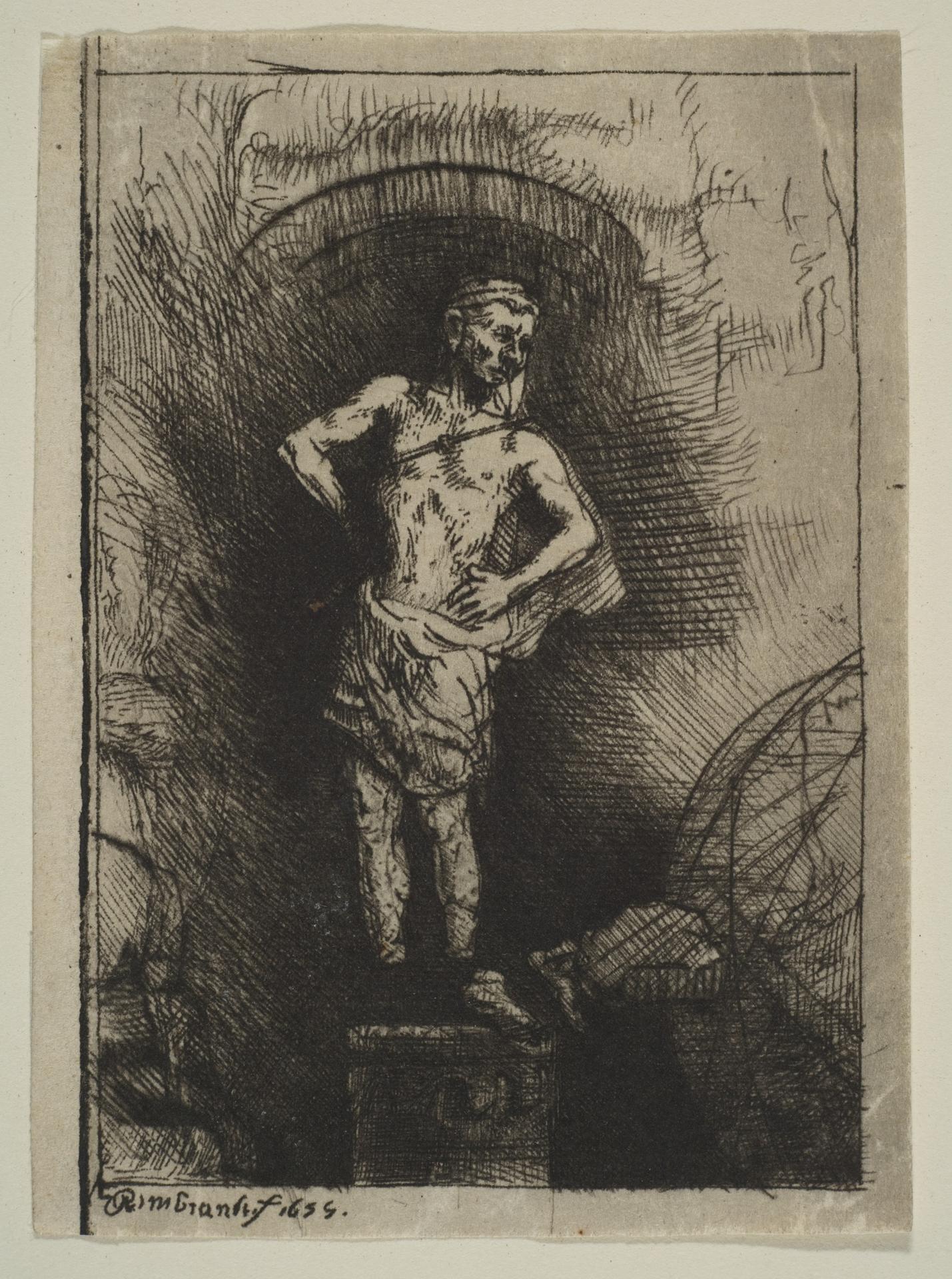
Rembrandt made this etching in 1655, drawing on Nebuchadnezzar's dream as told in the Book of Daniel. A male figure stands in a gloomy, arched space, both hands pressed to his throat. The artist worked with etching needle, burin, and drypoint; the sheet survives in the third of five states.
Description
A gaunt, sinewy man stands barefoot on a pedestal, wearing only plain trousers reaching his ankles, and grips his own neck with both arms. Dark light fills the vaulted room, picking out shadow and the texture of the masonry. Behind the figure, forms dissolve into vagueness, perhaps trees or something else from nature. Hatching and drawn lines organize the sheet, giving figure and space alike depth and a tactile surface.
Context
During the 1650s Rembrandt turned increasingly to biblical subjects and to the question of how feeling can be caught in an image; this plate dates from 1655. Its source is Daniel 2:31-33, where Nebuchadnezzar dreams of a statue. The figure is often read as the king himself, confronting this image from his dream. By then Rembrandt was long an established master, known for his restless experiments in printmaking.
Impact
Strong contrasts of light and dark and the puzzling shapes behind the figure give the sheet a somber, inward-turned mood. The way the figure clutches his throat reads as tension and exposure. Dense hatching carries the eye across passages of light and shadow and makes the image seem almost like sculpture.
Technique
Etching, afterwards reworked with burin and drypoint — this let Rembrandt set thin lines beside soft tones of shadow. In the third of the five states the plate is already fully worked, with carefully executed hatching.
AI-generated description text
Source: Metropolitan Museum of Art · Public Domain (CC0 1.0)