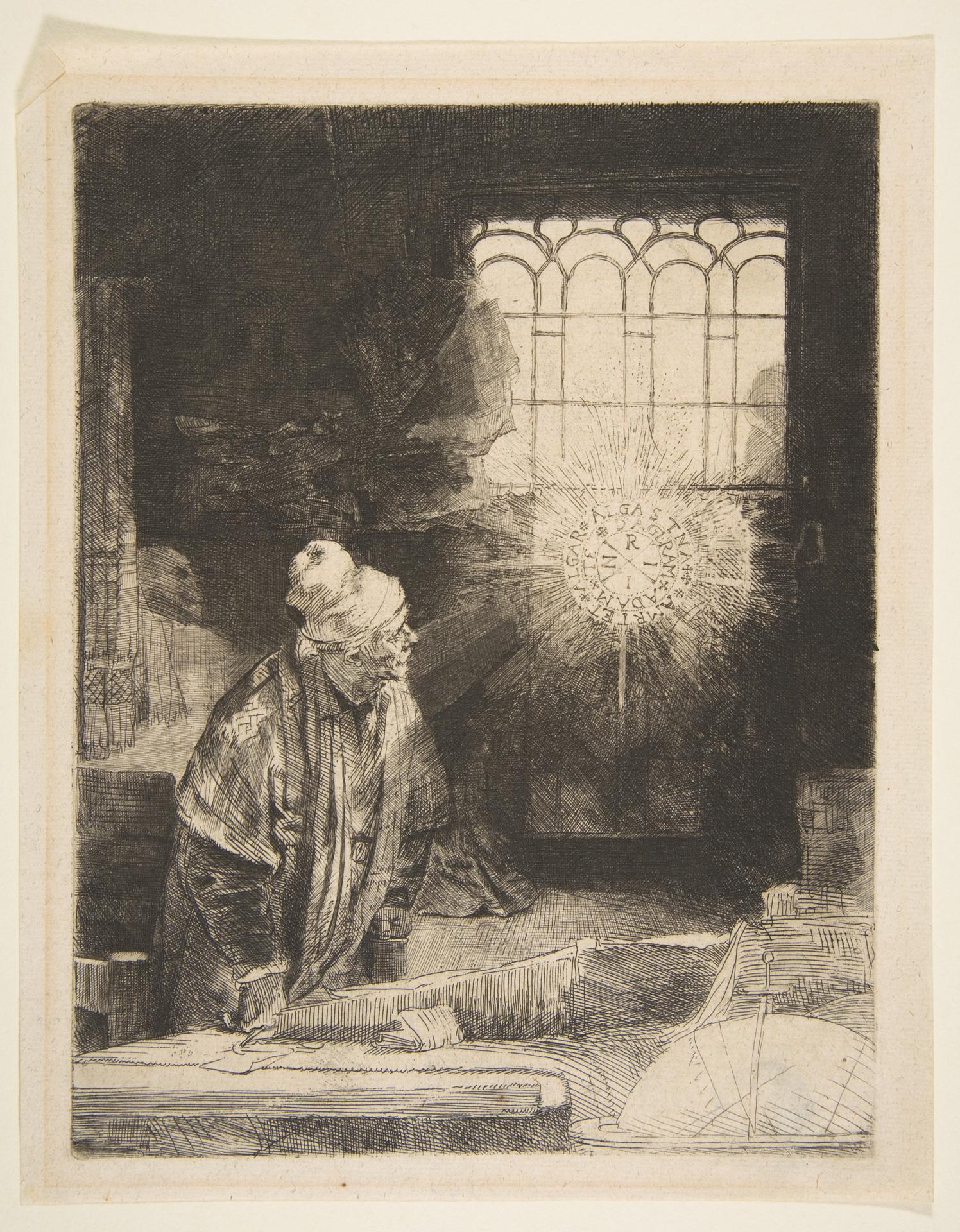
Faust (ca. 1652, Met-Objekt 5347)
Original title: Faust
kurzbeschreibung
Around 1652 Rembrandt van Rijn made "Faust" as an etching with drypoint passages; the impression described here is the sixth of seven states. A kneeling figure sits in a murky room that is lit only by the glow of a window fitted with a dial face.
Description
Wearing a cap and jacket, a kneeling figure bends over a book or a parchment scroll on the table, eyes fixed intently on what is written there. Light enters through a window, and set into that window is a brightly shining dial, dividing hard glare from deep shadow. The furnishings stay sparse: a chair, a table with a few objects. Light and darkness govern the arrangement and give the scene something dramatic and puzzling.
Context
By tradition the subject is read as the Faust story, though that identification is not securely documented. The print belongs to Rembrandt's mature years, when he was testing the effects of light and shadow in depth. That the etching survives in several states points to a working, searching process. Within his printed oeuvre, prized for technical virtuosity, the work holds a firm place.
Impact
The intense light and the deep shadows create a mood that reaches into the uncanny, almost the supernatural. The figure's tense concentration and the strange dial leave the viewer room to interpret. Look at the print for a while and you are drawn into this quiet, dark illumination.
Technique
Etching, engraving and drypoint come together here, allowing both fine lines and soft gradations of tone. The drypoint leaves its characteristic slightly frayed edges, which help carry the atmospheric impression. In the sixth of seven states one can follow how the artist reworked the plate step by step.
AI-generated description text
Source: Metropolitan Museum of Art · Public Domain (CC0 1.0)