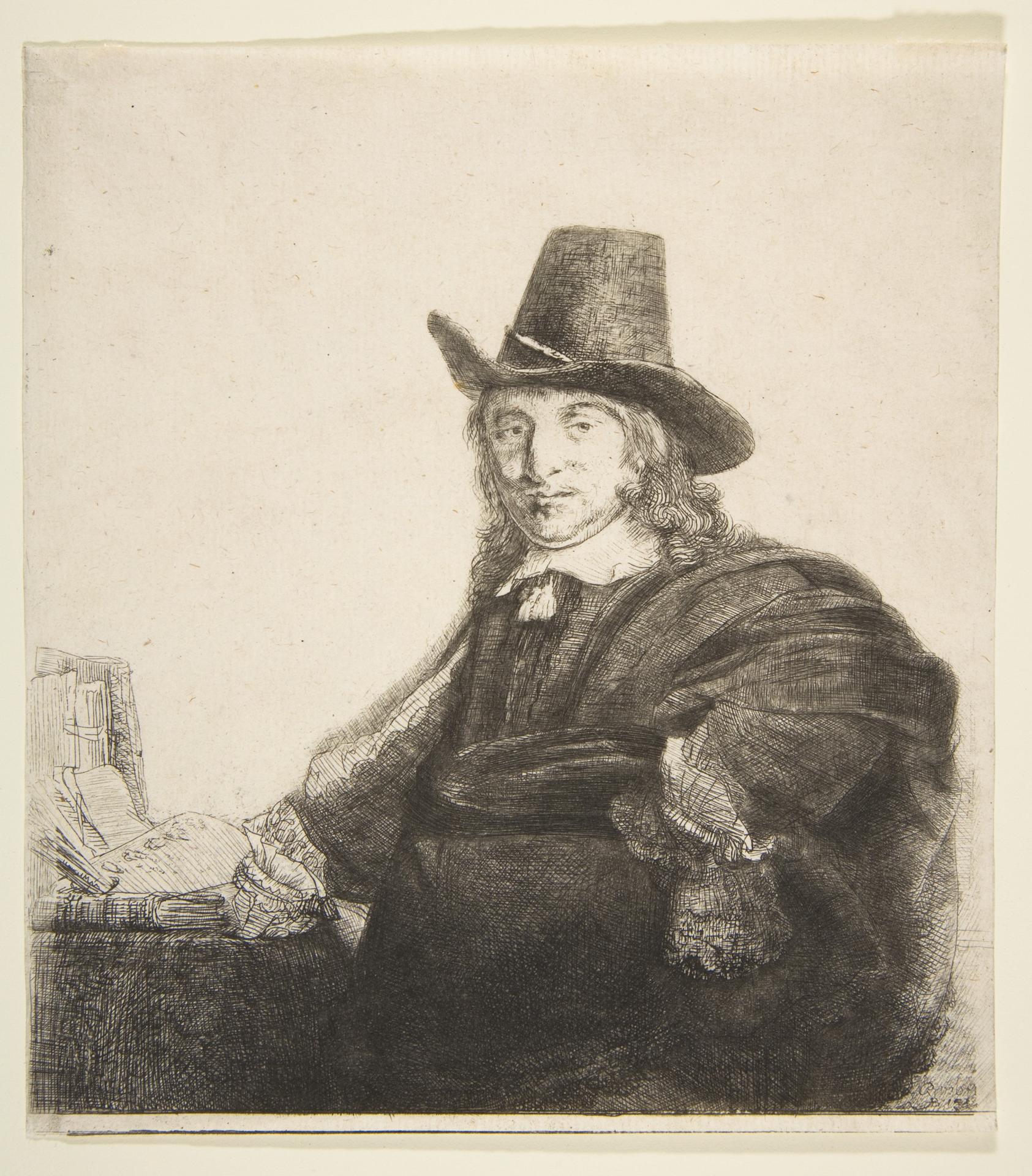
Jan Asselijn, Painter (Krabbetje) (ca. 1646, Met-Objekt 5325)
Original title: Jan Asselijn, Painter (Krabbetje)
kurzbeschreibung
Around 1646 Rembrandt van Rijn made an etching of the painter Jan Asselijn, seated and turned inward. For this print he combined etching with drypoint and burin; it survives in the fifth of seven states. Asselijn appears in a tall, broad-brimmed hat and a garment with a prominent wide collar, his posture thoughtful.
Description
Slightly turned to the left, the sitter fills the middle of the plate, his face calm and musing. Above it sits a high hat with a broad brim; long sleeves and a striking collar define his clothing. Books and a sheet of paper rest on the table before him, suggesting reading or study. The arrangement stays plain and fixed on the person. Even light avoids hard contrasts, while carefully drawn lines and delicate hatching bring out textures and forms.
Context
The portrait was made around 1646, when Rembrandt was in demand in Amsterdam both as a portraitist and as a printmaker. Jan Asselijn, a Dutch painter who specialised in Italian landscapes, had returned from Italy in 1646. Rembrandt probably honoured him with this sheet and placed it within his series of artists' portraits. That the print exists in several states points to intensive work on the plate.
Impact
A quiet, familiar mood comes off the sheet and brings the painter close to the viewer. The precise linework and evenly spread light give the view a clear, almost drawing-like presence and stress the dignity of the sitter. Anyone looking at the pensive pose is invited to linger.
Technique
Etched and then reworked with drypoint and burin, the process allows very fine, exact lines. What is at hand is the fifth of seven states, evidence of the plate changing step by step. The trimmed sheet measures 18.8 × 17 cm, a format usual for printed portraits of the time.
AI-generated description text
Source: Metropolitan Museum of Art · Public Domain (CC0 1.0)