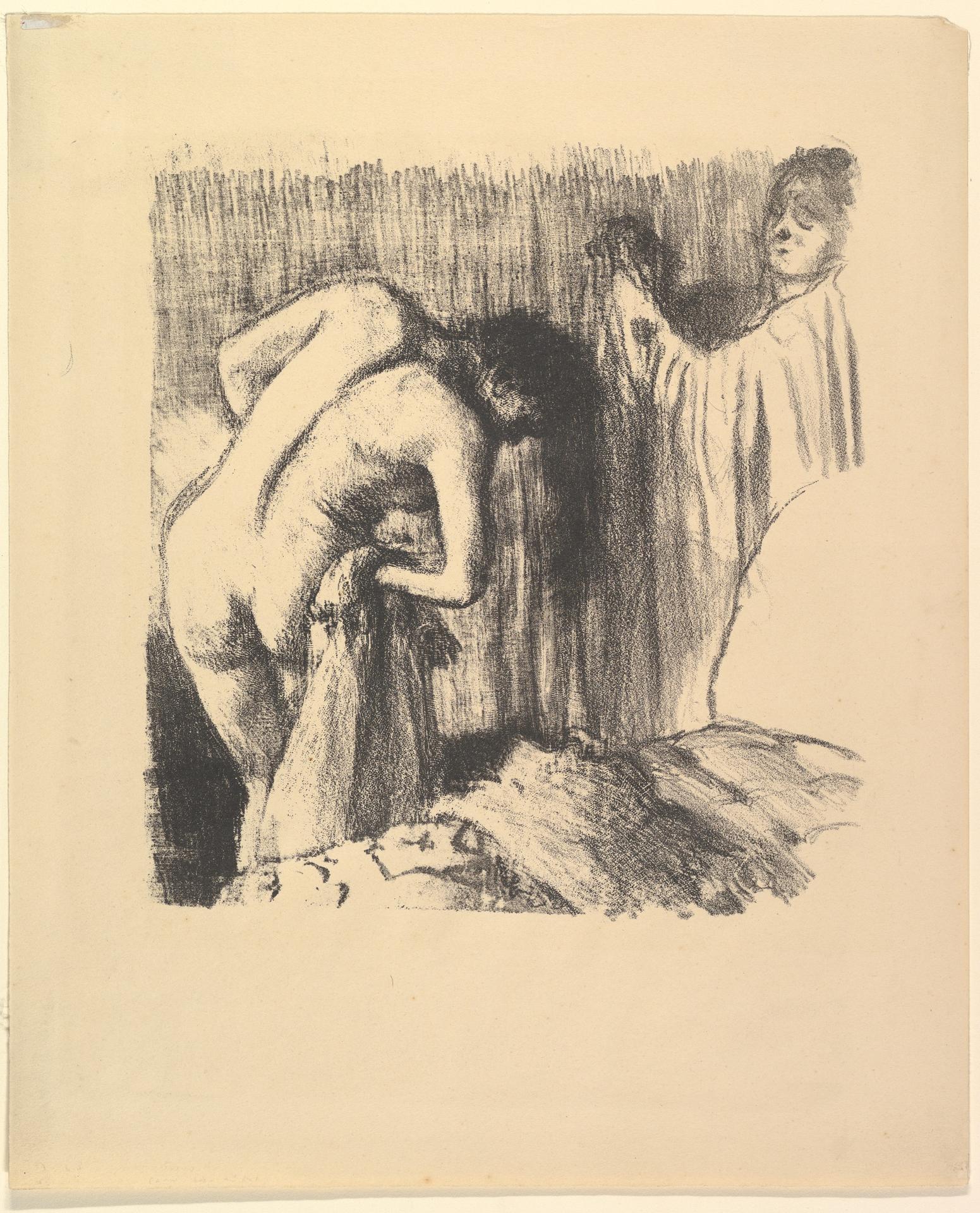
After the Bath III (1891–92, Met-Objekt 530)
Original title: After the Bath III
kurzbeschreibung
Edgar Degas's lithograph "After the Bath III" from 1891–92 presents two women in a bathroom. The left figure is nude and bent forward, while the right stands upright and clothed. Executed as a black-and-white print, its effect arises from chalk strokes and hatching.
Description
Against a striped wall, two women meet. The naked figure on the left bends down, absorbed in washing or drying. On the right stands a clothed woman, her head slightly lowered. The layout is asymmetrical: the front figure on the left, the rear one on the right. Frontal light picks out contours and casts shadows on the wall. Gradations of gray emerge through hatching and chalk marks; the approach remains realistic, touched with impressionist traits.
Context
This lithograph of 1891–92 belongs to a series of bathing scenes that Degas explored in depth during the 1890s. The bathroom motif runs through his late work, often with women in unobserved, intimate moments. Transfer lithography allowed him to bring the immediacy of his drawing directly onto the stone. The print is known as the first of two states, suggesting a trial printing process.
Impact
Drawn by the light and the movement of the figures, the viewer finds themselves in a quiet, observing closeness, without any display. The uneven distribution of the figures and the restrained grays create a confidential, almost private mood. Realistic precision and impressionist linework merge, giving the print something lively and sketch-like.
Technique
The print was made as a lithograph, specifically a transfer and crayon lithograph. It exists in the first of two states, indicating later revision. The gray values result from fine hatching and chalk marks transferred to the stone.
AI-generated description text
Source: Metropolitan Museum of Art · Public Domain (CC0 1.0)