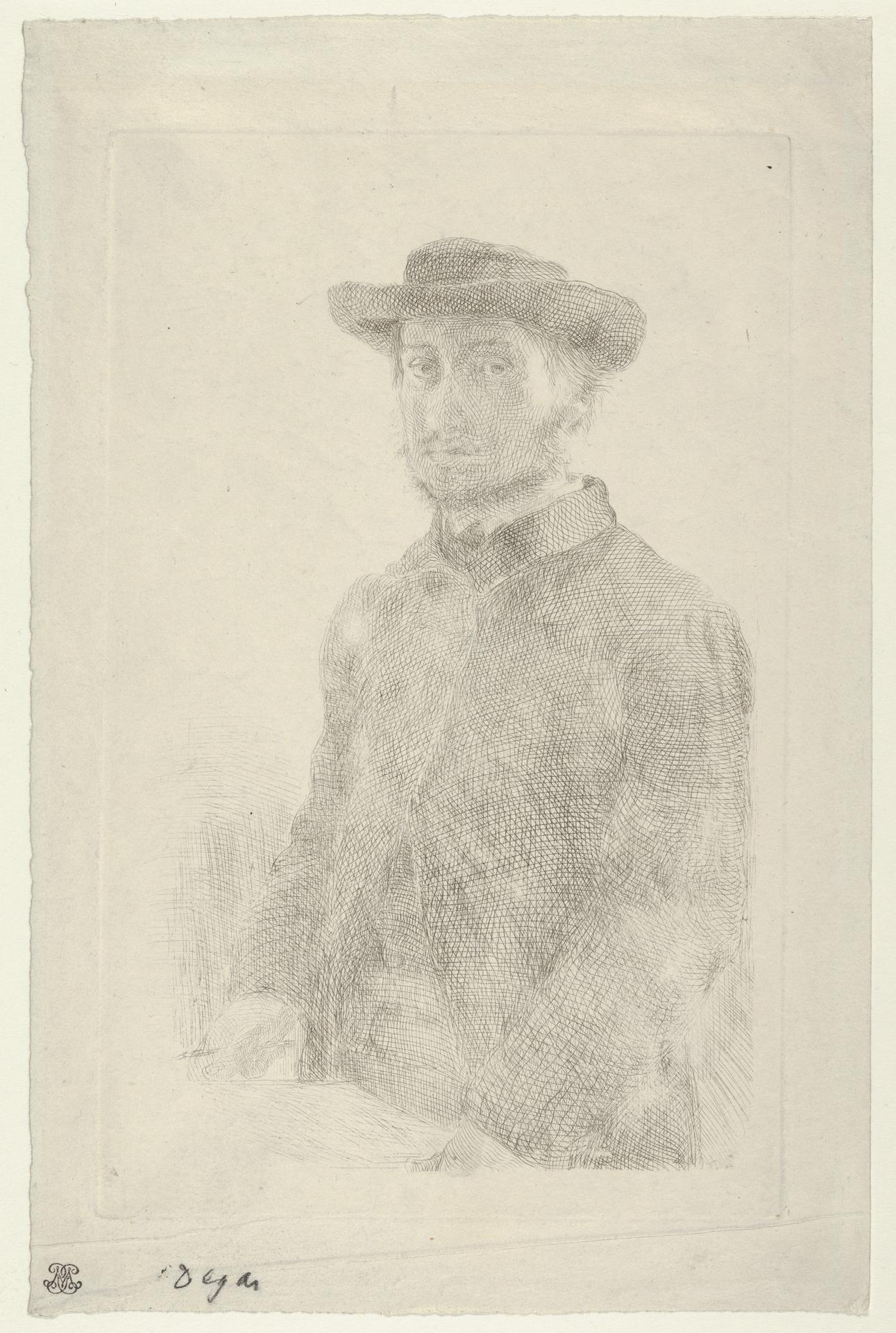
Self-Portrait (1857, Met-Objekt 527)
Original title: Self-Portrait
kurzbeschreibung
Unlike many self-portraits by his contemporaries, Degas’s 1857 etching does not place the artist in his studio but presents him as a concentrated, almost private study. Wearing a cap and shirt, he sits for the plate, worked in drypoint and bitten tone, though only the second of four states survives. The monochrome scheme heightens the sense of an immediate, close-up view.
Description
The figure is seated or half-seated; a cap covers his head, and a collared shirt wraps his upper body. Dense parallel lines model the fabric and bring out its texture. The background remains bare, almost empty, so that attention stays fixed on the figure. From the front, even light falls on face and garment, tracing their outlines.
Context
In 1857, during a stay in Italy, Degas engaged with the masters of the Renaissance. This sheet was made at that time as one of his very first graphic works. The existence of several states attests to thorough reworking of the plate. The experimental character of the etching is clearly felt.
Impact
A quiet, inward mood emanates from the portrait. The spare setting and even light create a concentrated atmosphere that draws the viewer close to the person. The nuanced linework contributes to the print’s silent, insistent effect.
Technique
In etching with bitten tone, acid-resistant particles are scattered on the plate to produce a uniform tone. The dense parallel strokes used for the clothing are characteristic of this process and reveal Degas’s sure hand. The sheet measures 23 x 14.4 cm and remains entirely in shades of gray.
AI-generated description text
Source: Metropolitan Museum of Art · Public Domain (CC0 1.0)