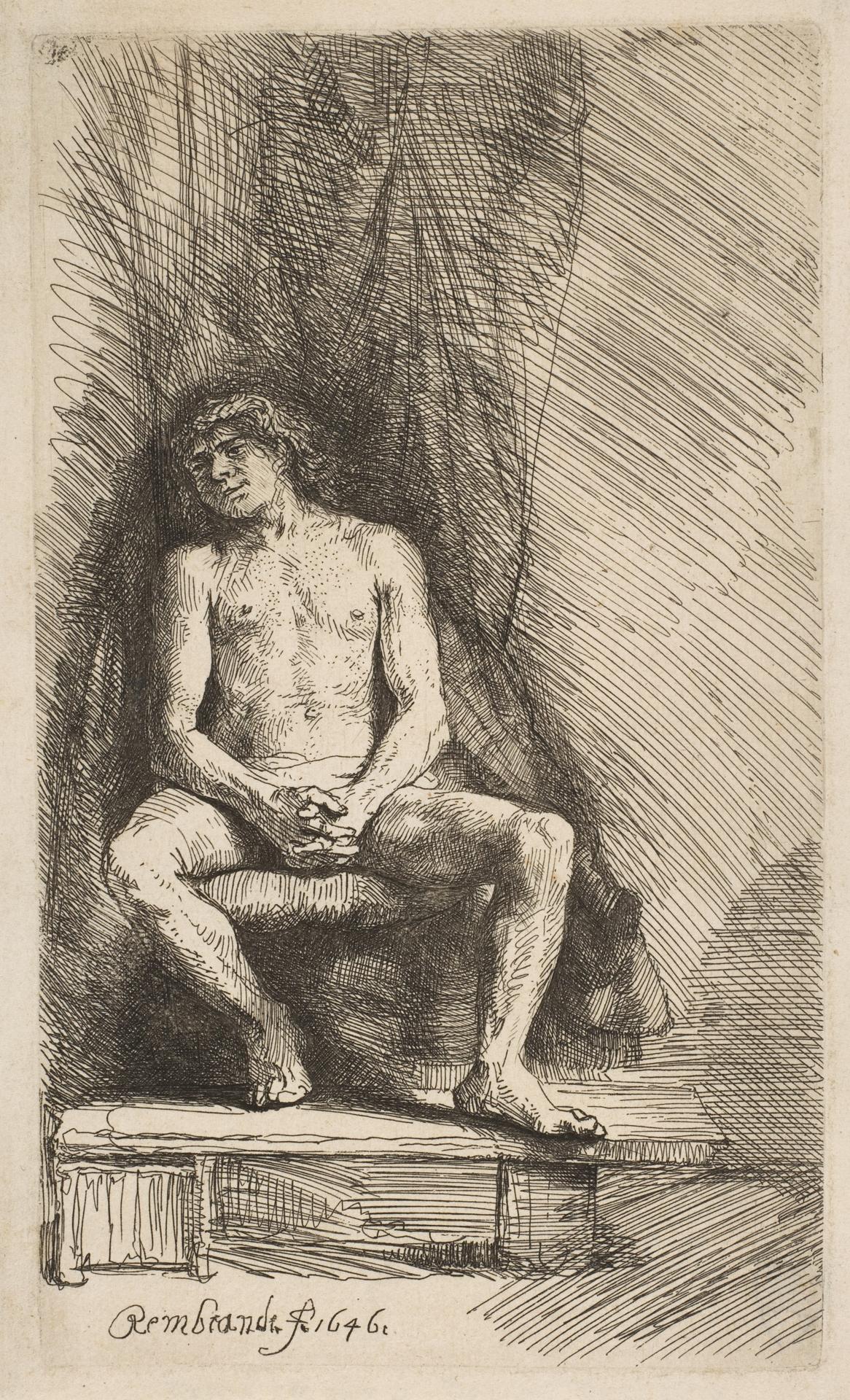
Nude Man Seated before a Curtain
Original title: Nude Man Seated before a Curtain
kurzbeschreibung
In 1646 Rembrandt van Rijn produced this etching of a seated nude man before a curtain, one of many sheets from his intensive study of the nude. The plate measures 16.3 by 9.6 cm. It presents a male figure turned inward, perched on a pedestal with his gaze fixed into the distance.
Description
The figure crouches on a pedestal that a hanging curtain partly conceals. His arms are crossed, his head turned away, and his posture reads as pensive. Curtain cords and pedestal are worked over in delicate strokes, building a dense texture. Light strikes the body from the left; on the right, shadows fall across both figure and pedestal. At the bottom, the name 'Rembrandt' and the date '1646' can be made out.
Context
The sheet dates from 1646, a period when Rembrandt was examining the human nude in depth. Studies like this often served him as preparatory material for larger paintings, yet they also reached collectors as independent works. He was known for his experimental approach to etching, which allowed him finely graded values of light and dark.
Impact
Because the figure does not meet the viewer's eye but rests within himself, the print gives off a quiet, thoughtful mood. The careful linework lends the surface a tactile quality that draws the eye closer. All told, a calm, contemplative atmosphere prevails.
Technique
In etching, the artist scratches the drawing into a wax layer over a metal plate and then bites it with acid. The density and depth of the strokes yield the delicate lines and the range of gray tones. Rembrandt used this process to achieve soft transitions and a rich texture.
AI-generated description text
Source: Metropolitan Museum of Art · Public Domain (CC0 1.0)