Jan Six (1647, Met-Objekt 5210)
Original title: Jan Six
kurzbeschreibung
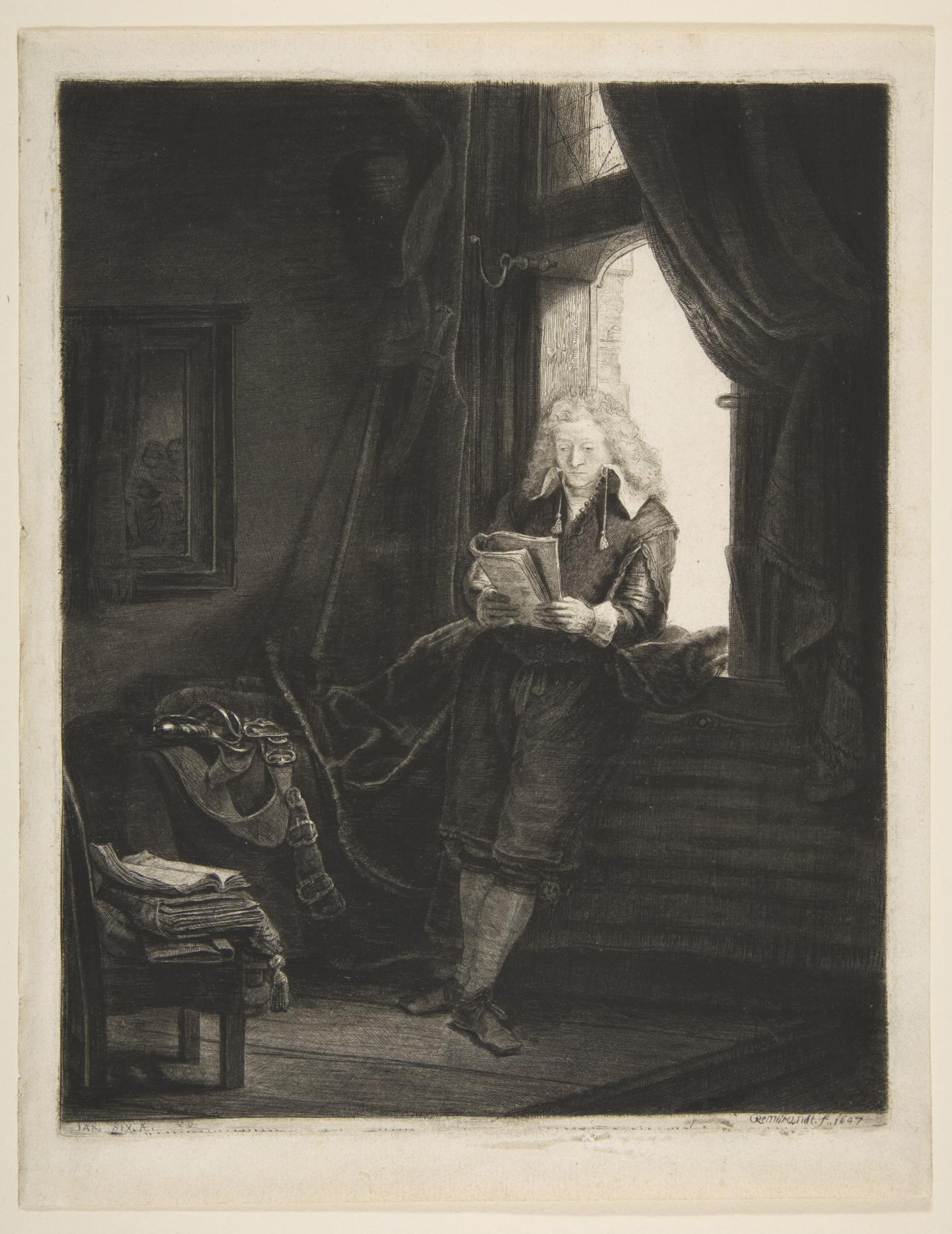
Rembrandt van Rijn portrayed the Amsterdam merchant and later mayor Jan Six reading in an interior in 1647. The print was executed as an etching with drypoint and burin, specifically in the fifth of five states.
Description
A man sits in a sparsely furnished room, absorbed in a book. He wears seventeenth-century clothing, including a jacket and a muff. Behind him a window opens, its heavy curtains partly drawn aside; a stack of books rests on a chair. Light entering through the window falls on the reader and bathes the room in a quiet, intimate mood. The reader occupies the foreground, while the window forms the back of a layout built around a central axis.
Context
The portrait was made in Amsterdam in 1647, when Jan Six (1618–1700) was active as a wealthy merchant and art collector. A personal connection existed between Rembrandt and Six, which is reflected in the unusually intimate design of the print. The etching became famous for its seemingly rapid execution, which rests on highly controlled technique. It is considered one of the masterworks of seventeenth-century etching.
Impact
Soft, incoming light and the reader's calm posture give the print a distinctly private and collected quality. Fine lines and strong hatching create a lively, almost sketch-like texture that draws the viewer into the quiet scene. The eye follows the light to the book and lingers there, undistracted by accessories.
Technique
The print was made as an etching, with Rembrandt adding drypoint and burin for shading and contours. In the fifth state, black and white stand out more strongly due to more deeply worked printing plates, increasing the contrasts. The process allows fine transitions and a rich tonality characteristic of Rembrandt's printed work.
AI-generated description text
Source: Metropolitan Museum of Art · Public Domain (CC0 1.0)