The Flute Player
Original title: The Flute Player
kurzbeschreibung
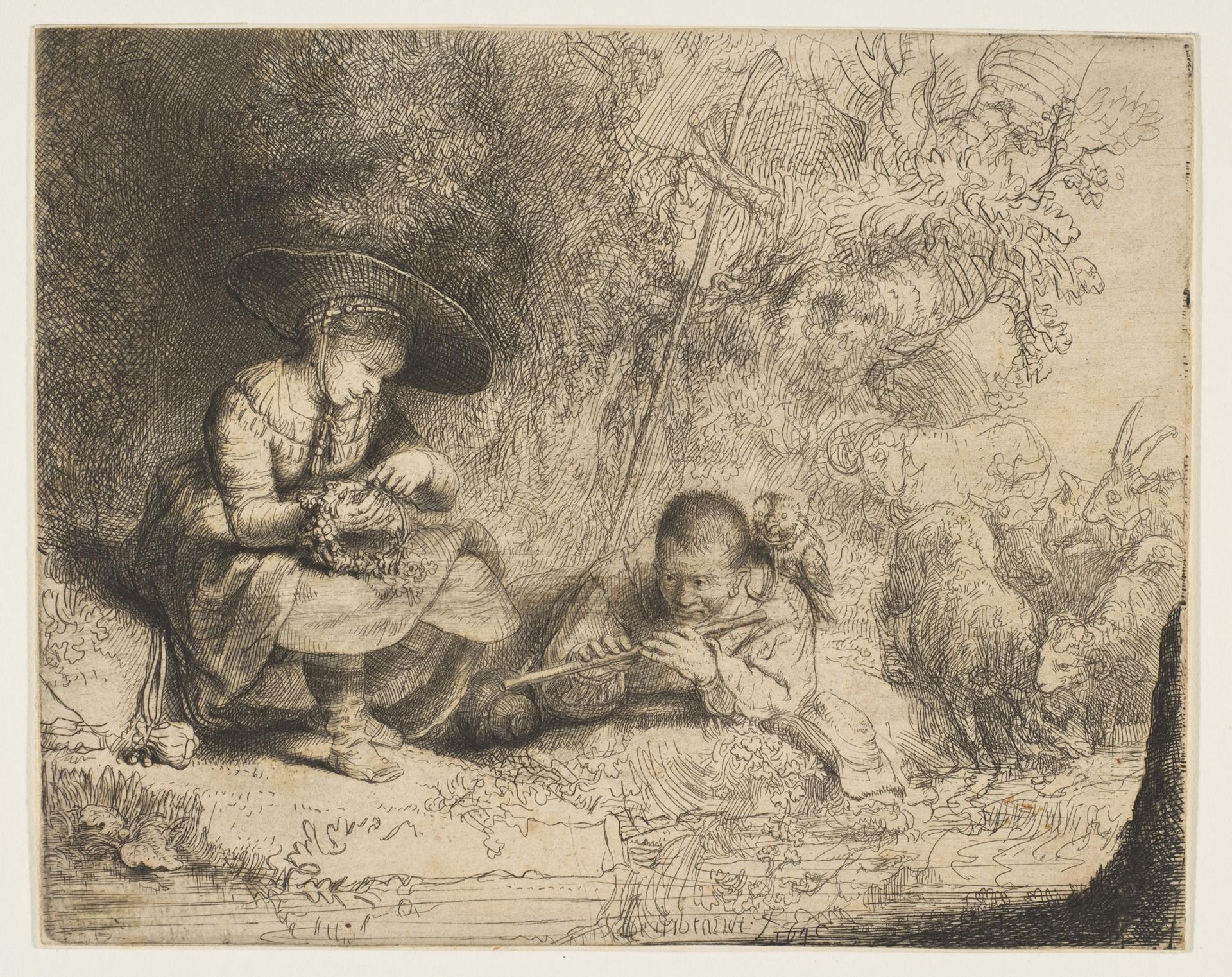
What separates Rembrandt's Flute Player of 1642 from the pastoral scenes of his contemporaries is the way a rural subject is matched by such finely differentiated work on the printing plate. An etching with drypoint, it survives here in the fourth of four states. A man making music and a seated woman keep company with animals, all set within a natural landscape.
Description
A kneeling flute player in rustic dress anchors the layout; beside him sits a woman in a long gown and a wide-brimmed hat, holding a piece of fruit, her eyes lowered. Two sheep and another animal graze on a hill behind them. Trees and shrubs enclose the group and reinforce the natural setting. Diffuse light falling from above picks out the shadows and surfaces of the figures.
Context
Rembrandt made this etching in 1642, during a period of intense engagement with printmaking, when biblical, mythological and genre subjects were often on his mind. A flute player in rural surroundings was a familiar motif, tied to the Dutch pastoral tradition. That the plate was reworked in four states is characteristic of his working method; this impression shows the final state.
Impact
The quiet rural mood and the nuanced gradation of greys give the print a harmonious, idyllic feel. Precise rendering of figures and nature produces a realistic, almost tangible atmosphere that draws the viewer into the scene. The diffuse light lends the work a soft, intimate tone.
Technique
Etching and drypoint meet here; drypoint leaves fine, burred lines that create soft, velvety effects. The plate was worked in four states, and this impression shows the last. A monochrome palette of greys results from the varying depth and density of the etched lines.
AI-generated description text
Source: Metropolitan Museum of Art · Public Domain (CC0 1.0)