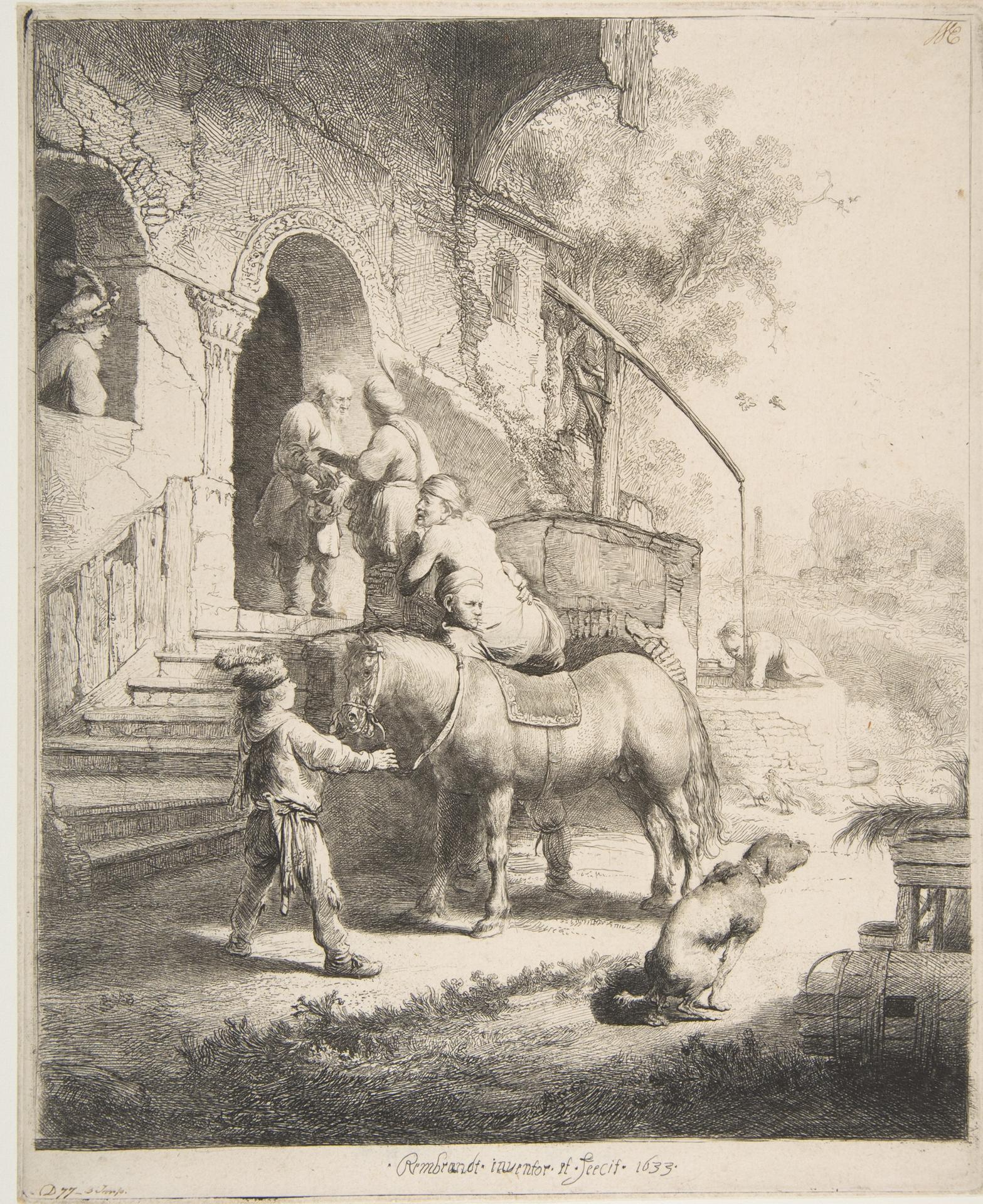
The Good Samaritan (1633, Met-Objekt 5170)
Original title: The Good Samaritan
kurzbeschreibung
Rembrandt van Rijn's 1633 etching takes up the biblical parable of the Good Samaritan: a Samaritan on horseback supports an injured man. The print was made as an etching with engraving and drypoint and exists in the fourth of four states. Rendered in black and white, the image places the rescue of a person in need in a rural setting.
Description
A rural area provides the setting. In the foreground a man sits on horseback while another stands beside him, holding him. On the ground lies an injured man, supported by a further figure on a staircase; behind them a building opens with an unlocked door. A dog crouches on the ground, and a figure stands on a platform in the background. Trees and plants frame the design and reinforce the rural character. Everything remains in black and white.
Context
In 1633 Rembrandt was working in Amsterdam, where he had already established himself as a portrait and history painter. The source for this print is the parable of the Good Samaritan from the Gospel of Luke, a popular subject in the seventeenth-century Netherlands. Rembrandt enjoyed experimenting with printmaking techniques; this work shows his early style with strong contrasts and rich detail.
Impact
The viewer's eye is drawn at once to the rescue taking place at the center of the image. Fine lines and the absence of color temper any drama, giving the print a calm, reflective mood. The detailed, realistic description gives rise to an immediate sense of care and human closeness.
Technique
Rembrandt combined etching with engraving and drypoint here. This allowed fine lines and soft transitions that bring out the realistic details of figures and landscape. The fourth state of the print may include further reworkings that add density to the depth and texture of the view.
AI-generated description text
Source: Metropolitan Museum of Art · Public Domain (CC0 1.0)