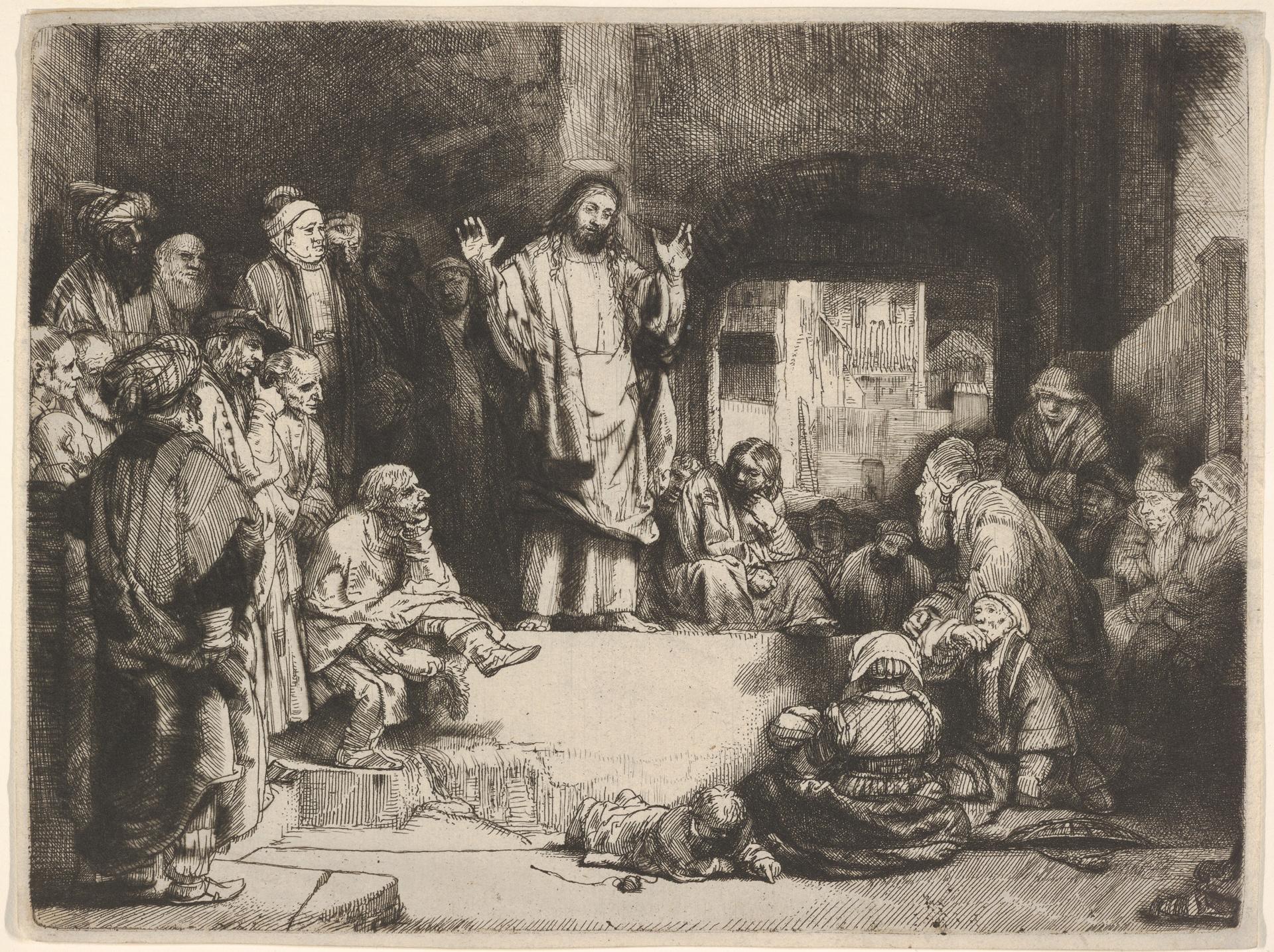
Christ Preaching, called La Petite Tombe
Original title: Christ Preaching, called La Petite Tombe
kurzbeschreibung
Around 1657 Rembrandt van Rijn made the etching Christ Preaching, known as La Petite Tombe, combining etching, engraving, and drypoint; the first of two states survives. It shows Jesus Christ on a raised stand speaking to a gathered crowd.
Description
Christ stands elevated at the center, arms outstretched, bathed in bright light that underscores his holiness. Around him listeners sit and kneel in varied poses, some visibly moved, others lost in thought. Their garments suggest a past era. Hints of architecture in the background evoke a temple or church. The monochrome tone of the etching relies on thin, variably strong lines that bring out spatial depth and surface texture.
Context
This print dates from around 1657, during Rembrandt's late period, when biblical subjects preoccupied him. The nickname La Petite Tombe did not originate at the time but arose later and likely refers to the small tomb slab in the foreground. Rembrandt was known as an inventive friend of printmaking, combining different techniques. Within his large graphic oeuvre, which circulated widely even during his lifetime, this etching holds a firm place.
Impact
The light around Christ and the harsh shadows beside it create a tense, almost intimate mood. The wealth of detail and varying line strength direct the eye to the main figure and to the listeners' reactions. The layout feels symmetrical and balanced, emphasizing the weight of the sermon.
Technique
Etched, engraved, and reworked with drypoint, Rembrandt could achieve the finest lines and soft transitions. Drypoint leaves its typical slightly raised lines, which print as a velvety tone. Printing was done on paper; the sheet is trimmed to 15.8 × 21 cm.
AI-generated description text
Source: Metropolitan Museum of Art · Public Domain (CC0 1.0)