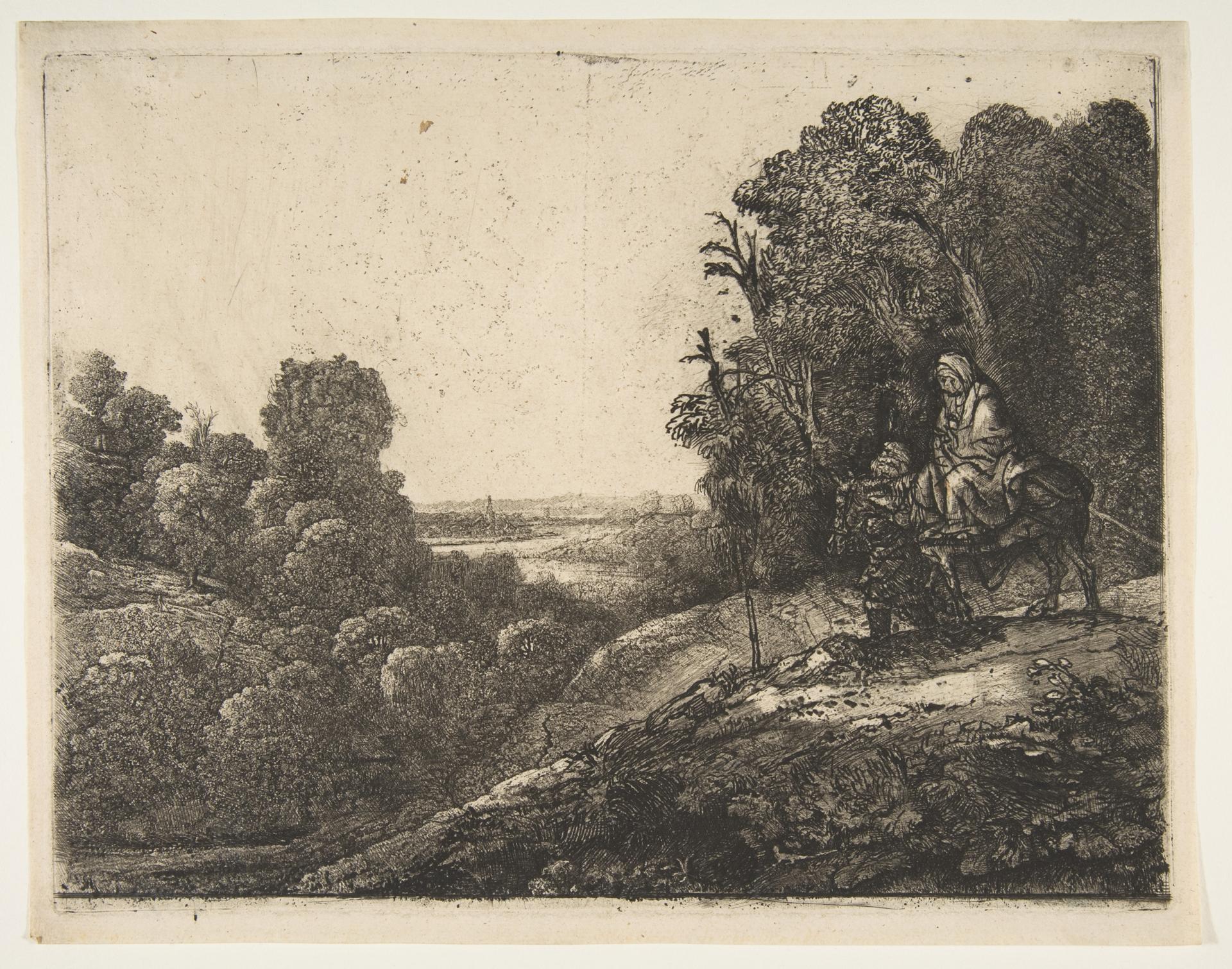
Flight into Egypt: Altered from Tobias and the Angel
Original title: Flight into Egypt: Altered from Tobias and the Angel by Hercules Segers
kurzbeschreibung
Rembrandt van Rijn built his own version on an etching by Hercules Segers that once showed Tobias and the angel. Around 1653 he turned the source into the Flight of the Holy Family into Egypt. Two figures ride through an expansive landscape on a horse. The fifth of six states came about through reworking with drypoint and burin.
Description
Open, wide terrain with trees and hills stretches to the horizon. In the lower right, two figures in traditional clothing ride a horse. While the riders and their immediate surroundings are worked out in detail with hatching and lines, the background stays more restrained. Light is distributed evenly, without strong shadows or highlights, which creates a quiet mood. The uneven layout draws the eye to the riders and the open field.
Context
Rembrandt took up an etching by Hercules Segers that originally depicted Tobias and the angel and reshaped it into the Flight into Egypt. This alteration belongs to his engagement with older masters and to his habit of reworking other artists' printing plates. The sheet was made in the 1650s, a phase of intensive experimentation in printmaking. The fifth of six states makes the progressive working of the plate visible.
Impact
The calm, even lighting and the wide landscape convey a still, contemplative mood. The detailed treatment of the figures contrasts with the reduced background and directs attention to the travelers. The arrangement feels balanced and inviting, without dramatic effects.
Technique
Rembrandt reworked the etching with drypoint and burin. Drypoint produces fine, burred lines that give the print a soft, velvety texture. By combining these techniques, Rembrandt could control light and shadow precisely and achieve a rich surface effect.
AI-generated description text
Source: Metropolitan Museum of Art · Public Domain (CC0 1.0)