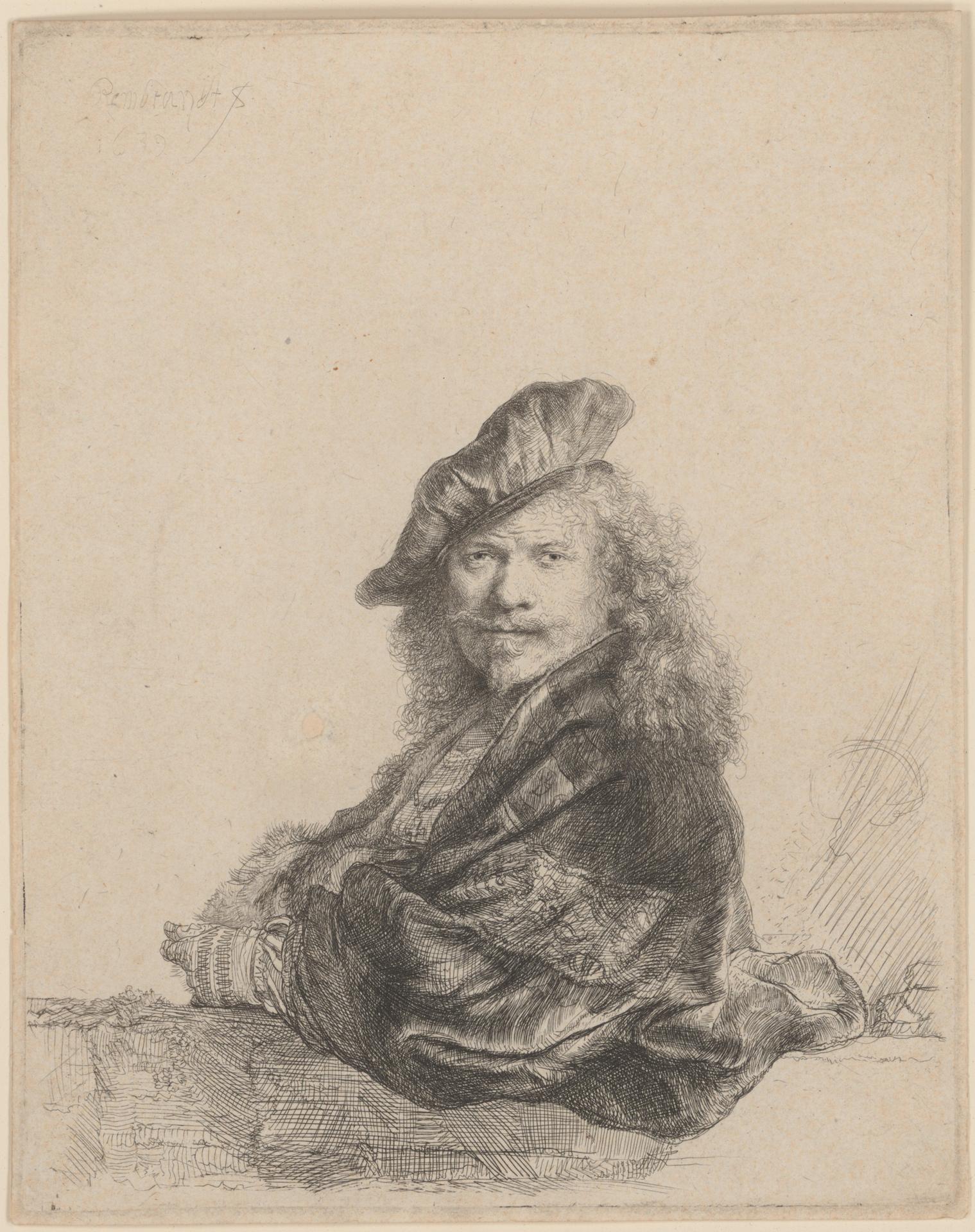
Self-Portrait Leaning on a Stone Sill
Original title: Self-Portrait Leaning on a Stone Sill
kurzbeschreibung
In 1639 Rembrandt van Rijn etched his own portrait, his upper body leaning on a stone parapet. For this print he combined etching, drypoint and burin; it exists in the second of two states. The self-portrait renders the artist's features and clothing with great precision, yet feels approachable and personal.
Description
Rembrandt appears in half-profile, seated, his head tilted slightly to the left. A cap typical of his time sits pushed back at an angle; the sleeves of his jacket are trimmed with fur. A short beard and curly hair frame his face. The background stays sparse, drawing the eye to the artist. Frontal light models his features and the surfaces of his clothing; a strong contrast emerges between the dark coat and the lighter ground.
Context
When Rembrandt made this self-portrait in 1639, he was already established as a portraitist in Amsterdam. The etching derives from a study for a painting now in the National Gallery, London. Self-portraits accompanied Rembrandt over many years and served him as a way to record his own artistic development. Etching, drypoint and burin were common means at the time for achieving fine gradations of shadow.
Impact
The direct lighting and the artist's calm expression give the print a personal, immediate presence. From the interplay of light and shadow the portrait gains a dramatic depth characteristic of Rembrandt's work. The precise rendering of face and clothing invites close looking.
Technique
Etching, drypoint and burin come together here to produce fine lines and soft tonal values. In the second state, reworkings are visible that strengthened the contrasts. With a plate size of 20 x 16 cm, the format matches what was usual for a self-portrait of this kind and allows precise reproduction of details.
AI-generated description text
Source: Metropolitan Museum of Art · Public Domain (CC0 1.0)