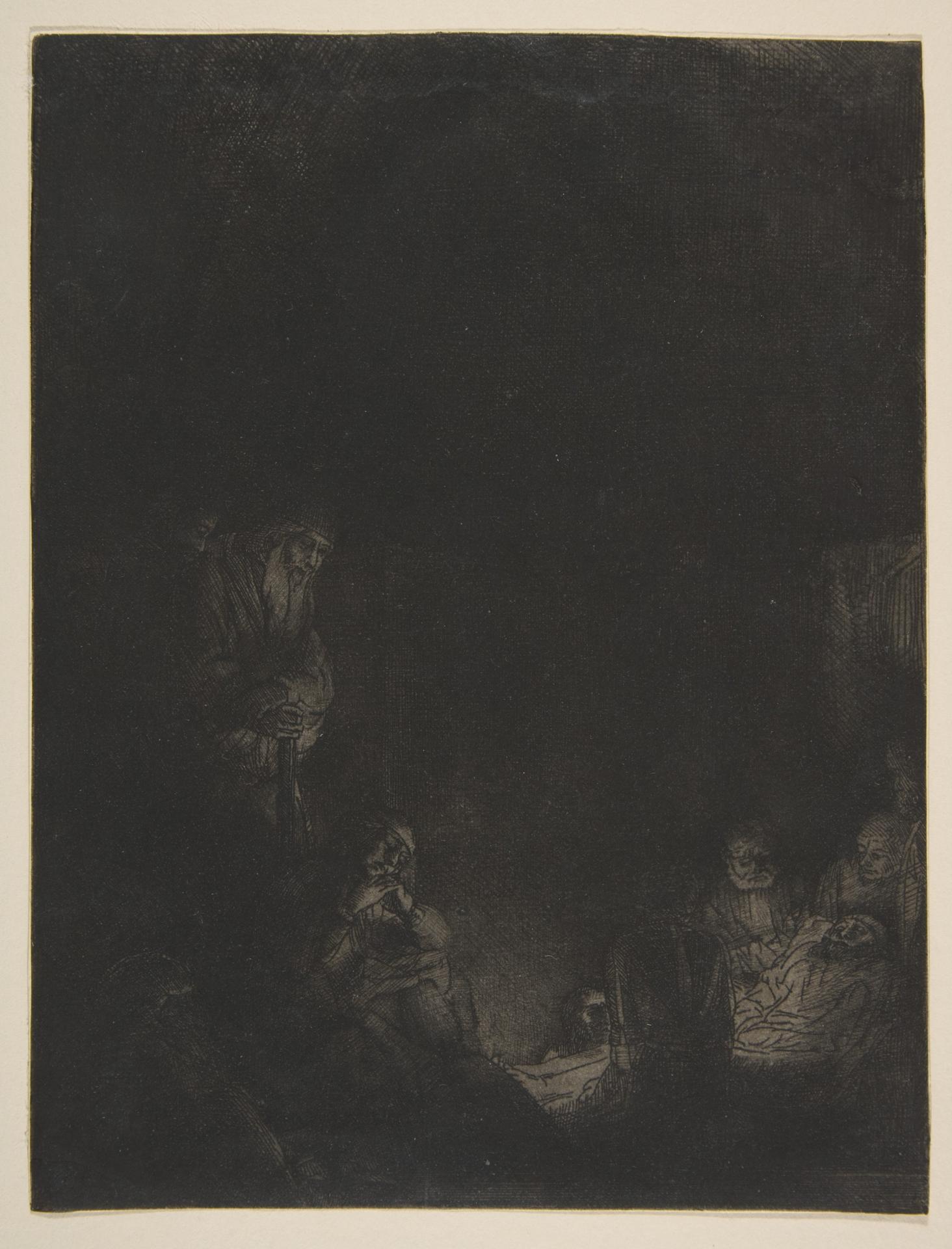
The Entombment (ca. 1654, Met-Objekt 5145)
Original title: The Entombment
kurzbeschreibung
Rembrandt's etching The Burial, made around 1654, presents the biblical mourning and entombment of Christ. Executed as an etching with drypoint, the sheet is the first of four states. Mourning figures crowd around the body, and the image is entirely focused on this group.
Description
In the foreground several people are visible: a seated figure in prayer or tears, beside her another who remains in her grief. A third mourner appears further back. Dark gray tones dominate the sheet, with light falling only sparsely, creating a subdued mood. The layout feels asymmetrical; the varied postures of the figures heighten the emotional tension.
Context
The 1650s were a period in which Rembrandt turned increasingly to biblical subjects. The entombment of Christ was part of the common repertoire in the seventeenth-century Netherlands, often included in Passion series. This print was made after his financial decline, when he devoted himself more strongly to printmaking. That four states of the plate survive shows how Rembrandt readjusted the effects of light and shadow over several working stages.
Impact
The print draws the viewer close to the grief of those present, sustained by the interplay of brightness and darkness. The muted tonal range and the spare imagery give the scene something solemn, almost intimate. Through drypoint the contours acquire a soft, velvety quality that reinforces the melancholy undertone of the moment.
Technique
Etching and drypoint were used; the latter leaves fine, raised lines that print softly and diffusely. Several states of the plate survive, with the present first state recording the original design. This method allowed light and shadow to be controlled very precisely, which Rembrandt exploited for the dramatic effect of the sheet.
AI-generated description text
Source: Metropolitan Museum of Art · Public Domain (CC0 1.0)