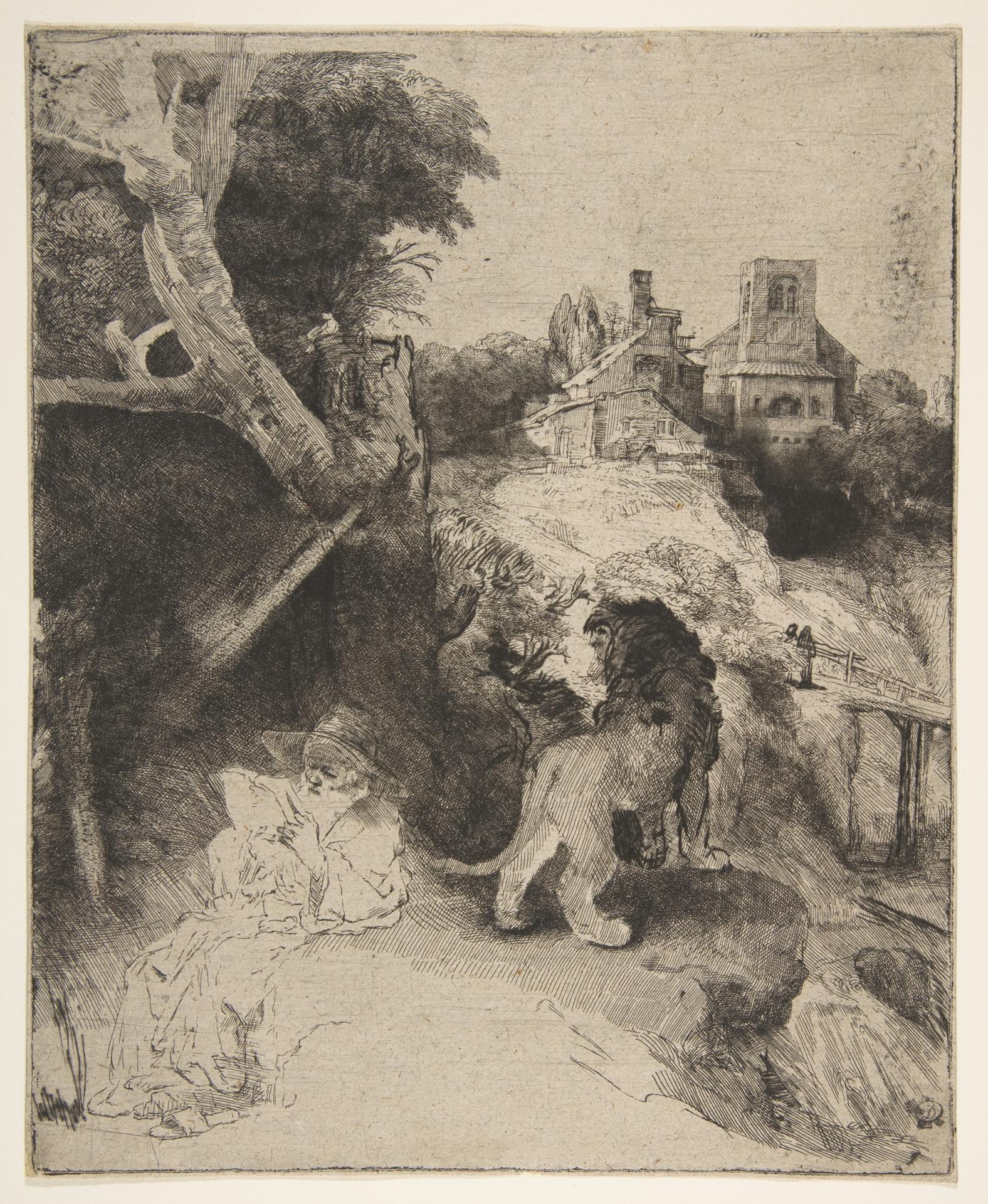
St. Jerome Reading in an Italian Landscape
Original title: St. Jerome Reading in an Italian Landscape
kurzbeschreibung
Unlike many contemporary depictions of Jerome that place the Church Father in his study or as a penitent in the wilderness, Rembrandt van Rijn here, around 1653, sets him in an open, Italianate landscape where he reads. The motif is executed as an etching, supplemented with drypoint and engraving, printed on oatmeal paper; it survives in the second of two states.
Description
Jerome sits on a rock in the foreground, bent over an open book. Two lions have settled at his feet and doze on the ground. Behind him trees rise, a hill and a building with a tower suggest a rural setting. Light enters from the left, bringing out the bodies and landscape details. The whole remains monochrome, articulated in various grays that emerge from drypoint and engraving.
Context
Rembrandt made this print during his mature Amsterdam period, when he was in demand both as a portraitist and as a graphic artist. Jerome in a landscape is a common motif of Christian iconography and was widespread in the seventeenth-century Netherlands. The landscape's Italian character points to Italian models that Rembrandt knew through collections and prints, although he never traveled there himself. The oatmeal paper used appears frequently in his printed work.
Impact
Quiet and contemplation define the print; soft transitions of gray and finely graded hatching contribute to this. Because drypoint and engraving work together, a lively surface texture emerges that reflects the light and gives the print something intimate, almost painterly.
Technique
On a copper plate Rembrandt combined etching, drypoint, and engraving to achieve graduated tonal values. Drypoint leaves fine, burred lines that print softly and velvety, while engraving allows precise, strong strokes. Printing was done on oatmeal paper, a coarse, unbleached paper that enhances the tonal depth and sculptural effect of the impression.
AI-generated description text
Source: Metropolitan Museum of Art · Public Domain (CC0 1.0)