Dante and Virgil
Original title: Dante and Virgil
kurzbeschreibung
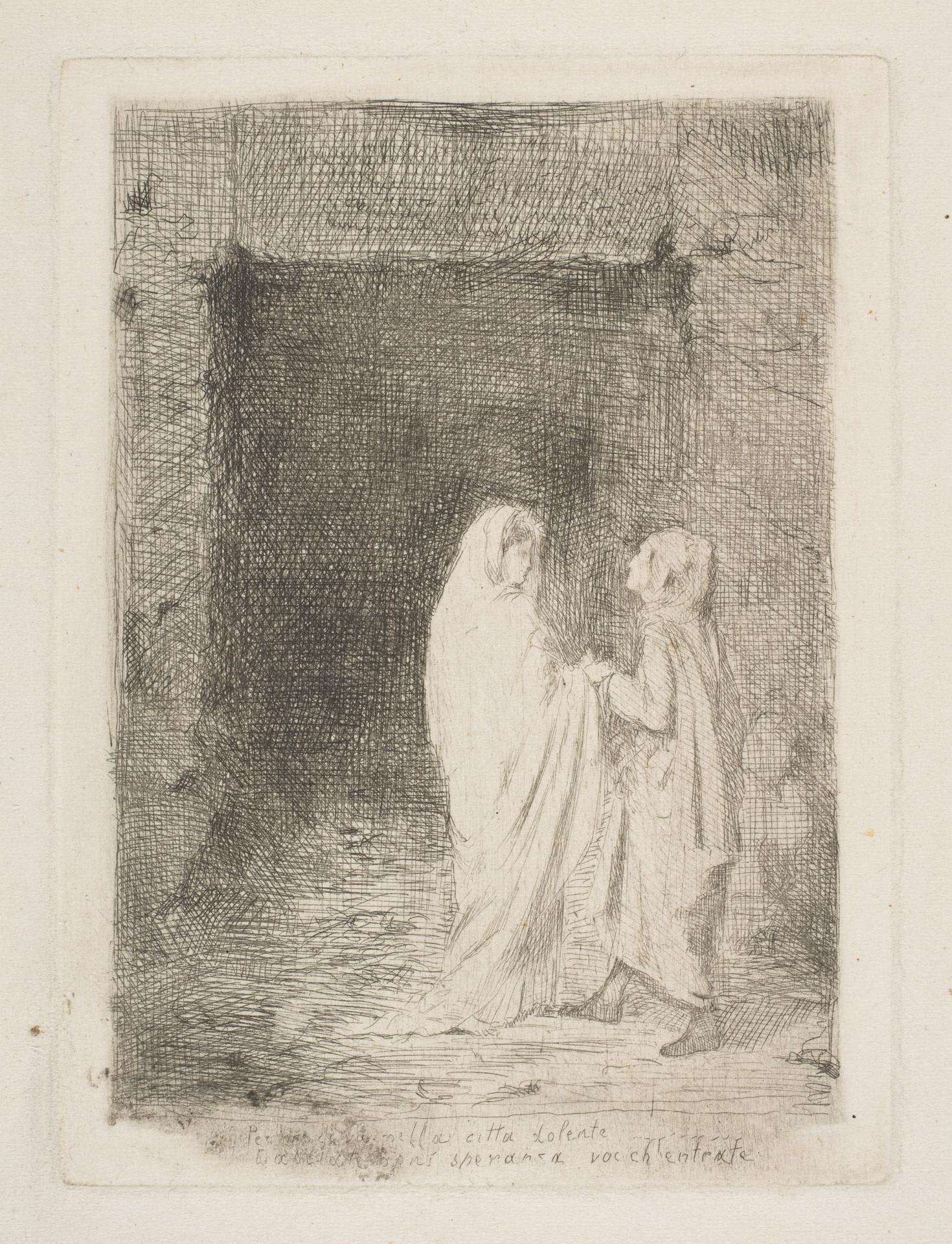
In 1857 Edgar Degas etched the encounter between Dante and Virgil: two poets stand facing each other in a darkened room, wholly absorbed in conversation. Of the three states of the plate, this is the second—and only a single impression of it survives.
Description
Two figures fill the center of the sheet. On the left stands a figure in light, long robes with a head covering; on the right, a second in darker, equally long clothing and also with a head covering. They turn toward each other as if exchanging words. Behind them lies a gloomy ground covered with dense hatching, giving the whole a somber quality. At the bottom of the image, Latin words are inscribed.
Context
In 1857 Degas was in Italy, where he engaged deeply with the art and literature there. The subject refers to Dante's Divine Comedy, in which Virgil guides the poet through Hell. At this time Degas still adhered strongly to history painting before later turning to Impressionism. This impression is the only known one of the second state and reveals how experimentally the young artist worked.
Impact
The dark surroundings with their fine hatching evoke a serious, contemplative mood. Because the two figures stand so close together in the center of the image, the sheet feels intimate and almost meditative.
Technique
An etching with drypoint on laid paper. Etching and drypoint together produce both fine, precise lines and softer, blurred areas. Of the second state of the plate, which shows reworkings, only a single impression is known.
AI-generated description text
Source: Metropolitan Museum of Art · Public Domain (CC0 1.0)