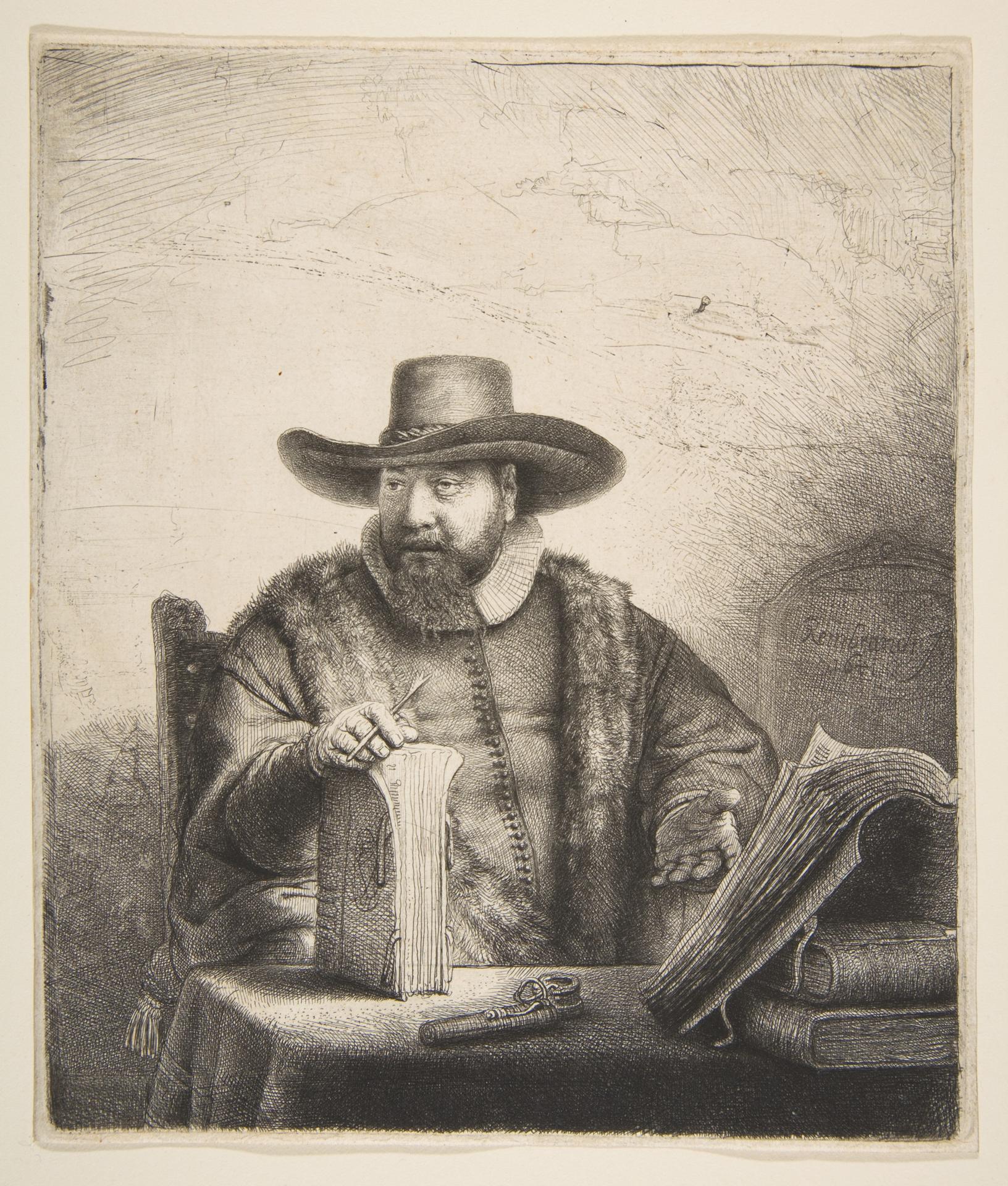
Cornelis Claesz Anslo, Mennonite Preacher
Original title: Cornelis Claesz Anslo, Mennonite Preacher
kurzbeschreibung
Rembrandt's 1641 etching portrays the Mennonite preacher Cornelis Claesz Anslo in his study. This is the second of five states of the print, with an image area measuring 18.6 x 15.7 cm. The clergyman is shown at a table among books, with a globe rising behind him.
Description
Anslo sits at the table, a book in his left hand and his right hand clasping a quill. More books and a pen lie spread out before him. He wears a broad, flat cap, a fur jacket, and a collar with pearl-like ornaments. Part of a globe appears behind him. The layout stays symmetrical: the figure at the center, objects distributed on the table to either side.
Context
The print dates from 1641, when Rembrandt was already working in Amsterdam as a sought-after portraitist and printmaker. Anslo was among the well-known Mennonite preachers and was portrayed by Rembrandt several times. This etching belongs to a series of portraits Rembrandt made of figures in his circle. Showing a clergyman in his working environment matched the era's interest in intimate, characterful likenesses.
Impact
The print feels calm and balanced; clear lines draw the eye to the sitter and lend him dignity. Clothing and objects are rendered so precisely that their materiality comes almost physically close. The subdued light creates a quiet, thoughtful mood that brings out the preacher's character.
Technique
Scratched into a metal plate and then etched, the print shows how Rembrandt used fine strokes and hatched areas to grade tonal values. The intaglio process allowed him both delicate contours and darker, denser passages. This is the second of five states, evidence of careful reworking of the plate.
AI-generated description text
Source: Metropolitan Museum of Art · Public Domain (CC0 1.0)