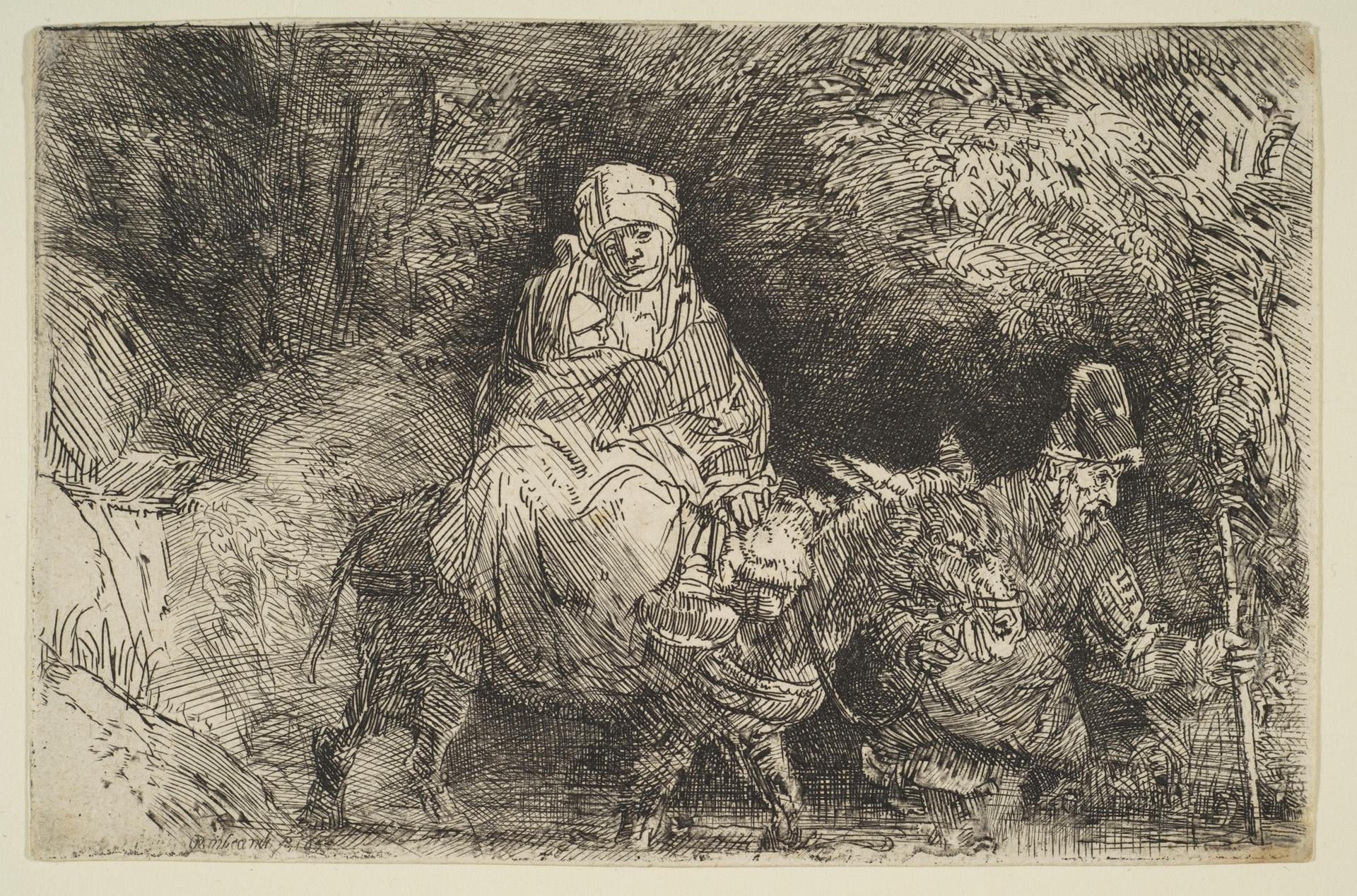
The Flight into Egypt: Crossing a Brook (1654, Met-Objekt 5110)
Original title: The Flight into Egypt: Crossing a Brook
kurzbeschreibung
In this 1654 print Rembrandt van Rijn takes up the biblical story of the Holy Family's flight into Egypt. Mary rides in the foreground on a donkey, carrying the child, while Joseph follows on a second donkey. Etching, engraving and drypoint are combined in a single plate measuring 9.5 by 14.4 cm.
Description
A woman sits on a donkey with a child on her back; beside her a man rides a second donkey, holding a stick. Both wear traditional garments, she a head covering, he a hat. Trees and shrubs frame the figures and settle them into a natural setting. The landscape format places the pair at the middle, the surroundings closing around the group. In the monochrome printing, lines of varying strength build up light and dark.
Context
The plate dates from 1654, when Rembrandt was working in Amsterdam and devoting close attention to biblical subjects. The flight into Egypt was among the common motifs in the seventeenth-century Netherlands. Rembrandt returned to the theme in several etchings, notable for their familiar, everyday tone. The small format suggests use in a private setting, perhaps for collectors or as a devotional image.
Impact
The event unfolds quietly and matter-of-factly, yet the delicate linework makes it approachable and dignified. Light draws the eye to the figures and lends the sheet a still, contemplative mood. Textures of garments and foliage are recorded in detail and reward a longer look.
Technique
Etching, engraving and drypoint work together, allowing a wide range of line strengths and tonal values. In etching, acid bites the lines into the copper plate, while the drypoint needle is scratched directly into the metal, leaving fine, soft edges. Light and shadow can thus be rendered precisely in the monochrome print.
AI-generated description text
Source: Metropolitan Museum of Art · Public Domain (CC0 1.0)