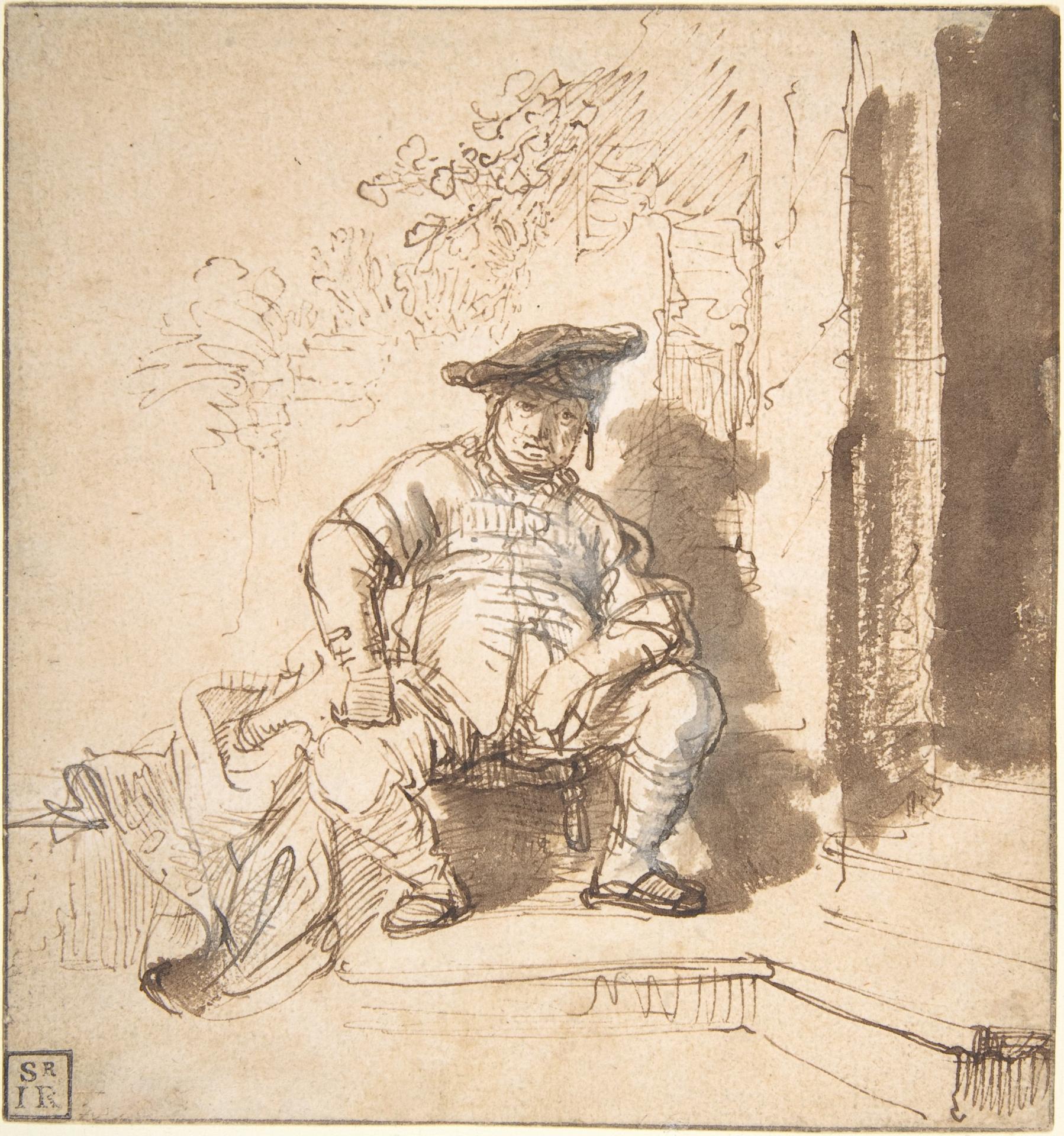
Seated Man Wearing a Flat Cap
Original title: Seated Man Wearing a Flat Cap
kurzbeschreibung
Unlike many of Rembrandt's comparable figure studies, this sheet captures a man in traditional clothing with a flat cap, seated on a chair. Drawn around 1635–40, it combines pen and brown ink with brush and brown wash, heightened with white gouache on paper.
Description
The seated man's body and gaze both turn to the left, shaping the view. He wears a shirt with an upturned collar and trousers; his hands rest folded on his leg. Vague trees and a window, through which light falls into the room, can be made out. Brown tones dominate, with white accents from the heightening. The layout feels asymmetrical: the figure in the foreground, background elements behind, while lines and shadows form a clear structure.
Context
Between 1635 and 1640, when Rembrandt was already celebrated in Amsterdam as a portraitist and printmaker, he made this drawing. It belongs to a series of everyday figures, often used as preliminary studies for paintings or etchings. Brown ink and wash were standard in 17th-century Dutch draughtsmanship for working out light and shadow effects.
Impact
An intimate, quiet mood emanates from the sheet, carried by the muted browns and soft light. The simple, clear arrangement directs the eye straight to the figure and creates closeness to the subject.
Technique
For contours and hatching Rembrandt used pen and brown ink; for areas he used brush and brown wash. White gouache served as heightening to place accents of light. Framing lines in brown ink bound the sheet and give the study its finished character.
AI-generated description text
Source: Metropolitan Museum of Art · Public Domain (CC0 1.0)