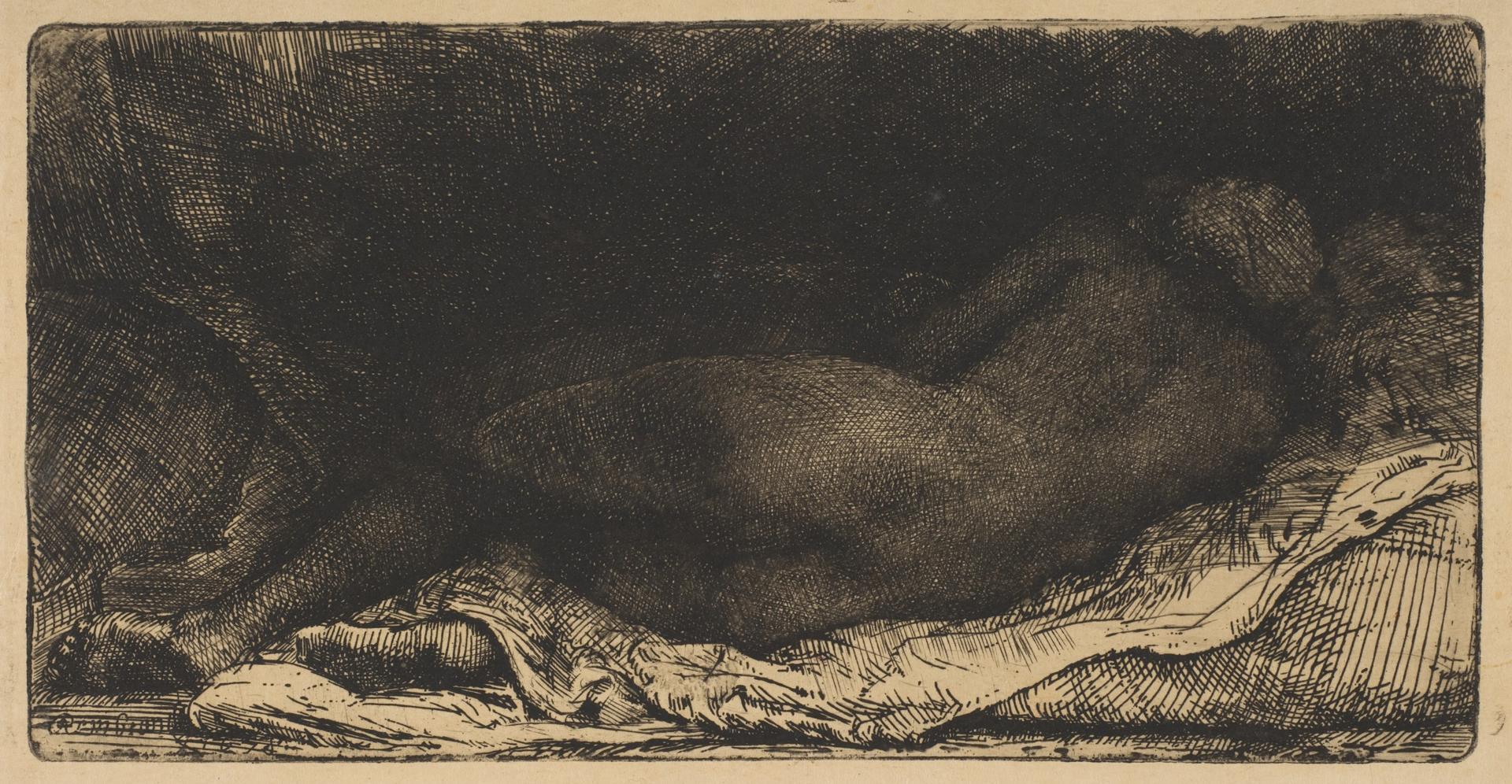
Reclining Female Nude
Original title: Reclining Female Nude
kurzbeschreibung
Rembrandt van Rijn produced the etching 'Liegender weiblicher Akt' (Reclining Female Nude) in 1658, combining etching, drypoint, and engraving. It shows a resting female figure, her body wrapped in cloth. This is the second of six states, printed on Japanese paper.
Description
A female figure lies in a relaxed pose, her head resting on a support, arms loose at her sides. Her legs are slightly bent, and fabric envelops her form, accentuating its contours. A dark, abstract background recedes behind her, making her stand out. Fine hatching and detailed lines capture the surfaces of skin and cloth. The subdued light gathers on the figure, creating a sense of depth.
Context
This print belongs to Rembrandt's late period, when he worked intensively on printmaking. It is part of a series of nude studies that art historians consider ground-breaking for the realistic depiction of the human body. At the time, the artist was increasingly experimenting with unusual poses and the interplay of light and shadow. Drypoint allowed him to draw fine, spontaneous lines that enhance the feeling of immediacy.
Impact
The intimate, unposed stance feels immediate and true to life. Against the dark, abstract background, attention focuses entirely on the figure, whose soft lines project a sensual presence. The interplay of delicate etched lines and bold drypoint strokes gives the print particular depth and texture.
Technique
The etching was reworked with drypoint and engraving—a typical approach for Rembrandt to adjust tonal values and details. The work is printed on Japanese paper, prized for its fine surface and its ability to reproduce even the most delicate lines. That this is the second of six states shows that Rembrandt revised the plate several times to achieve the desired effect.
AI-generated description text
Source: Metropolitan Museum of Art · Public Domain (CC0 1.0)