Two Women Embracing
Original title: Two Women Embracing
kurzbeschreibung
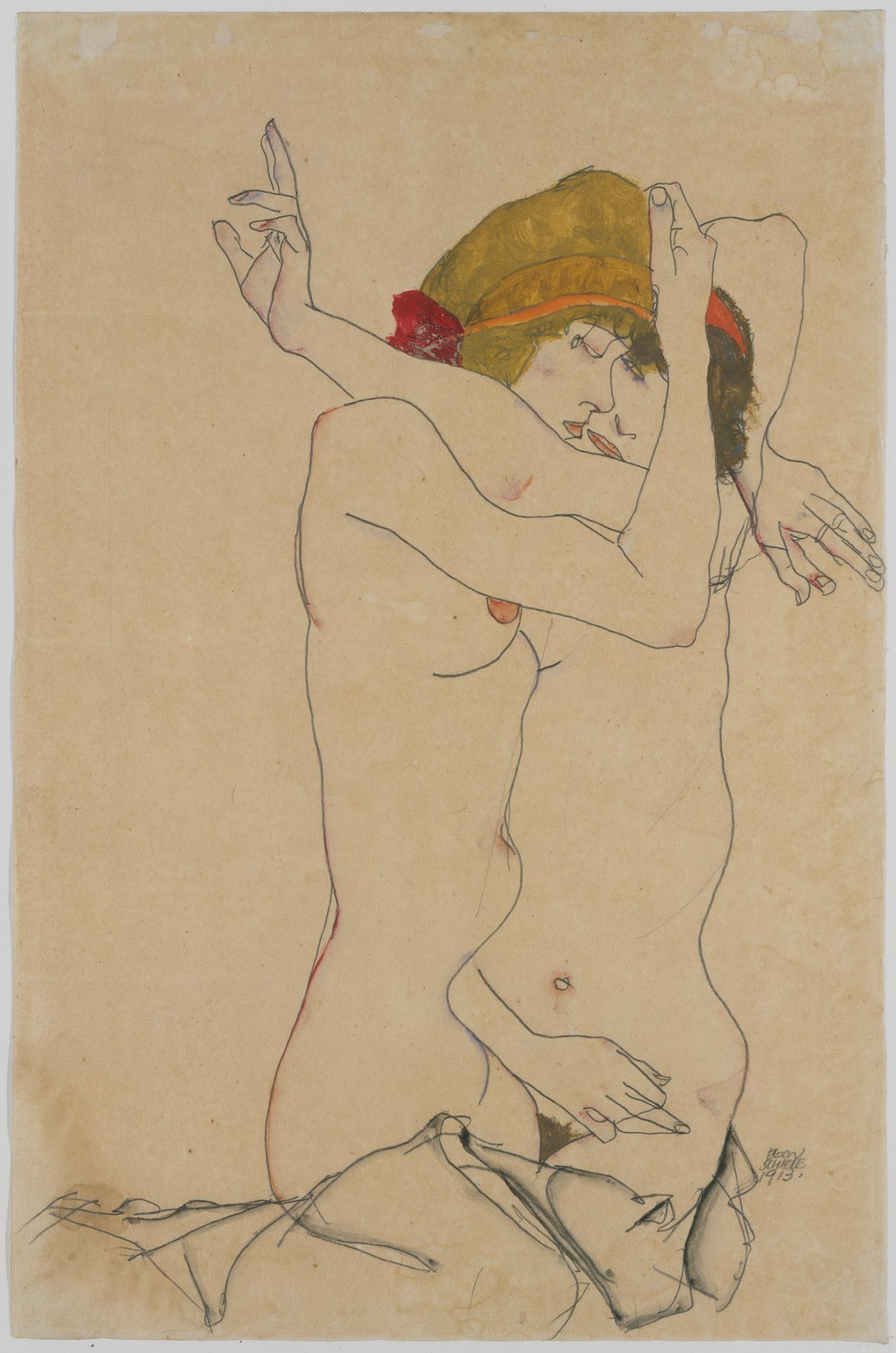
Egon Schiele made "Two Women Embracing" in 1913. It shows two naked women locked in a close, intimate embrace. The work is in gouache, watercolor, and graphite on paper, measuring 48.3 by 31.8 cm. What stands out is the expressive line and the posture of the two bodies.
Description
The woman on the left wears a yellow cap with an orange stripe and a red bow; her arms are raised in a gesture. On the right stands a dark-haired woman without a head covering, her arms touching the other. Both figures are unclothed and occupy the middle of the asymmetrically built image. Pastel tones dominate, loosened by accents of red and orange. Light falls evenly across the surface, with no strong shadows.
Context
The year 1913 falls in a phase when Schiele was deeply engaged with the human body and with how people relate to one another. The sheet was made in Vienna, where the artist was gaining a foothold after his release from prison in 1912. Female couples appear several times in his work, often in the context of studies on eroticism and identity. Works on paper in gouache and watercolor were characteristic of this period.
Impact
The expressive lines and idiosyncratic color draw the viewer straight into the action. Tenderness and movement lie close together in the embrace, creating a palpable tension. By narrowing everything down to the bodies and their gestures, the sheet gains in expressive power.
Technique
Schiele worked with gouache, watercolor, and graphite on paper, applying the colors in thin, sometimes glazing layers. The graphite strokes structure the figures and sharpen their contours. Because opaque gouache and transparent watercolor come together, fine gradations and targeted accents were possible.
AI-generated description text
Source: Metropolitan Museum of Art · Public Domain (CC0 1.0)