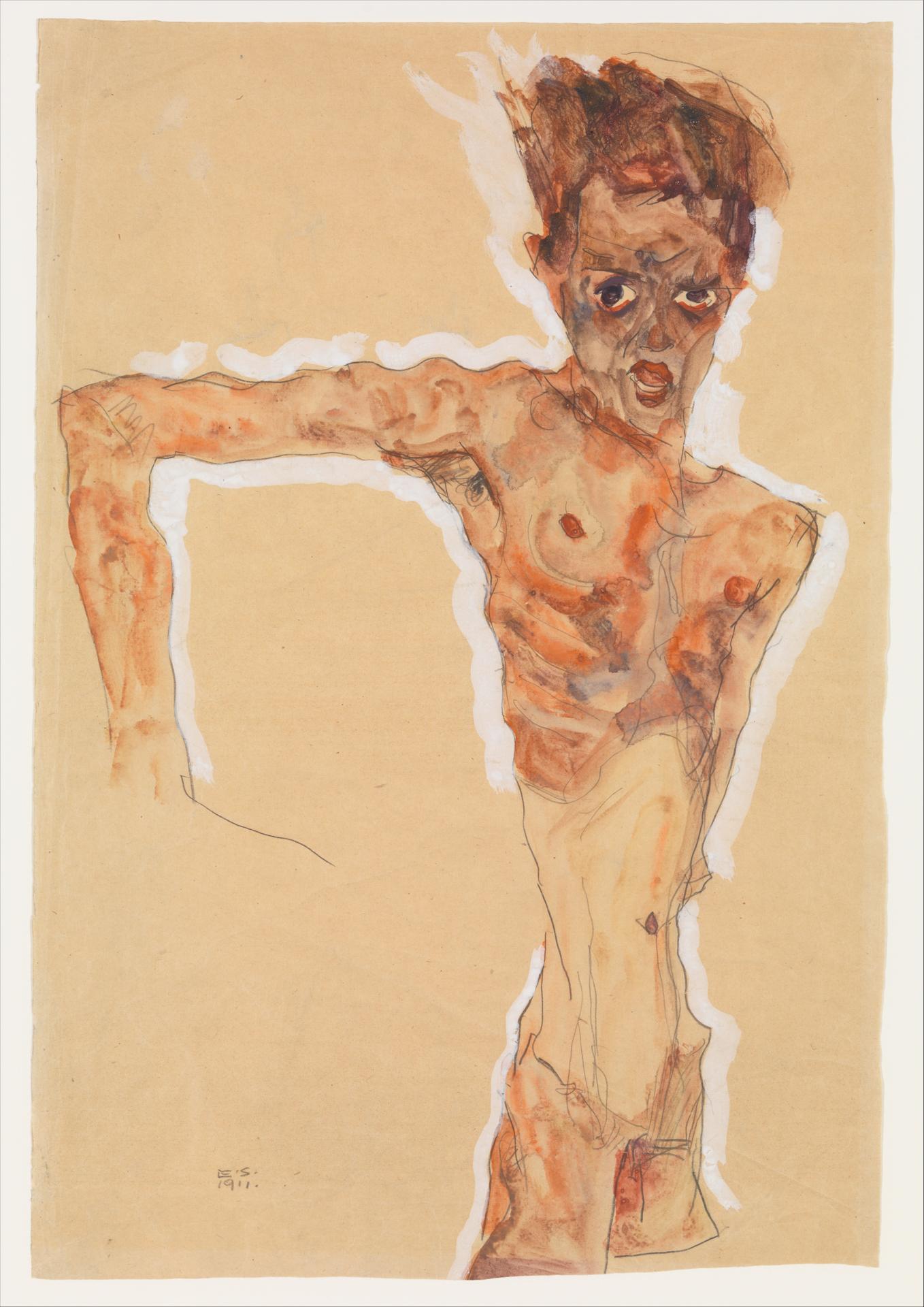
Self-Portrait (1911)
Original title: Self-Portrait
kurzbeschreibung
Egon Schiele painted himself in 1911 — an expressive, distinctly stylized figure. Executed as a watercolor drawing with graphite and opaque watercolor on paper, the sheet shows his naked torso as it appeared in the mirror.
Description
A male body is caught in a reflection. The form is radically simplified, with strong contours emphasizing muscles and fatty tissue. The palette stays earthy, dominated by browns and oranges. The face wears a tense, almost painful expression, carried by the application of paint and the linework. The hair looks disheveled and is rendered in related tones. The background remains plain and restrained, while the white mirror frame clearly sets the figure apart. The layout feels asymmetrical, with the body leaning slightly to the left.
Context
Schiele, an Austrian Expressionist painter, became known for unconventional and often provocative self-portraits. In 1911, the year of this sheet, he was intensely grappling with his own body and the human psyche. He was influenced by Gustav Klimt at the time but was increasingly developing his own unmistakable hand. He lived and worked in Vienna then, exploring identity, sexuality, and existence.
Impact
Expressive lines and the tense facial expression seize the viewer immediately and hold them. Because the earth tones stay sparse and the background neutral, all attention goes to the physical and psychological presence of the sitter. The unusual mirror perspective and the asymmetry of the arrangement give the sheet something dynamic — and at the same time vulnerable.
Technique
Watercolor, graphite, and opaque watercolor on paper interlock; translucent and opaque layers create a particular depth. The strong, dark contours are drawn with graphite, then the areas are filled in with earthy watercolor tones. This allows body details to be captured precisely while the color areas remain expressive.
AI-generated description text
Source: Metropolitan Museum of Art · Public Domain (CC0 1.0)