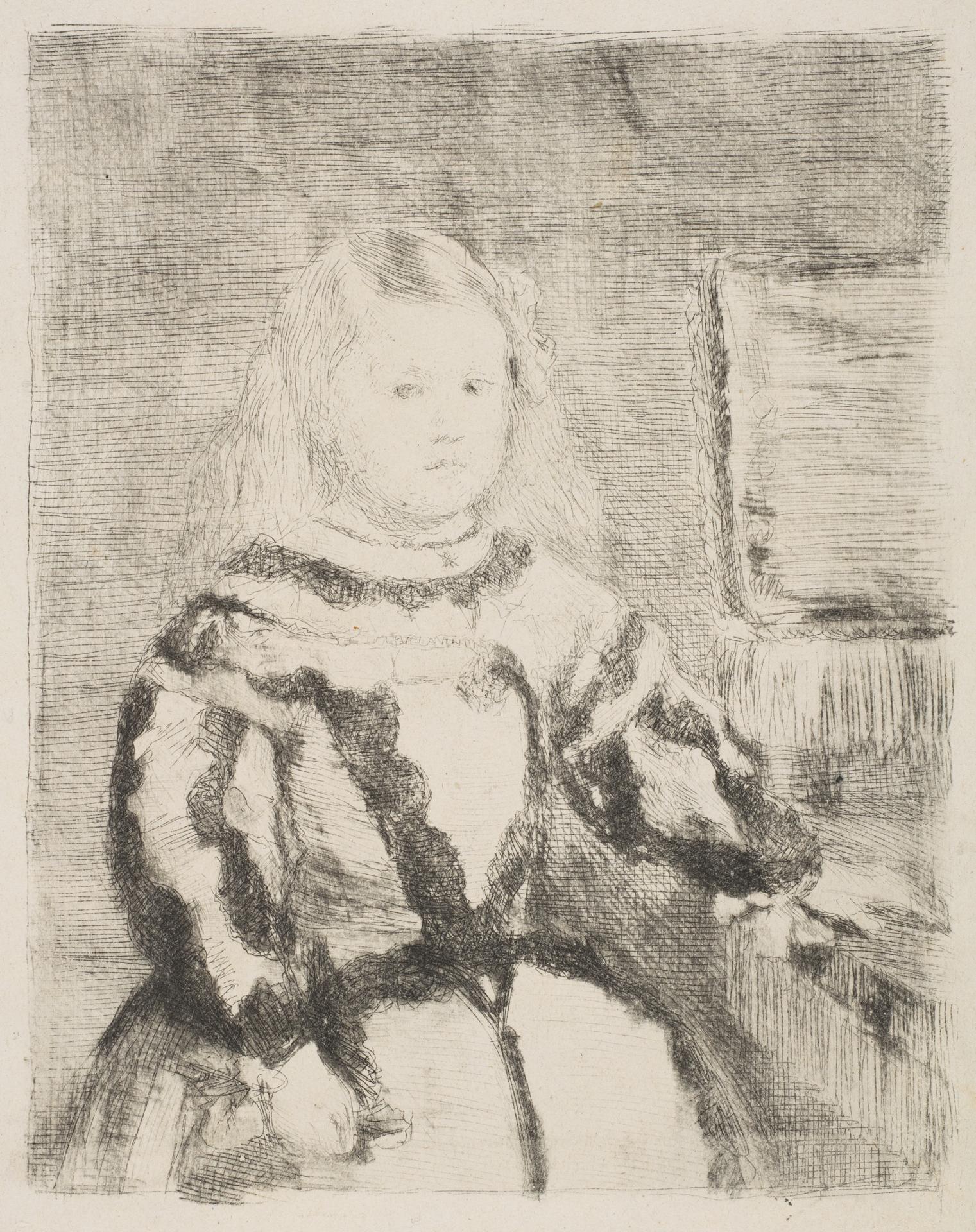
The Infanta Margarita, after Velázquez
Original title: The Infanta Margarita, after Velázquez
kurzbeschreibung
Around 1861–62, Edgar Degas made this etching after a painting by Diego Velázquez. It shows the young Infanta Margarita in an interior, executed as a drypoint. The present impression is the second of two states and the only known example.
Description
A young person sits at the center of a room. Her dress features a striking fur trim on the sleeves and neck, and long hair falls over her shoulders. Behind her is a window with closed shutters, creating a quiet mood. Light falling from the front highlights her facial features and the texture of the fabric. The rendering remains monochrome, using varying shades of gray and line weights.
Context
During his early career, when he was deeply engaged with Spanish painting, Degas created this etching. The source was the famous portrait of Infanta Margarita by Velázquez, which Degas likely knew through reproductions or at the Louvre. At that time, he began to be enthusiastic about printmaking and to experiment. The only known impression of this state is now kept at the Metropolitan Museum of Art.
Impact
The sheet feels intimate and calm, reinforced by the closed shutters and soft light. Fine lines and the furry texture give the portrait an almost tactile quality. The restriction to gray tones directs attention to the Infanta's facial features and posture.
Technique
Etching with drypoint, second of two states. This technique allows both fine, precise lines and soft tonal transitions. With the drypoint, Degas rendered details such as the fur trim with lively strokes.
AI-generated description text
Source: Metropolitan Museum of Art · Public Domain (CC0 1.0)