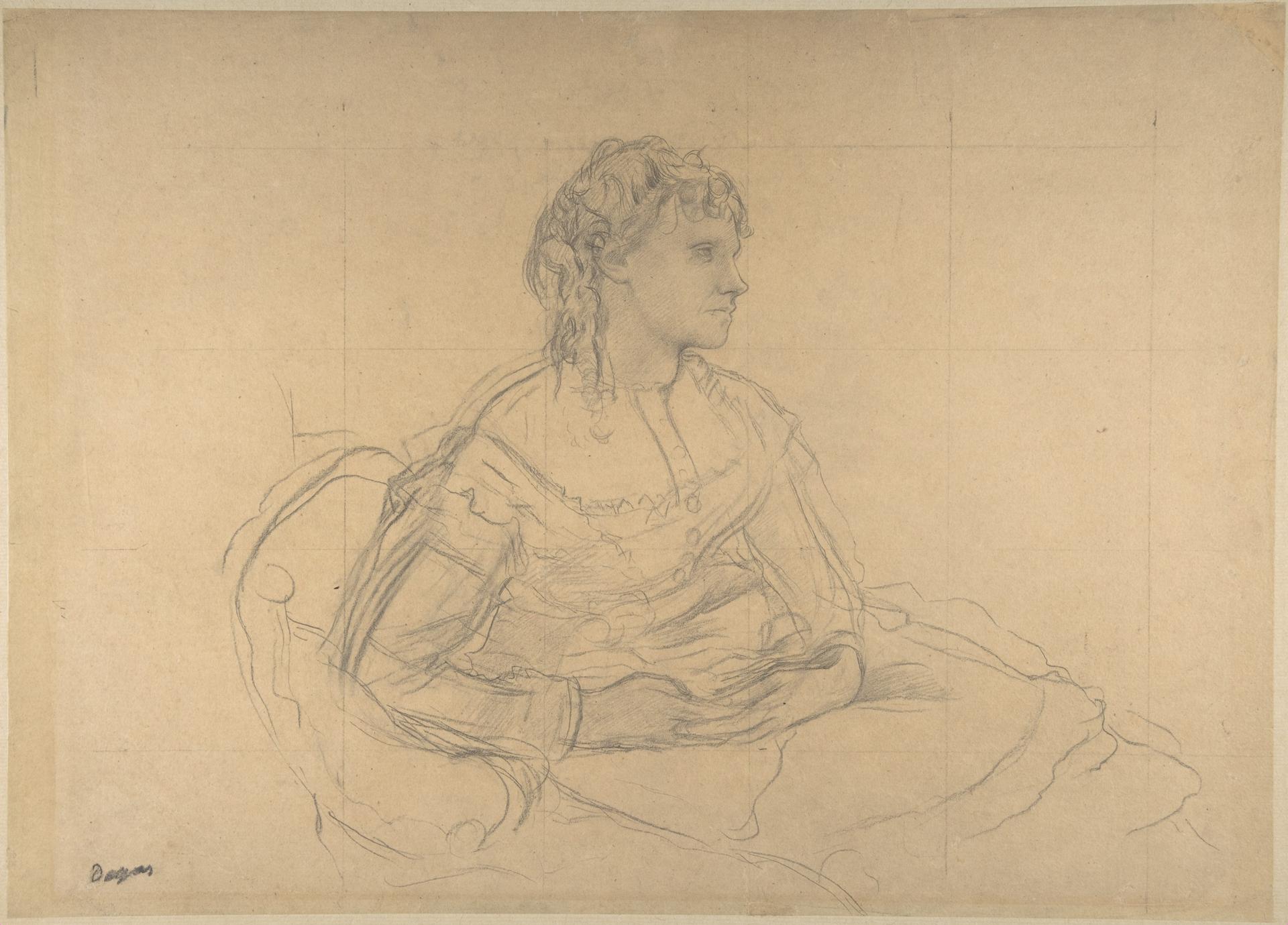
Study for “Madame Théodore Gobillard” (Yves Morisot) (1869, Met-Objekt 491)
Original title: Study for “Madame Théodore Gobillard” (Yves Morisot)
kurzbeschreibung
In 1869, Edgar Degas made a graphite study for his painting Madame Théodore Gobillard. The subject is Yves Morisot, seated in an armchair, her head turned to the left, wearing a dress with many folds. This upright sheet measures 33.3 by 44 cm.
Description
A seated woman turns to the left. Her dress, with its folds and ruffles, falls from her shoulder. Her hair is gathered into a curly braid. The setting is bare: an empty wall and part of a piece of furniture, likely an armchair. The layout brings the figure entirely into the foreground. There is no color; everything is in shades of gray. The light appears even, without cast shadows. The style is realistic, with attention to texture and the folds of the garment.
Context
This drawing was made in 1869 as preparatory work for a portrait of Yves Morisot, sister of the painter Berthe Morisot, who later married Théodore Gobillard. The painting belongs to the circle of the Morisot family, with whom Degas was closely connected. The sheet probably served to clarify the composition and to capture the drapery of the dress. Such an approach was typical for Degas: he often sketched figures several times before executing them in oil.
Impact
Precise lines and the calm, collected posture of the sitter define the sheet. Because everything unnecessary is omitted, an intimate, almost private mood emerges. The folds of the dress bring lively texture to the image and draw attention to the artist's careful craftsmanship.
Technique
The work is executed as a pure graphite drawing on paper, with fine strokes and hatching. This technique allows for accurate rendering of fabric structures and facial features. The even distribution of light and absence of shadows indicate controlled, meticulous line work.
AI-generated description text
Source: Metropolitan Museum of Art · Public Domain (CC0 1.0)