Study for Vieille Italienne (recto); Drapery Study (verso)
Original title: Study for Vieille Italienne (recto); Drapery Study (verso)
kurzbeschreibung
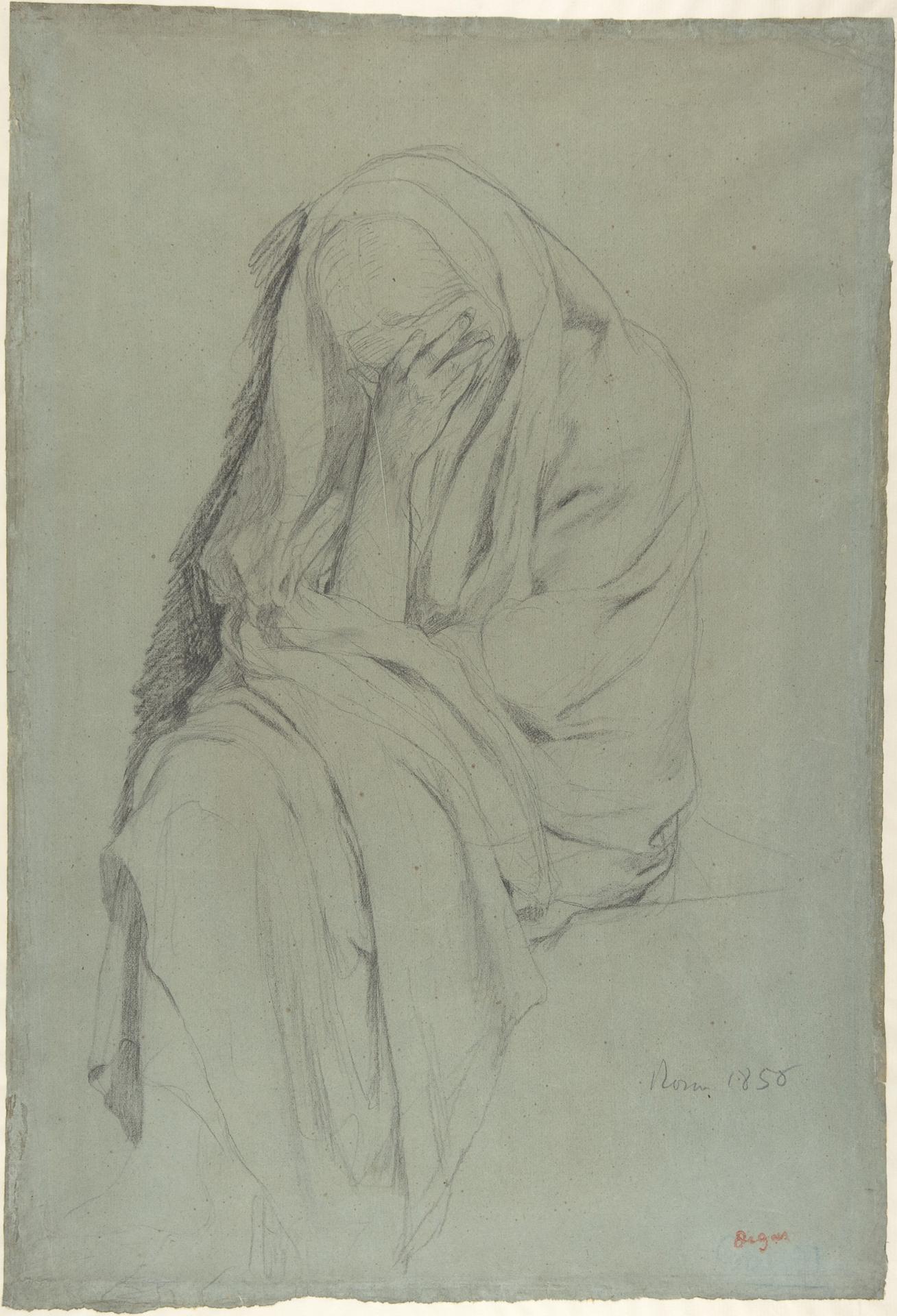
In 1856, during his stay in Italy, Edgar Degas made this graphite drawing of a seated woman turned inward. The sheet carries a study for the painting 'Vieille Italienne' on the front, and an independent drapery study on the back. It measures 43.3 x 29.5 cm.
Description
A woman sits with her arms crossed in front of her body, hands held before her face—a gesture that suggests thought or grief. A long garment wraps around her, partly hiding her face. The folds and shadows of the fabric are carefully worked out, so that the texture and weight of the material become palpable. The background remains largely empty, which brings the figure to the fore. At the lower right are the signature and the date 'Nov. 1850'.
Context
The sheet was made in 1856, when Degas was in Italy studying Renaissance art. 'Vieille Italienne' (Old Italian Woman) was a subject he treated several times in those years. The study likely served as preparation for a painting or a larger composition. The drapery study on the reverse shows how precisely Degas wanted to capture fabrics and their folds.
Impact
A quiet, intimate mood emanates from the drawing, brought about by the closed posture and the empty background. The nuanced shading gives the figure an almost sculptural presence, even though it is executed only in graphite. The image feels true to life and empathetic, without slipping into sentimentality.
Technique
The work is executed in graphite on paper—a medium that allows fine transitions from light to dark. Degas used varying line density and hatching to shape light and shadow. The monochrome gray scale is characteristic of graphite drawings and underscores the formal clarity of the construction.
AI-generated description text
Source: Metropolitan Museum of Art · Public Domain (CC0 1.0)