Picture Book of Gold Brocades (Ehon kokinran)
Original title: Picture Book of Gold Brocades (Ehon kokinran) 絵本古錦蘭
kurzbeschreibung
The 'Picture Book of Gold Brocade' (Ehon kokinran) consists of three woodblock-printed books that Suzuki Harunobu issued in 1763 (Hōreki 13). Printed in ink on paper, they gather scenes of everyday life in eighteenth-century Japan. Among Harunobu's works, these volumes count as his early book illustrations.
Description
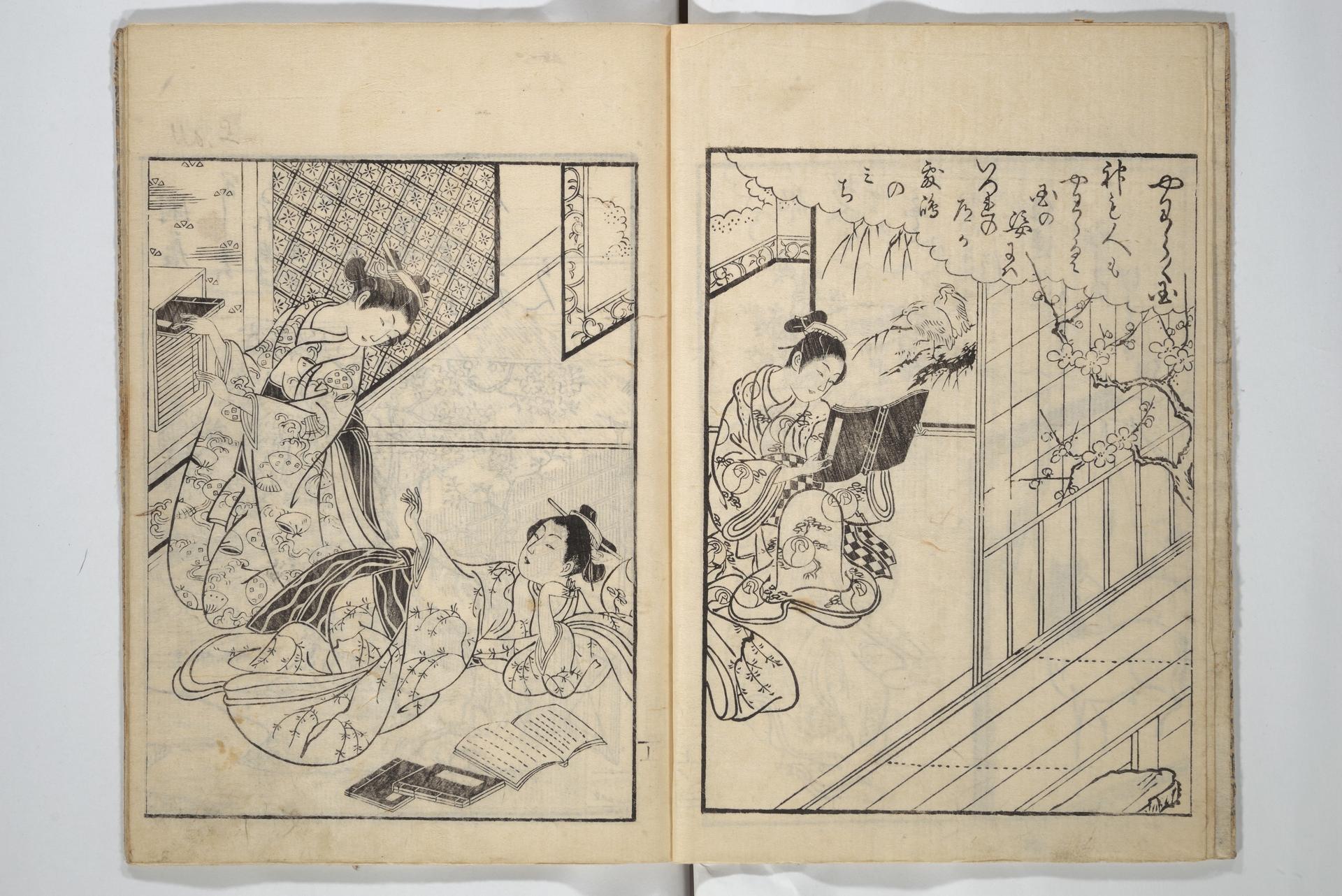
On the double-page spread, a woman in traditional dress reclines on a mat at left while another person offers her a tray; a book and a tray lie on the floor. At right, a woman sits by a window reading. Sliding doors and cherry blossom branches suggest the Japanese interior. The image remains in black and white, with clear contours and sparingly set forms.
Context
Harunobu is regarded as a pioneer of colour woodblock printing, yet this early document was made without colour. In 1763, when an urban public in Edo (present-day Tokyo) sought illustrated books, the volumes came onto the market. The title refers to precious gold brocade, a sign of luxury and elegance that alludes to the refined world of the figures.
Impact
A quiet composure emanates from these intimate scenes. Clean lines and a reduced visual language give the print a timeless elegance characteristic of Harunobu. The everyday life depicted feels familiar yet idealised, opening the viewer's access to the Japanese world of the eighteenth century.
Technique
For printing, the drawings were cut into woodblocks and transferred with ink to paper. Each page measures about 22.5 × 16 cm. This process allowed fine lines to be reproduced precisely, as needed for fabrics and facial features.
AI-generated description text
Source: Metropolitan Museum of Art · Public Domain (CC0 1.0)