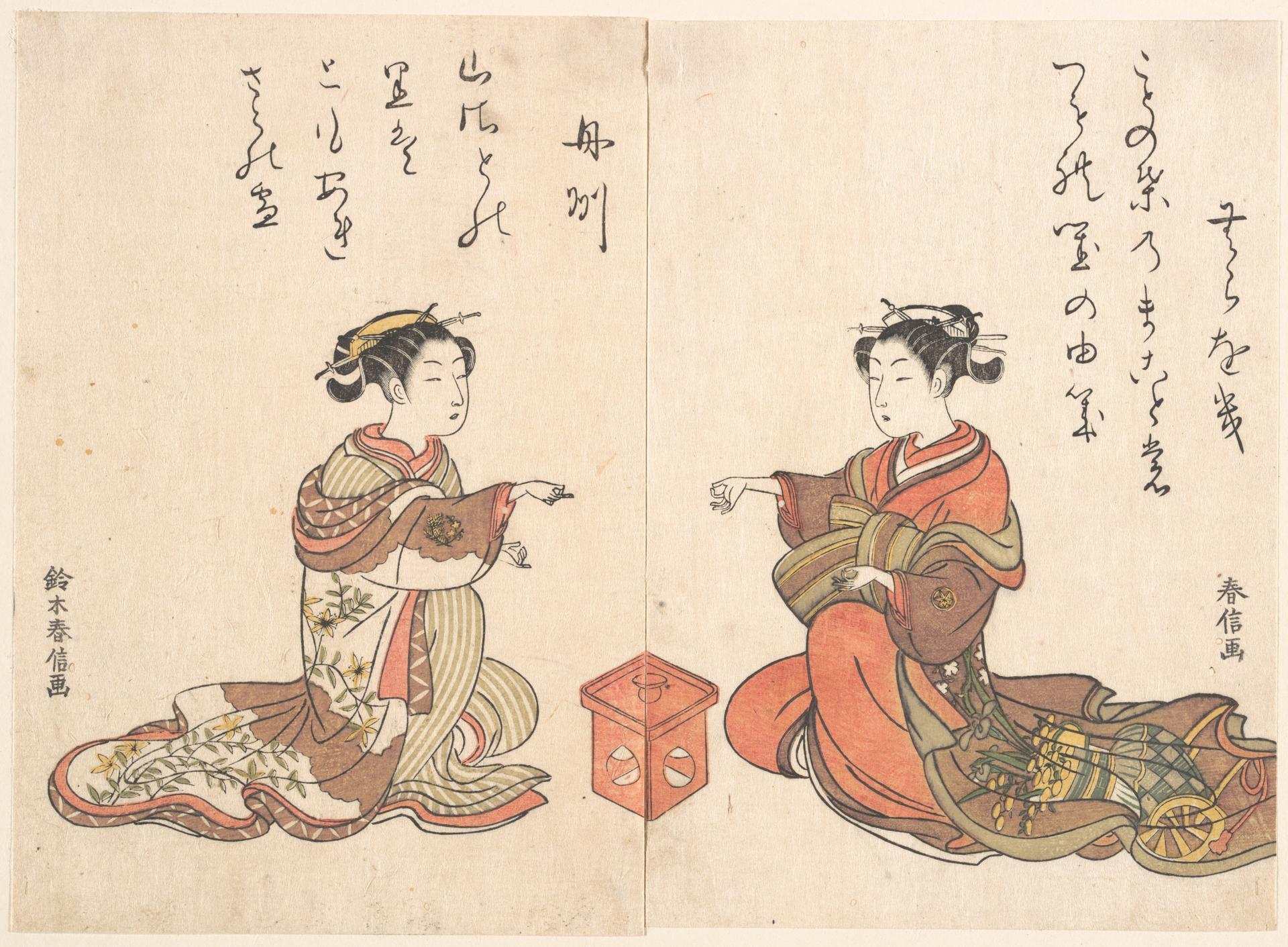
Two Girls Play the Finger Game of Kitsume Ken
Original title: Two Girls Play the Finger Game of Kitsume Ken
kurzbeschreibung
Suzuki Harunobu, a leading master of Japanese colour woodblock printing, created this diptych titled Two Girls Playing the Finger Game Kitsune Ken between 1725 and 1770. It shows two women in traditional kimono engaged in the finger-guessing game of that name in an interior. The work is a woodblock diptych in ink and colour on paper.
Description
Seated on the floor and facing each other, two women are absorbed in the finger game Kitsune Ken. The left wears a white kimono with brown and yellow patterns, the right a red robe with green and yellow ornaments. Elaborate hairstyles and visible jewellery define the groomed appearance of both figures. A small red-lacquered wooden box stands between them and serves as a game element. Chinese characters in the upper part of the image establish a poetic or narrative connection. Vivid colours and even light distribution correspond to the woodblock practice of the period.
Context
Harunobu is one of the central representatives of ukiyo-e and is regarded as a pioneer of multicolour woodblock printing (nishiki-e) around the middle of the eighteenth century. The finger game Kitsune Ken was a widespread pastime in the Edo period and also found its way into the visual arts. Numerous prints by Harunobu show women in everyday or playful moments and thus reflect the social life of the era. The diptych format often served at that time to capture more complex scenes and interactions.
Impact
Calm and intimacy shape the layout; the symmetrical arrangement of the figures and the clear colouring contribute to this. Lively contrasts between white, red and green give the scene a decorative lightness and draw the eye to the interaction between the two women. All in all, a harmonious yet playful mood emerges, characteristic of Harunobu's depictions of everyday life.
Technique
A separate printing block was cut for each colour, so that the diptych consists of two woodblock prints in ink and colour on paper. Harunobu worked with multicolour printing, in which the individual blocks are pulled one after another. Precisely cut contours and evenly opaque colour areas attest to the high accuracy of the printing and the craftsmanship of the workshop.
AI-generated description text
Source: Metropolitan Museum of Art · Public Domain (CC0 1.0)