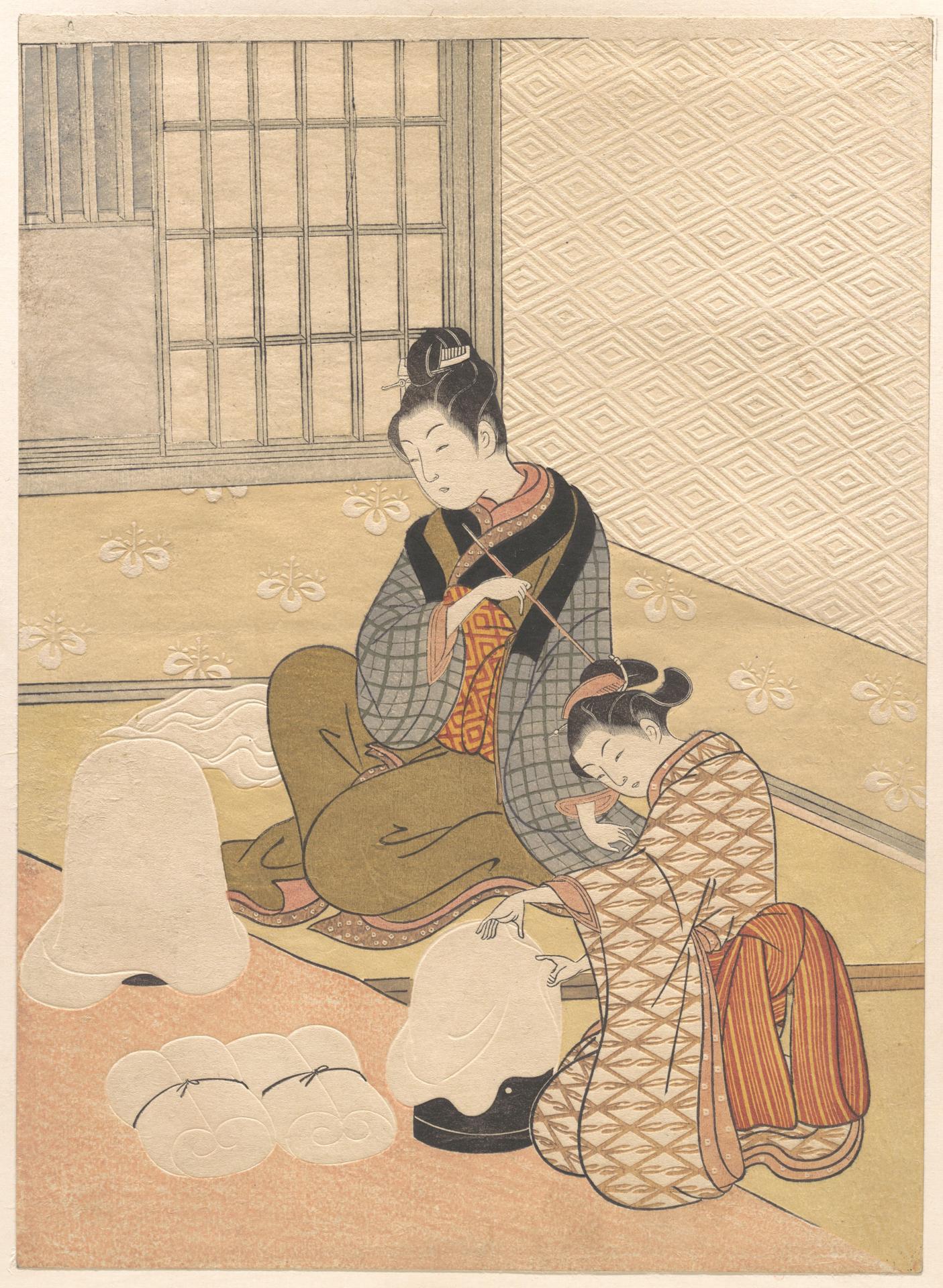
Evening Snow on the Heater
Original title: Evening Snow on the Heater
kurzbeschreibung
Unlike many related prints that push a single figure into the foreground, Suzuki Harunobu's Evening Snow on the Heater sets two women facing each other in a Japanese interior. This color woodblock print dates to the late 18th century and combines blind embossing (karazuri) with ink and color on paper in a vertical format. Both women sit on tatami mats, each holding a fan.
Description
Two women sit facing each other. The one in front wears a kimono with a geometric pattern, her hair done up in a knot, her gaze lowered, a fan in her hand. The woman behind appears in a kimono with a floral pattern, also with hair piled high and a fan. Floral ornaments cover the tatami mats on the floor. A wooden-framed window and a geometric wall pattern close off the rear. Soft light enters from outside, and the palette stays mostly in earth tones and white.
Context
Suzuki Harunobu, a leading ukiyo-e artist of the second half of the 18th century in Edo (present-day Tokyo), is regarded as a pioneer of multicolor woodblock printing (nishiki-e), which spread from around 1765. The theme of evening snow belongs to a widespread series of depictions of famous places or seasons in Japanese art. Blind embossing (karazuri) allowed fine patterns and textures such as snow or fabric designs to be raised in relief.
Impact
The print feels quiet and intimate, a still slice of everyday life. Clean lines and restrained color create a harmonious, almost poetic mood. Blind embossing gives certain areas a subtle relief effect that draws the viewer closer.
Technique
Each color required its own woodblock; blind embossing (karazuri) was printed without color to make patterns stand out in relief. Ink and color went onto paper, and the format corresponds to a medium-sized print (chu-ban). The careful execution attests to the high artisanal precision of Japanese color woodblock printing.
AI-generated description text
Source: Metropolitan Museum of Art · Public Domain (CC0 1.0)