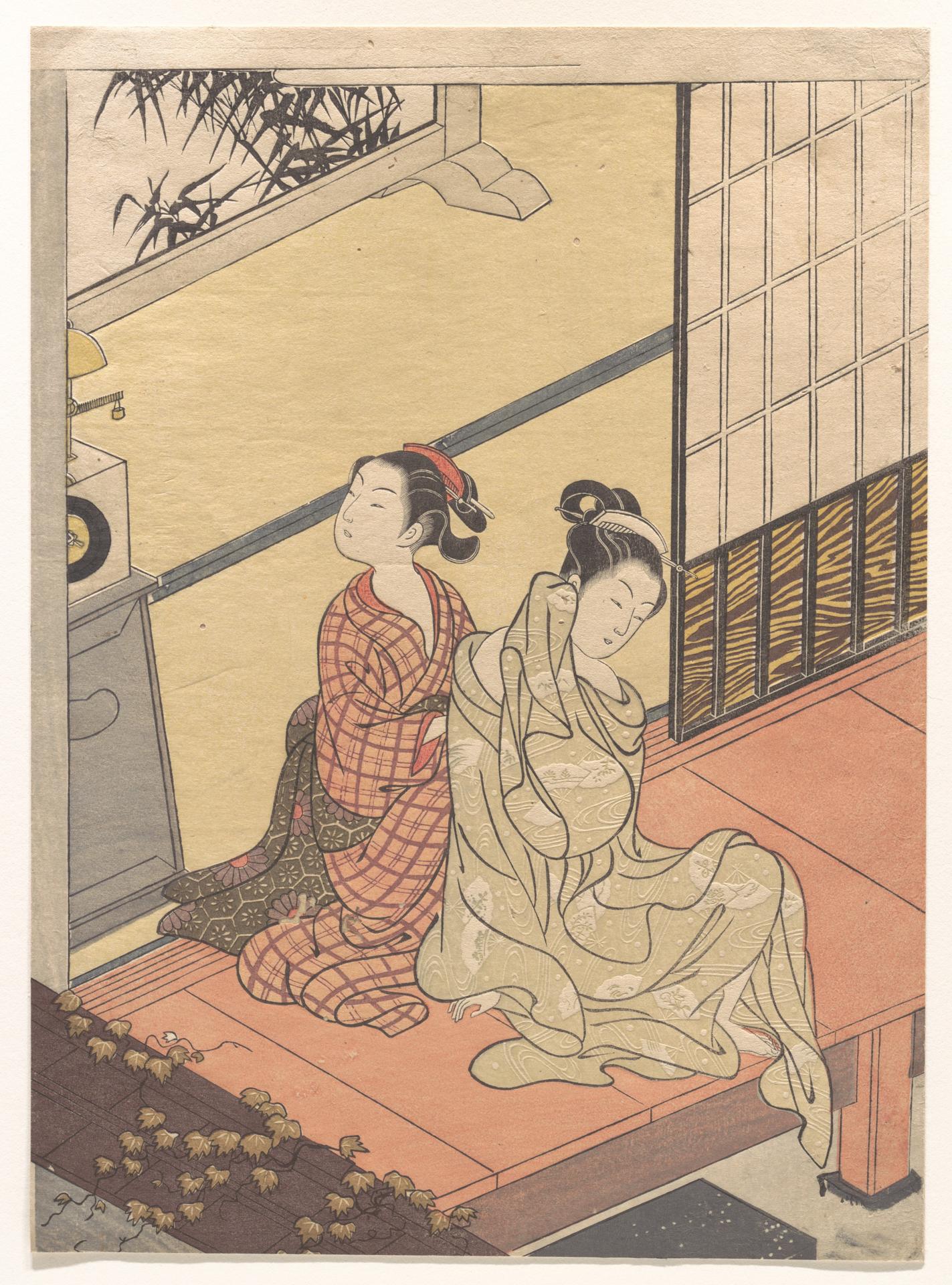
Evening Chime of the Clock (Tokei no banshō), from the series 'Eight Parlor Views' (Zashiki hakkei)
Original title: Evening Chime of the Clock (Tokei no banshō), from the series “Eight Parlor Views” (Zashiki hakkei)
kurzbeschreibung
Around 1766 Suzuki Harunobu made the print "Evening Bell of the Clock" (Tokei no banshō) for his series "Eight Views of the Living Room" (Zashiki hakkei). Two women in an interior turn their eyes toward a clock. The view is rendered as a color woodblock print in chūban format, printed with ink and color on paper.
Description
Two women in traditional Japanese dress have settled on a low bench. One wears a dark kimono with a red-checked obi, the other a beige-white robe with an obi of the same tone. Both face a clock standing on a table. Tatami mats, a wooden door and a window through which bamboo leaves can be seen define the room. Warm beiges, browns and reds dominate the image, and soft light falls in from outside.
Context
Within Harunobu's series "Eight Views of the Living Room" this sheet is a parody of the famous "Eight Views of Xiao and Xiang." Such parodies were enormously popular in the Edo period and brought the everyday scenes of contemporary Japan into view. Harunobu is regarded as a pioneer of full-color printing (nishiki-e), which emerged around 1765. In the phase when the series was made, bourgeois pleasures and domestic subjects increasingly became the stuff of woodblock prints.
Impact
A quiet, intimate mood surrounds the print and invites the viewer to share the two women's still moment. The warm colors and clear layout produce a harmonious, almost poetic effect characteristic of Harunobu's elegant style.
Technique
The sheet was printed as a woodblock on paper with ink and watercolors. The chūban format, a medium-sized horizontal one, suited intimate scenes. Several blocks were used for the different colors, which allowed for fine gradations and details.
AI-generated description text
Source: Metropolitan Museum of Art · Public Domain (CC0 1.0)