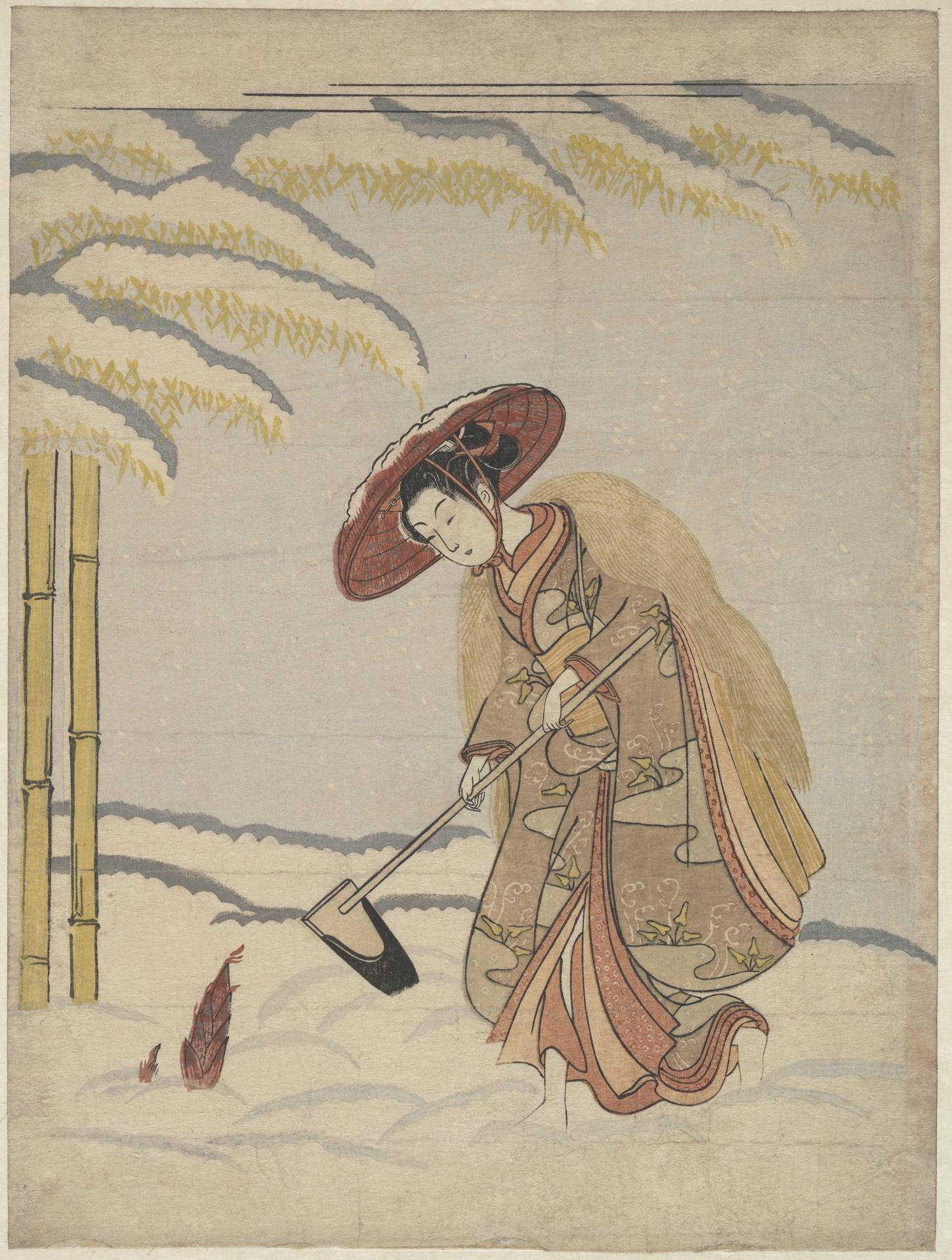
Woman Digging Bamboo Shoots in the Snow, or Parody of Meng Zong (Mōsō), from Twenty-Four Paragons of Filial Piety
Original title: Woman Digging Bamboo Shoots in the Snow, or Parody of Meng Zong (Mōsō), from Twenty-Four Paragons of Filial Piety
kurzbeschreibung
Unlike conventional depictions of filial piety, this print by Suzuki Harunobu, made around 1765, shows a woman digging up bamboo shoots in a snowy landscape. The vertical color woodblock print (28.3 × 21.3 cm) belongs to the series of the Twenty-Four Paragons of Filial Piety and parodies the story of Meng Zong, who searched for bamboo shoots in winter for his sick mother. The work is executed as a woodblock print with ink and color on paper.
Description
In contrast to many contemporary prints, Harunobu here relies on an almost monochrome winter landscape: in the middle of the image, a woman with a spade bends over the snow to uncover bamboo shoots. She wears a broad-brimmed hat and a patterned robe whose folds and ornaments are cut with great precision. Behind her rise bamboo stalks, their leaves partly covered with snow. The palette remains mostly subdued with beige tones, broken by red and blue accents on the clothing. Diffuse light creates a quiet, wintry mood; the lines are sharp, and the areas are clearly separated from one another.
Context
Unlike the mostly male heroes of moral tales, Harunobu places a female figure in the picture. The artist was a pioneer of multicolor woodblock printing (nishiki-e), which became established in Edo in the 1760s. This print was made around 1765, when parodies of classical subjects enjoyed great popularity in ukiyo-e art. The series of the Twenty-Four Paragons of Filial Piety is based on Chinese moral tales that were widely known in Japan. That a woman here takes the place of the male protagonist corresponds to Harunobu's preference for elegant depictions of women (bijinga).
Impact
Compared with more dramatic scenes in the series, this print radiates a quiet, contemplative calm. The winter scene feels focused and restrained. The parodic reinterpretation of the moral story creates a subtle irony that can prompt a smile. Clear contours and the reduced colorfulness lend the image a graphic elegance characteristic of Harunobu's style.
Technique
As was usual for multicolor prints of this period, separate woodblocks were made for the different colors, which required extremely precise registration. The print is a woodblock print with ink and color on paper in the vertical chūban format. The delicate lines and the flat color gradations attest to the high technical quality of eighteenth-century Japanese printmaking.
AI-generated description text
Source: Metropolitan Museum of Art · Public Domain (CC0 1.0)