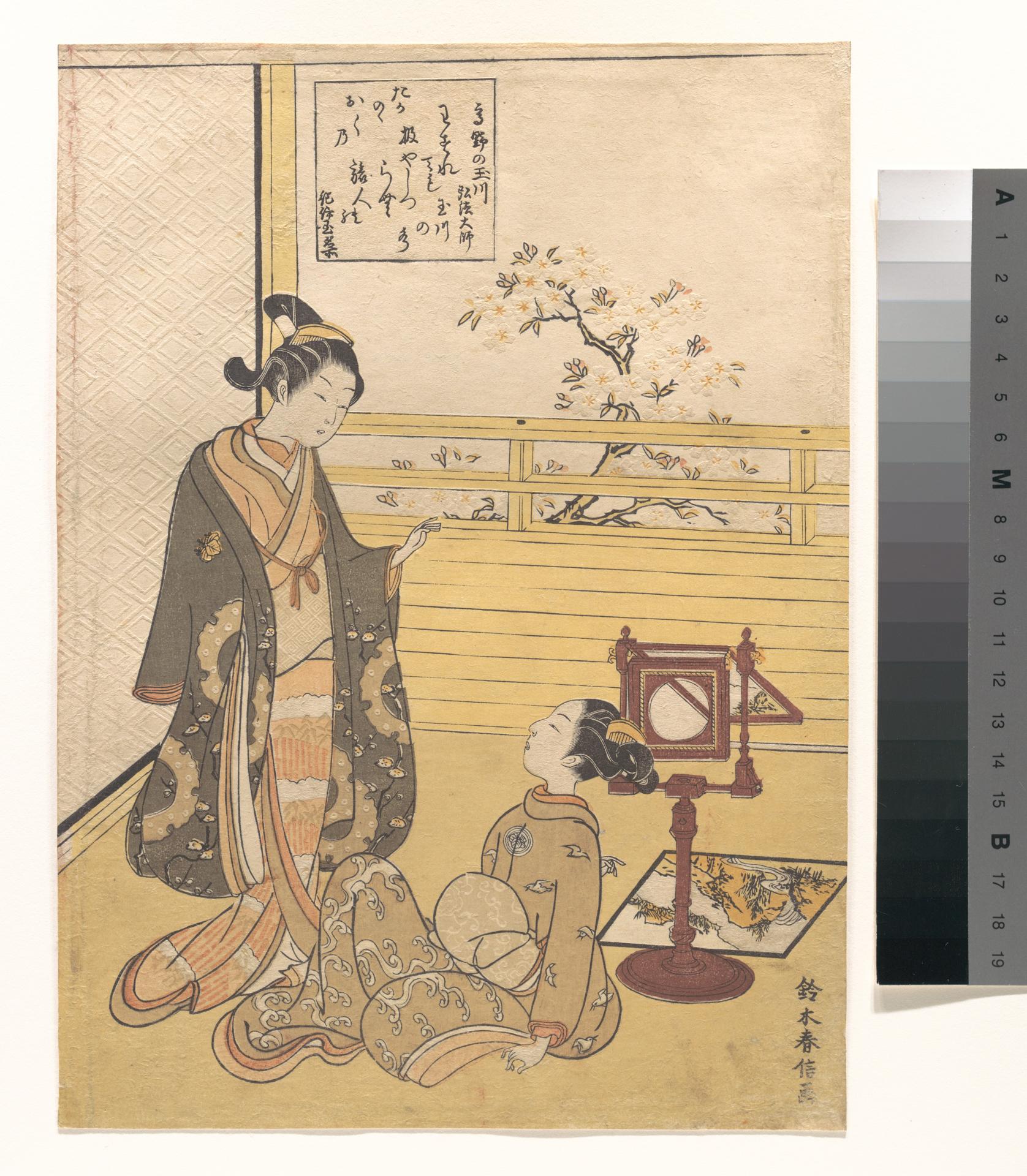
A Teenage Boy and Girl with a Viewer for an Optique Picture (Nozoki-karakuri); Kōbō Daishi’s Poem on the Jewel River of Kōya (Kōya no Tamagawa: Kōbō Daishi)
Original title: A Teenage Boy and Girl with a Viewer for an Optique Picture (Nozoki-karakuri); Kōbō Daishi’s Poem on the Jewel River of Kōya (Kōya no Tamagawa: Kōbō Daishi)
kurzbeschreibung
Suzuki Harunobu, one of the defining masters of the Japanese colour woodblock print, made this sheet around 1788. It presents a woman and a young man in a traditional Japanese interior. The subject pairs a viewer for an optical picture with a poem by Kōbō Daishi. The work is executed in ink and colour on paper.
Description
A standing woman holds a box-like device in her hands while a seated young man peers through it. Behind the figures runs a wooden wall with a painted flower, and beside it sits a text panel of Japanese characters. Warm browns, beiges and oranges dominate the palette, broken by accents of blue and green. Even, almost shadowless light suggests an artificial or highly uniform source. Crisp contours and precisely placed colour are true to the idiom of the Japanese woodblock print.
Context
Harunobu ranks among the leading figures of nishiki-e and helped drive the development of multicolour printing in the second half of the eighteenth century. The sheet belongs to the series on the six jewelled rivers (Tamagawa), which draws on poems by the monk Kōbō Daishi. The dating around 1788 is puzzling, since Harunobu died in 1770; a later edition or a revised date is conceivable. Looking through an optical device points to the enthusiasm for Western optical instruments in Japan at the time.
Impact
Quiet postures and warm tones give the print an inward, intimate character. A everyday scene and a poetic backdrop merge into a still, reflective mood. Without dramatic tension or clutter, the private world of the two figures opens up to the viewer.
Technique
Ink and colour on paper, printed in the ukiyo-e manner. Several printing blocks were used for the nuanced colour gradations and details. Precise contours and flatly applied colour attest to the high craftsmanship of the colour woodblock print.
AI-generated description text
Source: Metropolitan Museum of Art · Public Domain (CC0 1.0)