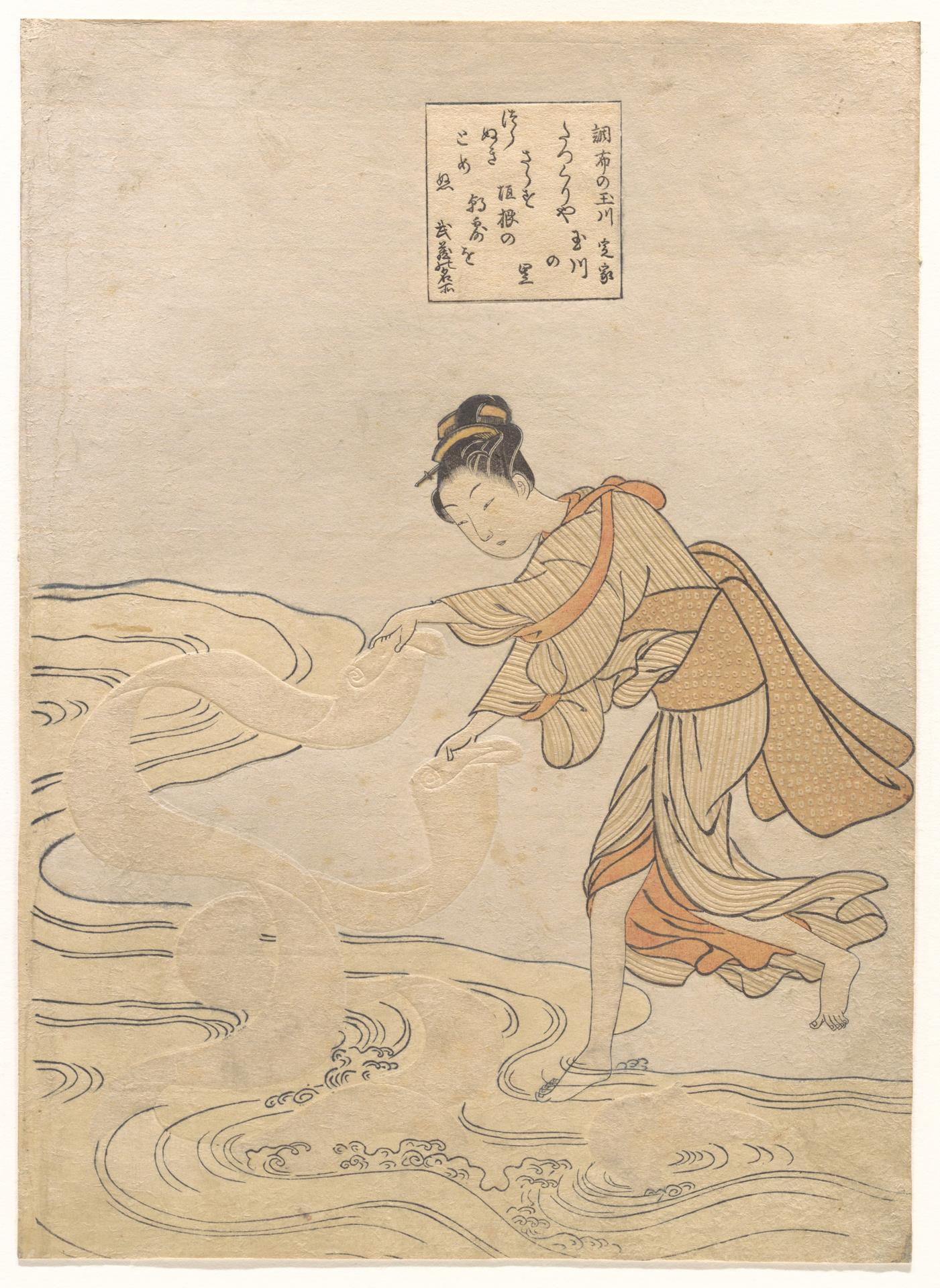
The Jewel River at Chōfu (Chōfu no Tamagawa)
Original title: The Jewel River at Chōfu (Chōfu no Tamagawa)
kurzbeschreibung
Suzuki Harunobu made this color woodblock print around 1768 during the Edo period. The chūban-sized sheet shows a woman fishing in a river and illustrates the characteristic line art and restrained palette of ukiyo-e.
Description
A woman stands in the water and lifts a fish from the river. A long garment is wrapped around her shoulders, and she wears a skirt; her hair is tied up with ribbons. Stylized wave lines suggest the river. A text box with Japanese characters occupies the upper area of the image. Earth tones dominate the color scheme, while the fish and the woman's clothing stand out through subtle accents.
Context
The print belongs to the series Six Jewel Rivers (Mutamagawa), a popular Edo-period theme rooted in classical poetry. Harunobu is regarded as a pioneer of full-color woodblock printing (nishiki-e), which became established in the 1760s. The series became known as an advertisement for the Echigoya perfume shop, which helped such prints circulate in Edo's urban milieu.
Impact
A quiet elegance emanates from the sheet: the figure blends harmoniously into the river landscape. Muted colors and clear lines create a still, poetic mood. Despite the lively motion of fishing, the arrangement feels balanced and contemplative.
Technique
Ink and color on paper, printed in chūban format of about 27 x 19.7 cm. Harunobu used the multi-color printing process (nishiki-e), in which several woodblocks are used for the different colors. The precise registration of the blocks allows fine details and soft color gradients.
AI-generated description text
Source: Metropolitan Museum of Art · Public Domain (CC0 1.0)