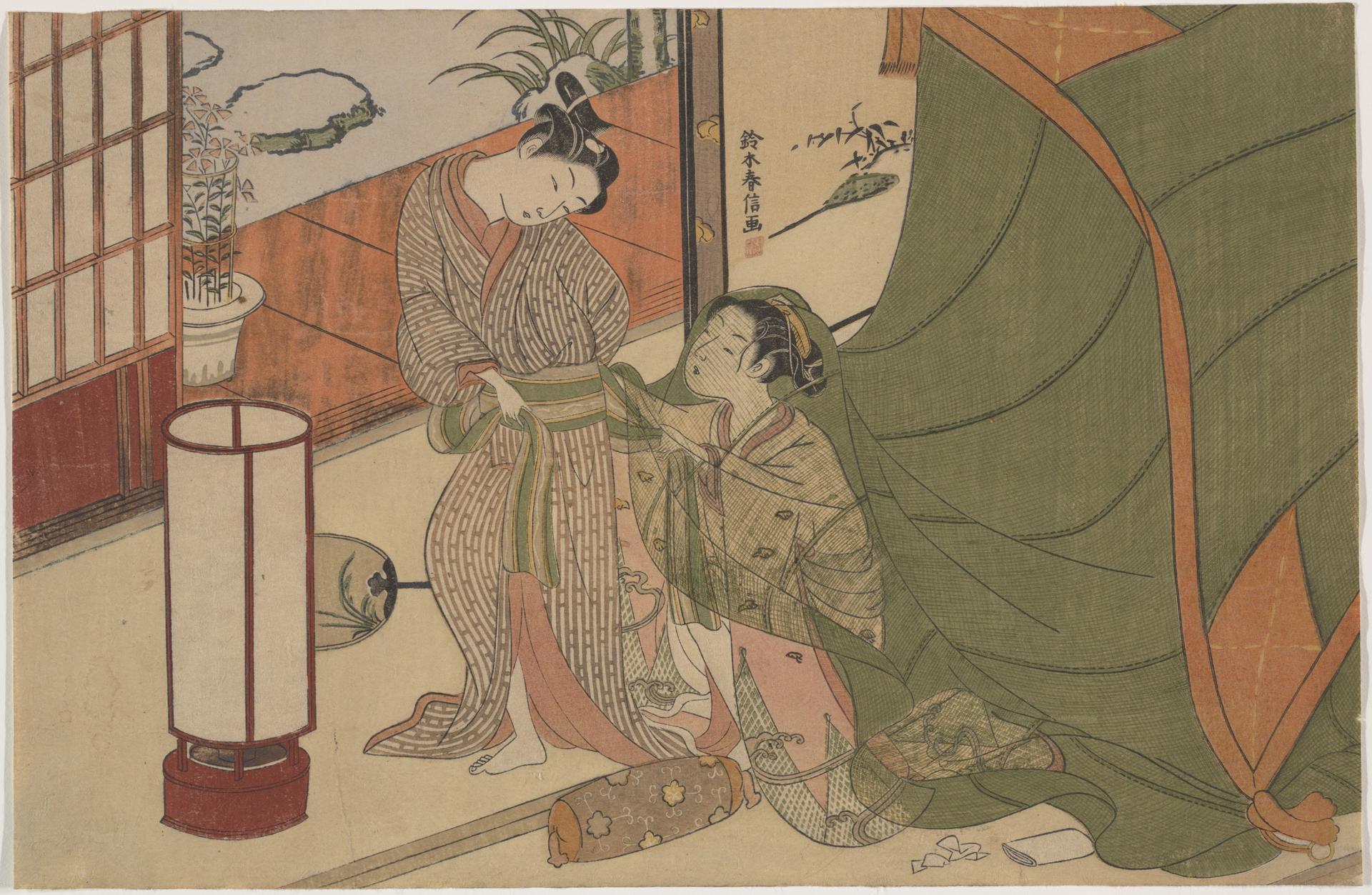
Parting of Lovers: The Morning After (ca. 1765–70, Met-Objekt 4797)
Original title: Parting of Lovers: The Morning After
kurzbeschreibung
Suzuki Harunobu's colour woodblock print "Parting of the Lovers: The Morning After" (c. 1765–70) presents a couple indoors after a night together. Printed as a chuban yoko-e in ink and colour on paper, the sheet belongs to the early years of Japanese full-colour printing.
Description
Two figures in traditional dress anchor the layout: on the left a standing figure in a striped kimono, head lowered; on the right a kneeling one in a kimono with vertical stripes, gaze also cast down. A table with a pot and a plant divides them, and behind it a wooden-framed window with another plant appears. A large, half-transparent cloth drapes over the figures on the right, while a table with a lamp stands at the left. Earth tones — brown, green, beige — dominate, set off by the colours of the kimonos; the light falls evenly from the front.
Context
The period of production falls in the late Edo era, when colour woodblock printing flourished in Japan. Harunobu is regarded as a pioneer of nishiki-e, the multi-colour print that developed from the 1760s onward. The morning parting of lovers was a common ukiyo-e subject and often reflected the intimate atmosphere of the urban pleasure quarters. The chuban yoko-e format suited such close-up scenes.
Impact
A quiet, almost wistful mood hangs over the pair, carried by the muted earth tones and the even light. The horizontal arrangement and clear lines produce a calm, balanced layout that draws the viewer into the still closeness of the moment.
Technique
Several colour blocks were used for the printing, each laying a separate field of colour onto the paper. Multi-colour printing (nishiki-e) allowed the fine tonal gradations and precise lines characteristic of Harunobu's style. Ink and water-based colours were pressed onto the paper, creating the delicate, pastel-like effect.
AI-generated description text
Source: Metropolitan Museum of Art · Public Domain (CC0 1.0)