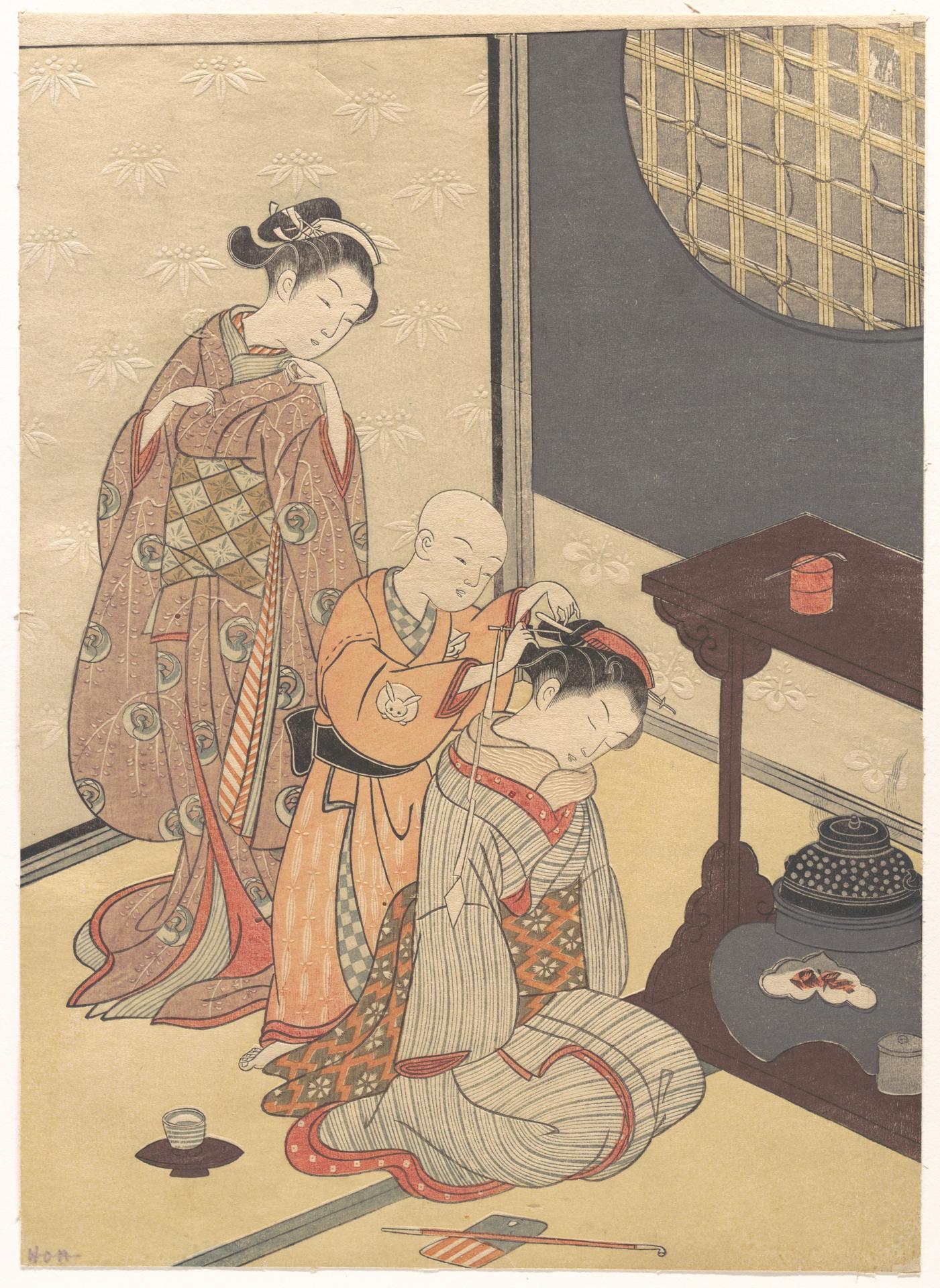
Night Rain at the Double-Shelf Stand, from the series Eight Parlor Views (Zashiki hakkei) (ca. late 18th century)
Original title: Night Rain at the Double-Shelf Stand, from the series Eight Parlor Views (Zashiki hakkei)
kurzbeschreibung
A child crouches between two women, fiddling with one woman's hair. That quiet household moment carries the title "Night Rain at the Double-Shelf Stand" and comes from Suzuki Harunobu. He made the sheet in the second half of the 18th century as a woodblock print in ink and color on paper, in the medium-sized chu-ban format. What we see is a traditional Japanese room with three figures in it.
Description
On the left an adult woman stands; on the right a second woman kneels; between them a child squats, tucking something into the kneeling woman's hair. Her kimono is printed with geometric and floral patterns. Earthy tones set the overall color, with red and blue providing accents. Softened light enters through a lattice door. The layout feels balanced, almost mirror-like, while the furnishings stay plain and traditional.
Context
Harunobu placed the sheet in his series "Eight Parlor Views" (Zashiki hakkei), a contemporary reworking of the classic "Eight Views of Xiao and Xiang." A pioneer of multicolor woodblock printing (nishiki-e), he shaped the idealized image of women in ukiyo-e. In the late Edo period, bourgeois domestic life and private everyday scenes moved to the center of interest. The "night rain" of the title quotes the literary motif of the Eight Views without any landscape being visible.
Impact
Stillness and closeness emanate from this print; the viewer seems to look into a private interior. The balanced arrangement of the figures and the restrained color keep things calm. Delicate coloring and precise contours feel elegant and bring out the beauty of the ordinary.
Technique
Several color blocks were used for printing, laid over one another in a multicolor process. Ink and colors sit on paper, and the outlines come from fine lines cut in wood. The chu-ban format matched Harunobu's usual way of working and allowed a detailed rendering.
AI-generated description text
Source: Metropolitan Museum of Art · Public Domain (CC0 1.0)