Parody of the Legend of Kyoyu and Sofu
Original title: Parody of the Legend of Kyoyu and Sofu
kurzbeschreibung
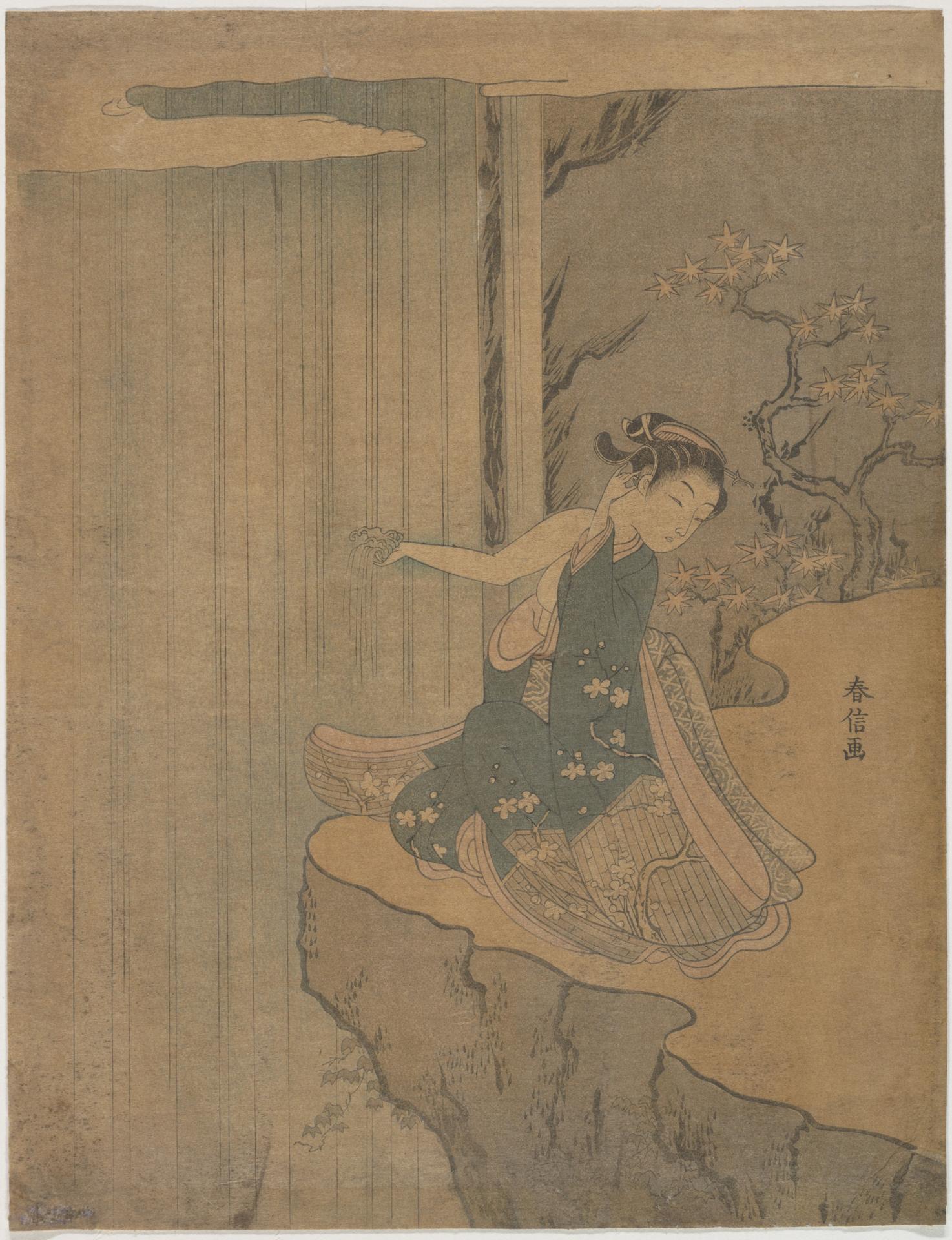
Unlike related prints that keep mythological scenes in their traditional guise, this color woodblock by Suzuki Harunobu transfers the legend of Kyoyu and Sofu into the realm of everyday life. Made between 1764 and 1772, the work shows a woman in Japanese dress seated on a rock and playing a harp-like stringed instrument—a secular reinterpretation of the familiar tale.
Description
On a rock, the woman holds a focused, elegant pose as she plucks the strings of the harp-like instrument. A waterfall plunges behind her, while a cloud motif floats at upper left and flowering branches encroach from the right. The muted palette of grays, blues, and beiges is accompanied by frontal light that accentuates the contours of the figure and her surroundings.
Context
Harunobu created this print in the late Edo period, when ukiyo-e woodblocks circulated widely and often parodied mythological or literary sources. The story of the two Daoist immortals Kyoyu and Sofu was frequently taken up in the visual arts; here it is translated into a contemporary, everyday situation. Such parodies were popular with urban audiences, combining familiar material with humorous immediacy.
Impact
A calm, contemplative mood emanates from the sheet, sustained by the subdued colors and stable layout. The mythological background and the everyday scene enter into a connection that unfolds a subtle irony and invites a smile without compromising aesthetic elegance.
Technique
The work was printed as a woodblock (ukiyo-e) with ink and colors on paper. For the fine lines and soft color gradations characteristic of Harunobu's practice, several color blocks were often used for nuanced tones. At about 27.3 × 21 cm, the format corresponds to a chuban print, as was usual for intimate cabinet pieces.
AI-generated description text
Source: Metropolitan Museum of Art · Public Domain (CC0 1.0)