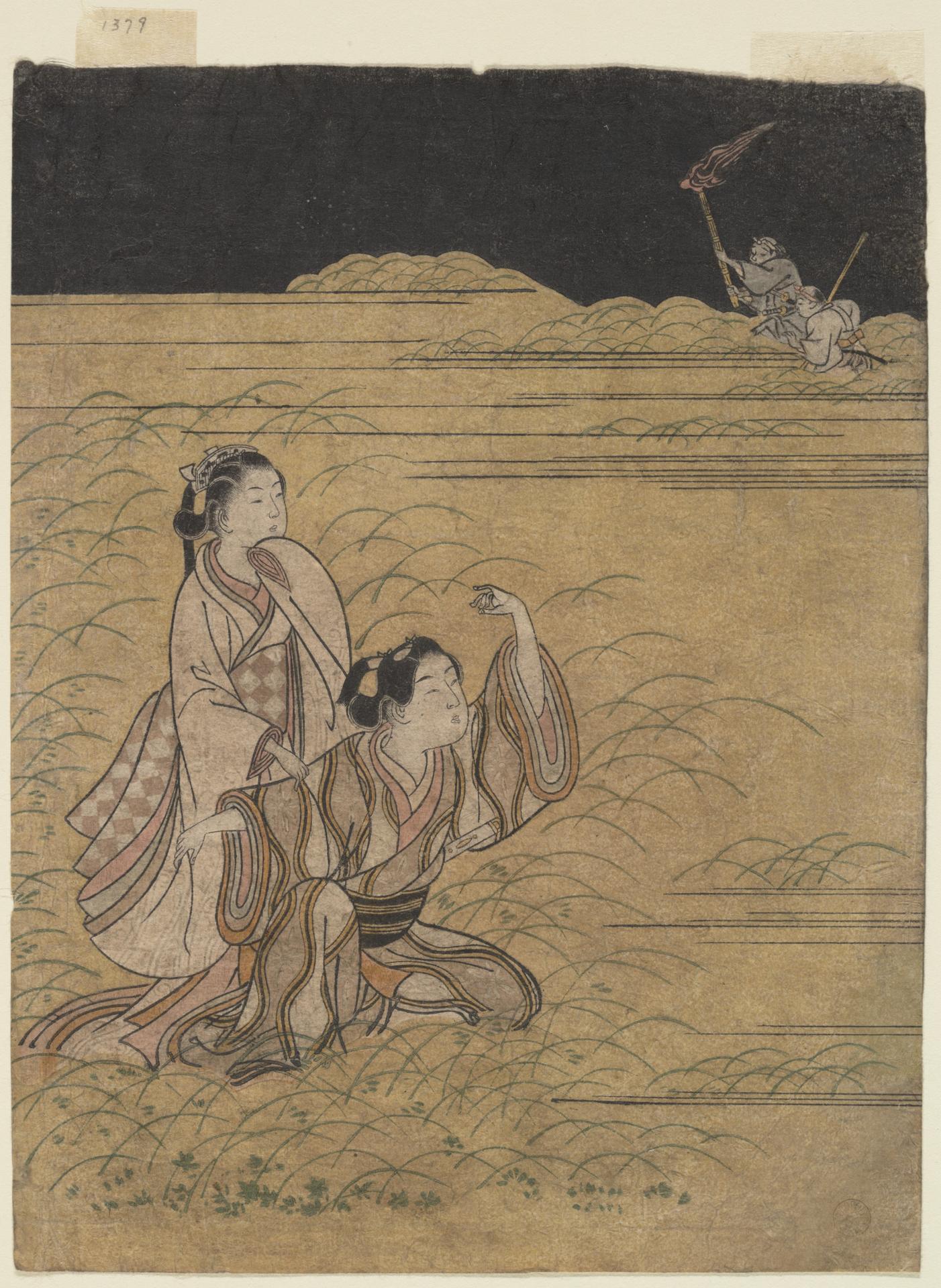
A Young Man and Women in the Moor of Musashino; Parody of the Akuta River episode of the Tale of Ise (Ise monogatari)
Original title: A Young Man and Women in the Moor of Musashino; Parody of the Akuta River episode of the Tale of Ise (Ise monogatari)
kurzbeschreibung
Suzuki Harunobu’s colour woodblock print from around 1765–66 moves a scene from the Ise monogatari into a moonlit marsh: two women and a horseman appear. The sheet takes up the famous Akuta River episode of the classical tale collection and parodies it.
Description
In the foreground two women in traditional robes linger, one seated, the other standing, their gaze lifted upward. Behind them a rider on horseback carries a torch. Grasses and a dark sky fill the space, conveying the night mood. Earth tones dominate the palette, punctuated by red and green accents.
Context
Harunobu is regarded as a pioneer of multicolour woodblock printing (nishiki-e) in Edo, present-day Tokyo. The print was made in the mid-1760s, when colour printing was just gaining ground. Such parodies of the Ise monogatari belonged to a widespread cultural game that translated classical literature into scenes of the present.
Impact
From the first glance the nocturnal atmosphere catches the attention, and the women’s upward gazes draw the eye along. A calm, almost melancholy mood arises. The drawing remains delicate, the colours are attuned to one another, creating an elegant, poetic feel characteristic of Harunobu.
Technique
Ink and colour on paper, printed from a woodblock—the process typical of Japanese ukiyo-e. Several printing passes brought the colours onto the paper one after another. Harunobu was among the first artists to produce multicolour prints of high quality.
AI-generated description text
Source: Metropolitan Museum of Art · Public Domain (CC0 1.0)