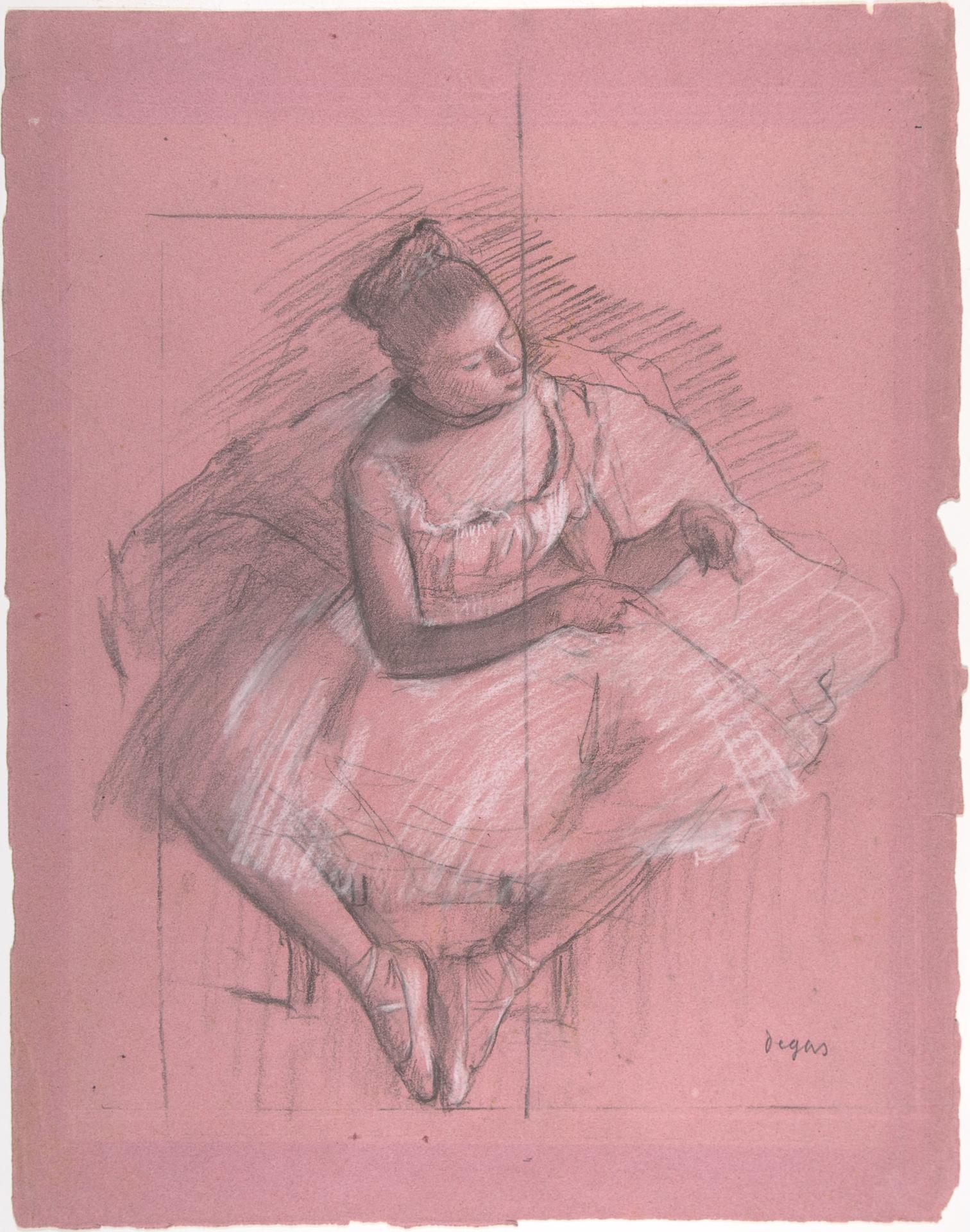
Seated Dancer
Original title: Seated Dancer
kurzbeschreibung
Edgar Degas drew 'Seated Dancer' in 1873–74. This study, executed in graphite and charcoal with white heightening on pink wove paper, bears a fine squared grid across the sheet—a sign that it was intended for transfer.
Description
The dancer's head tilts slightly to one side, her arms resting in her lap. Her legs are loosely bent, and the long dress falls in a soft cascade from the waist. The pink paper provides a ground from which the figure stands out clearly. Outlines are drawn throughout, with white accents highlighting certain areas. Dense and open hatching alternate, capturing fabric and posture.
Context
In the early 1870s Degas turned increasingly to the ballet of the Paris Opera. The squaring suggests the sheet served as a model for transfer to another medium. He often made such studies in preparation for paintings or pastels. Degas observed dancers both on stage and during rehearsals and rests.
Impact
A calm, intimate mood emanates from the sheet, bringing the dancer's private side into view. Delicate pink and clear lines give the figure a floating, vulnerable quality. White heightenings appear only sparingly, lending the figure physical presence.
Technique
Degas used graphite and charcoal, with white heightening over pink wove paper. A fine grid of lines enabled transfer to scale. Dense strokes alongside looser ones reveal great assurance in handling the drawing medium.
AI-generated description text
Source: Metropolitan Museum of Art · Public Domain (CC0 1.0)