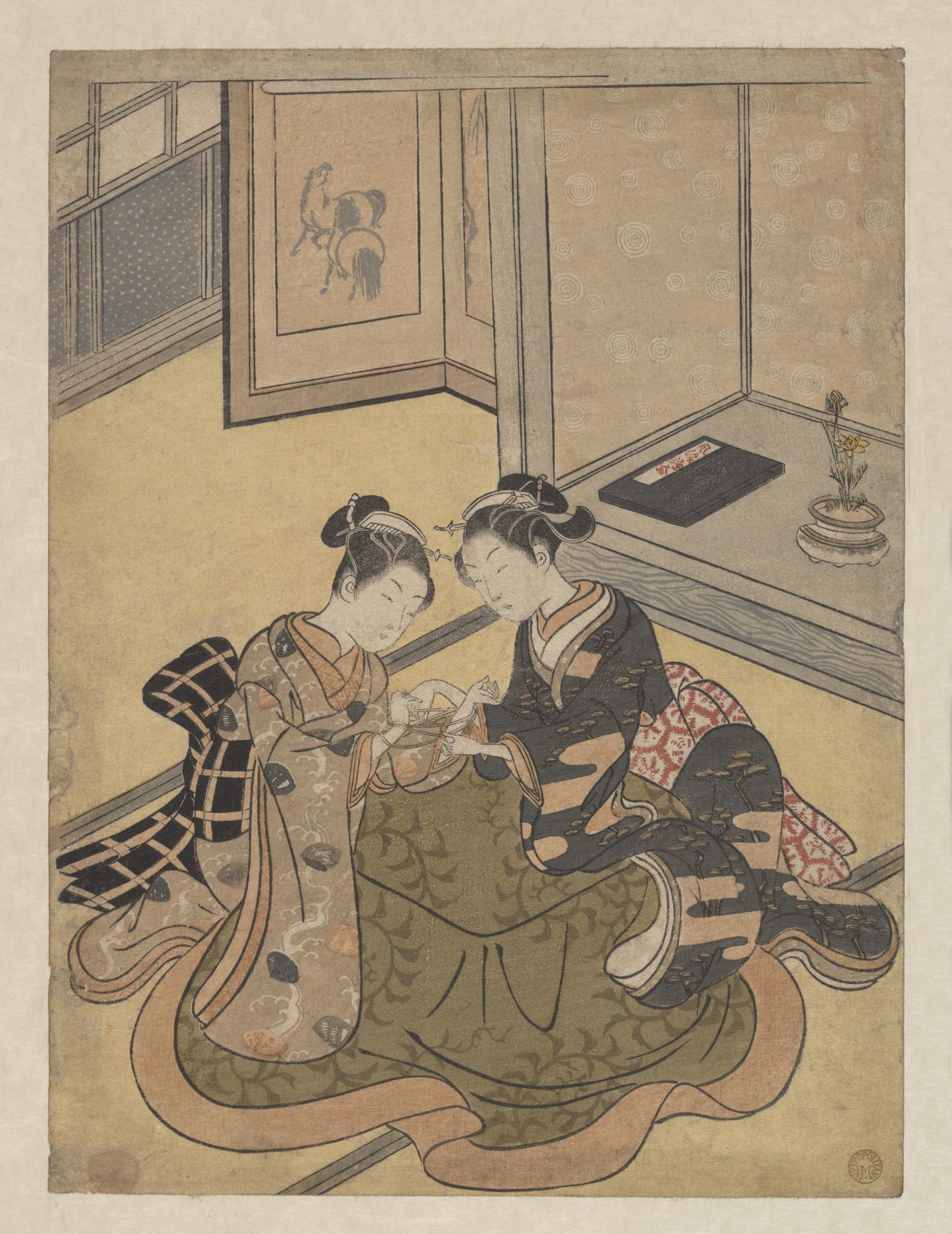
Young Women Playing Cat’s Cradle (Ayatori)
Original title: Young Women Playing Cat’s Cradle (Ayatori)
kurzbeschreibung
Two women sit on the floor, absorbed in cat's cradle (ayatori) as they talk. This Japanese woodblock print (nishiki-e) in ink and colour on paper is by Suzuki Harunobu and dates from around 1765–66. Their traditional dress is as much a part of the scene as their focused attention on the game.
Description
The eye is first drawn to the two seated women, who are manipulating a cat's cradle string and concentrating entirely on the game. Their kimonos show different, elaborately patterned fabrics in various colours. Light falling from the side gives the scene a warm daylight feel, while the colours remain muted and recall traditional Japanese colour techniques. A wooden door with a painting of a horse, a wall decoration and a small flowerpot with a yellow flower complete the room.
Context
Suzuki Harunobu worked in Edo (now Tokyo) in the second half of the 18th century and is counted among the major artists of ukiyo-e. As a pioneer of nishiki-e, the multi-colour woodblock print that developed in the 1760s, he shaped the printmaking of his time. In Japanese art, cat's cradle (ayatori) was seen as a symbol of youthful pastime and sociability. Harunobu's works often appeared in limited editions for a wealthy urban audience.
Impact
Calm and intimacy emanate from the scene: the women sit still, warm light surrounds them, and the delicate lines and muted palette create an elegant, restrained atmosphere characteristic of Harunobu's style. The viewer is drawn into the quiet activity without any dramatic movement distracting the gaze.
Technique
This colour woodblock print (nishiki-e) used several woodblocks, one for each colour. This made it possible to achieve fine lines and nuanced colour gradations that stand out clearly in the print. Printing was done with ink and colour on paper; details such as the kimono patterns and the wooden door are executed with great precision.
AI-generated description text
Source: Metropolitan Museum of Art · Public Domain (CC0 1.0)