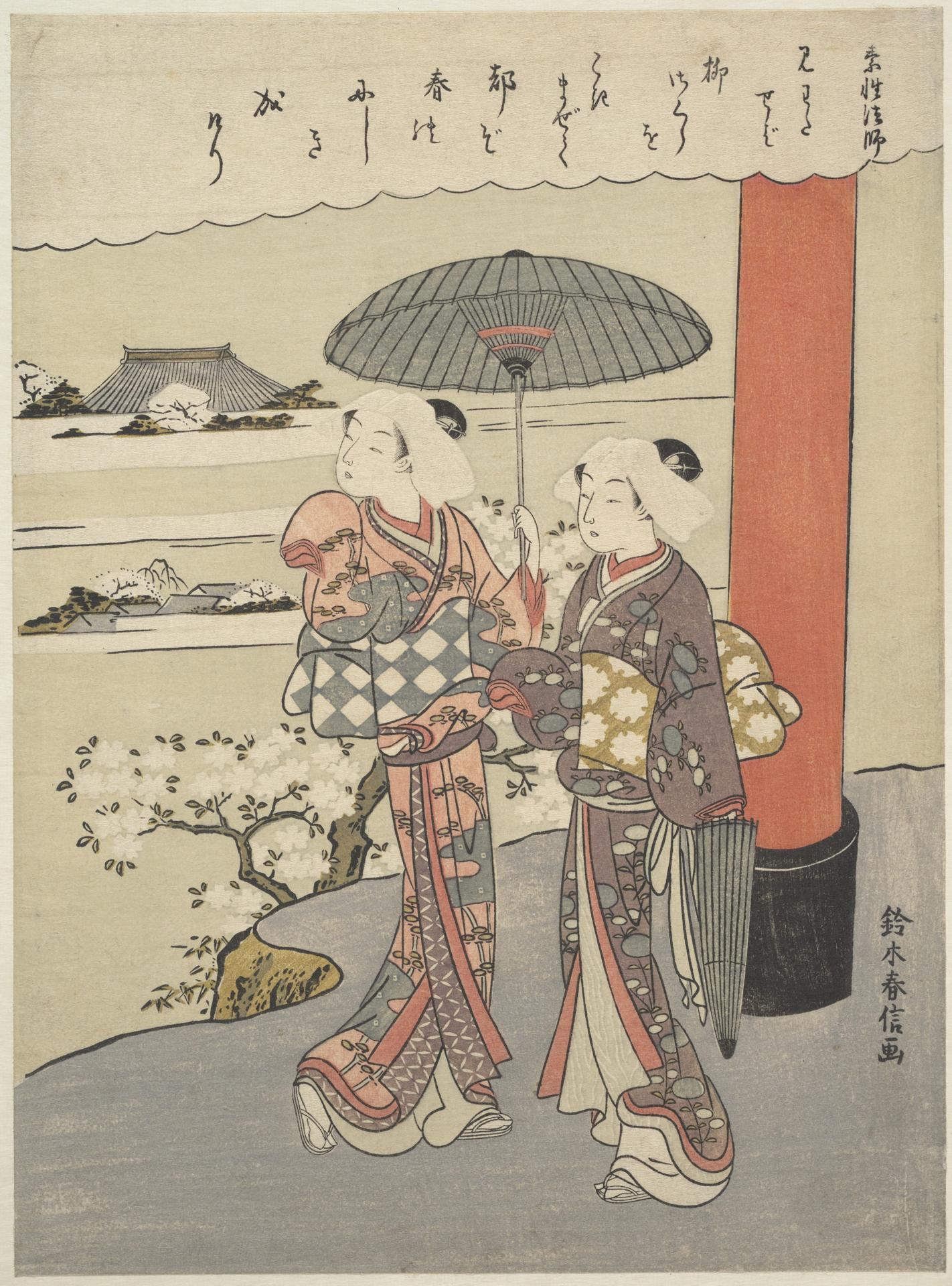
Poem by the Monk Sosei (act. 850-97)
Original title: Poem by the Monk Sosei (act. 850-97)
kurzbeschreibung
Two women in traditional dress stand beneath a wide parasol, with a building, trees, and a lake behind them. Suzuki Harunobu made this print around 1767–68 as a woodblock with ink and color on paper, enhanced by embossing (karazuri). Calligraphic characters refer to the poem by the monk Sosei.
Description
A broad black-and-white parasol stretches over two women on a path leading to a structure with a ring of red pillars. The left figure wears a kimono with a red-and-white checkered and striped pattern, the right one a blue-and-white kimono with flowers. Both have traditional shoes and white head coverings. Trees and a lake form the backdrop; above the parasol stand Chinese characters. The color palette remains mostly neutral, apart from the red pillars and the kimono patterns.
Context
This print belongs to the series Fūryū enpo (Elegant Pictures for Private Use), which Harunobu created in the 1760s. It refers to a poem by the monk Sosei from the anthology Hyakunin Isshu, a collection of one hundred poems. Harunobu is regarded as a pioneer of full-color woodblock printing (nishiki-e); this work was made in the chūban format, then common in private circles.
Impact
The scene feels quiet and intimate, with the figures embedded in everyday surroundings, giving the print a genre-like character. Restrained colors and the fine embossing create a subtle, tactile quality that invites close looking.
Technique
The print is a woodblock (moku-hanga) with ink and color on paper; embossing (karazuri) produces relief effects. Full-color printing (nishiki-e) allowed fine gradations of color, as seen in the kimono patterns. The embossing was applied without color to emphasize textures such as the parasol or textiles in relief.
AI-generated description text
Source: Metropolitan Museum of Art · Public Domain (CC0 1.0)