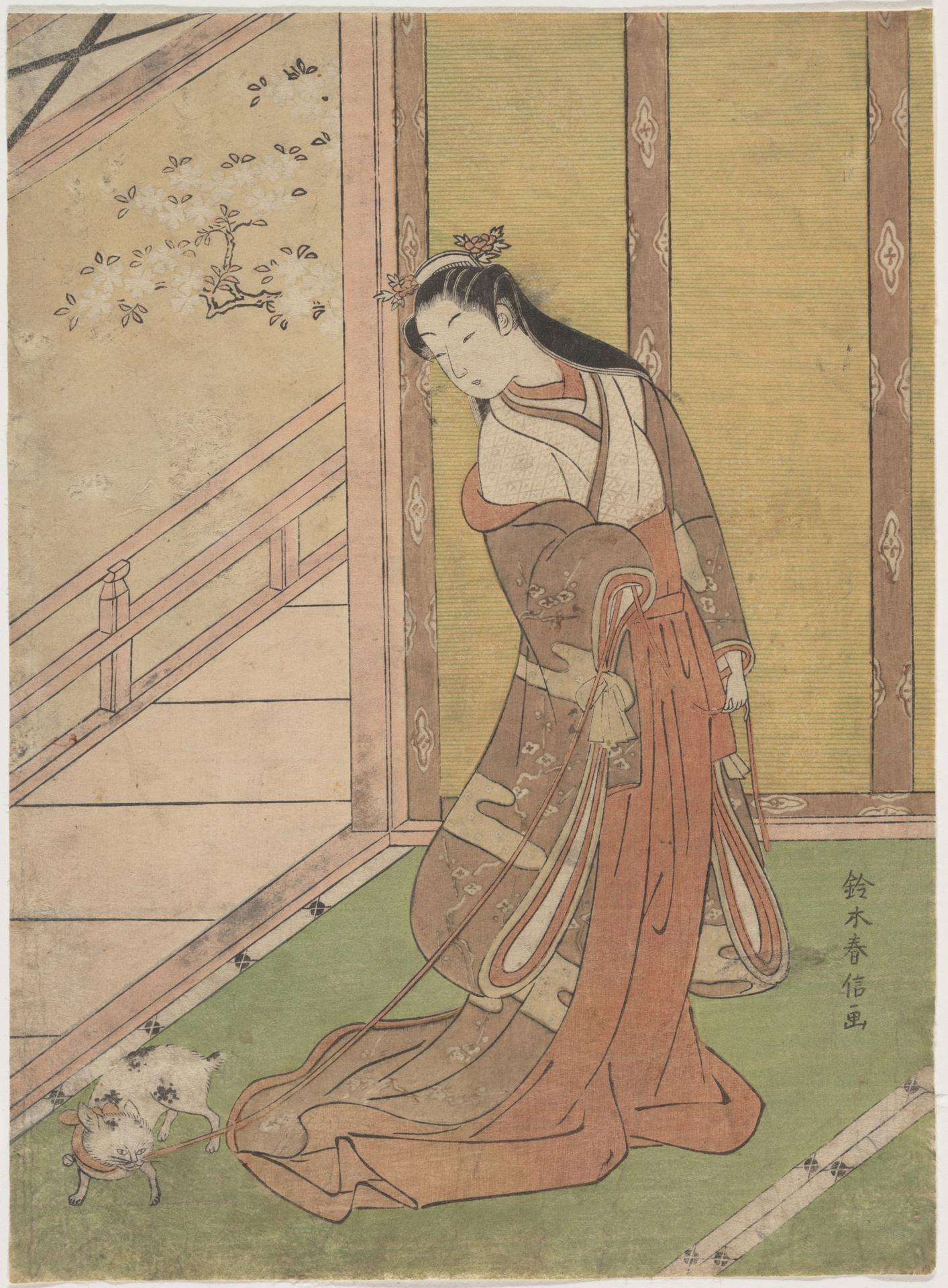
Onna San no Miya (the Third Princess)
Original title: Onna San no Miya (the Third Princess)
kurzbeschreibung
Unlike many of Harunobu's related prints, which place a single figure against an empty ground, this image sets the third princess within a specific architectural setting: a woman in traditional Japanese dress kneels on a staircase, her gaze lowered in thought. The color woodblock print on paper dates from around 1768–70.
Description
A long robe richly decorated in brown and red tones envelops the figure, with a veil falling over it; flowers adorn her upswept hair. Her downcast eyes create a pensive, almost worried expression. On the floor beside her lies a small white cat skin, which she seems to be holding. The layout is symmetrical, with the woman at the center; behind her run wooden railings and a wall with decorative elements, while at upper left a blossoming tree leans into the interior.
Context
Harunobu ranks among the most important ukiyo-e artists of the Edo period and is considered a pioneer of multicolor woodblock printing (nishiki-e). The third princess comes from the classic novel 'Genji Monogatari' (The Tale of Genji), a source often drawn on in Japanese art. Women in elegant robes and with emotional expression form a core motif in Harunobu's work, which addressed an urban audience in Edo, present-day Tokyo.
Impact
A quiet, melancholic mood emanates from the print; the lowered gaze and warm tones carry it. Precise lines and careful coloring give the scene a delicate, intimate atmosphere. The symmetrical arrangement and calm structure feel harmonious and at the same time reflective.
Technique
For this woodblock print, ink and color were transferred to paper. The multicolor printing that Harunobu brought to maturity allowed fine gradations and detailed reproduction. Clear contours and precisely applied colors distinguish the ukiyo-e prints of the Edo period.
AI-generated description text
Source: Metropolitan Museum of Art · Public Domain (CC0 1.0)