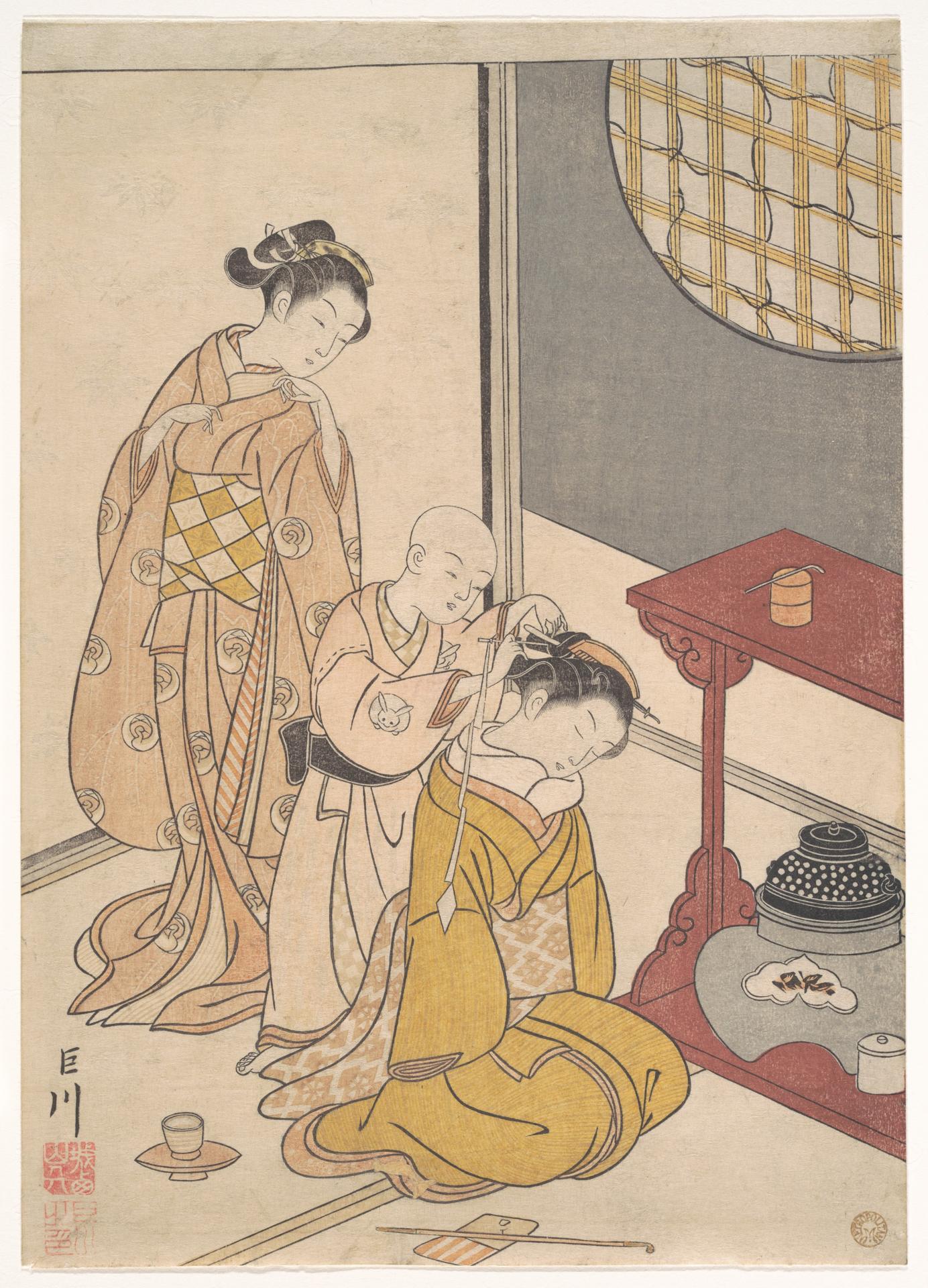
Night Rain at the Double-Shelf Stand, from the series Eight Parlor Views (Zashiki hakkei) (ca. 1766)
Original title: Night Rain at the Double-Shelf Stand, from the series Eight Parlor Views (Zashiki hakkei)
kurzbeschreibung
Suzuki Harunobu made "Night Rain at the Double Shelf" around 1766 as one sheet of his series Eight Views of the Living Room (Zashiki hakkei). This chuban-format colour woodblock print shows a woman having her hair combed by a boy while a second woman watches from behind. Ink and colours on paper.
Description
A seated woman in traditional Japanese dress fills the front half of the picture; a boy, also in traditional robes, stands close behind her and draws a comb through her hair. Set a little apart, a second woman observes the scene, a hairband around her head. The layout feels balanced, the figures placed centrally. Colours stay muted and warm, with beige, brown and gold; light falls evenly and hard contrasts are absent.
Context
The Zashiki hakkei series takes up the familiar tradition of the "eight views" (hakkei), which originally treated landscapes around Lake Biwa, and moves it into the bourgeois interior of the Edo period. Harunobu is regarded as a pioneer of the full-colour woodblock print (nishiki-e) and from the mid-1760s shaped the image of the idealised female figure. The first edition of this sheet dates from about 1766, when the artist had reached his mature phase. The series counts among the earliest examples to link everyday interior scenes with poetic titles.
Impact
A quiet, almost intimate mood runs through the sheet, carried by the balanced arrangement and the warm, muted colours. Because the light falls evenly and hard shadows are missing, a still, contemplative impression emerges. The viewer feels drawn into a private moment of daily life that is at once distant and close.
Technique
The print survives in its first edition, printed with ink and colours on paper. It measures 28.6 x 20.3 cm and corresponds to the chuban format (medium size). Clear, sharp lines and carefully applied areas of colour characterise the nishiki-e technique, which Harunobu helped to develop decisively.
AI-generated description text
Source: Metropolitan Museum of Art · Public Domain (CC0 1.0)