On the Veranda
Original title: On the Veranda
kurzbeschreibung
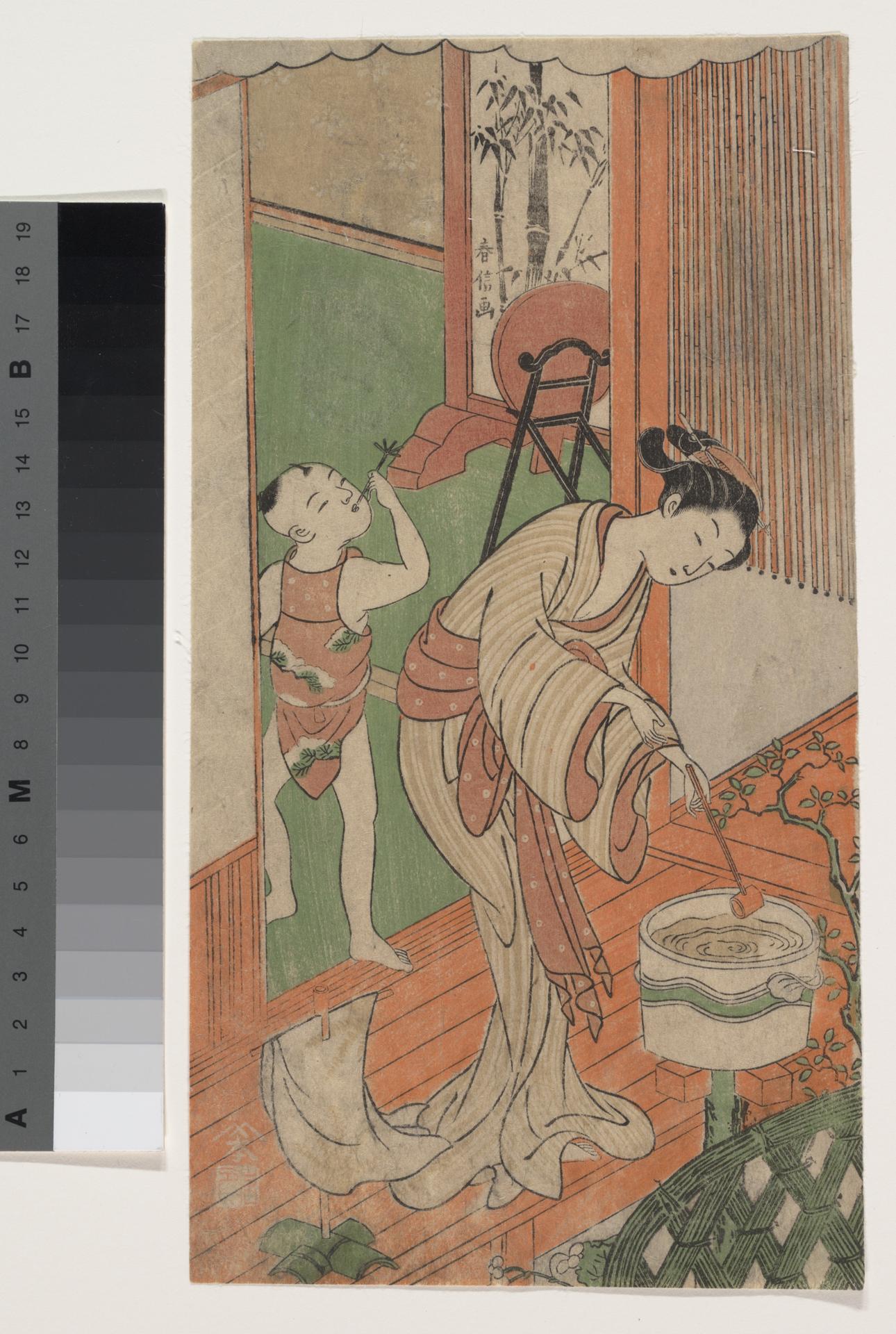
This print by Suzuki Harunobu, made in 1769 or 1770, stands out among related ukiyo-e sheets for the unusual weight it gives to the veranda itself. A woman and a boy appear in a domestic scene, rendered as a colour woodblock print in ink and colour on paper. The work captures an ordinary moment and belongs to the ukiyo-e genre.
Description
Where many prints of the period isolate their figures, this arrangement folds two people into a tight architectural frame: a woman kneels or sits turned toward a bowl with a spoon, while a boy stands before her and hands her something. She wears a wide traditional robe, the boy a plain one. Bamboo poles and a chair divide the space, a green wall and a wooden door close off the view. Earthy tones dominate, with green and red accents setting counterpoints. Light falls evenly, without hard shadows, marking the setting as an interior.
Context
Harunobu ranks among the defining artists of the Japanese colour woodblock print and is regarded as a pioneer of multicolour printing (nishiki-e). This motif arose in the late Edo period, when the urban bourgeoisie of Edo (present-day Tokyo) enjoyed a flowering of printmaking. Harunobu above all created scenes of daily life with young women and children, idealised in grace and simplicity. The veranda as a setting points to Japanese architecture, which lets inside and outside flow into one another.
Impact
A quiet, familiar mood emanates from this sheet, drawing the viewer into a private scene of everyday life. Clear lines and a harmonious range of colour give the image a timeless elegance and reveal Harunobu's high artistic quality. The slender vertical composition emphasises the figures' delicacy and creates a calm, almost poetic atmosphere.
Technique
To make the print, the motif was cut into several woodblocks and then transferred to paper in colour. Each colour required its own block, producing a multicolour print. Precise contours and finely graded tones attest to the craftsmanship typical of ukiyo-e production in that era.
AI-generated description text
Source: Metropolitan Museum of Art · Public Domain (CC0 1.0)