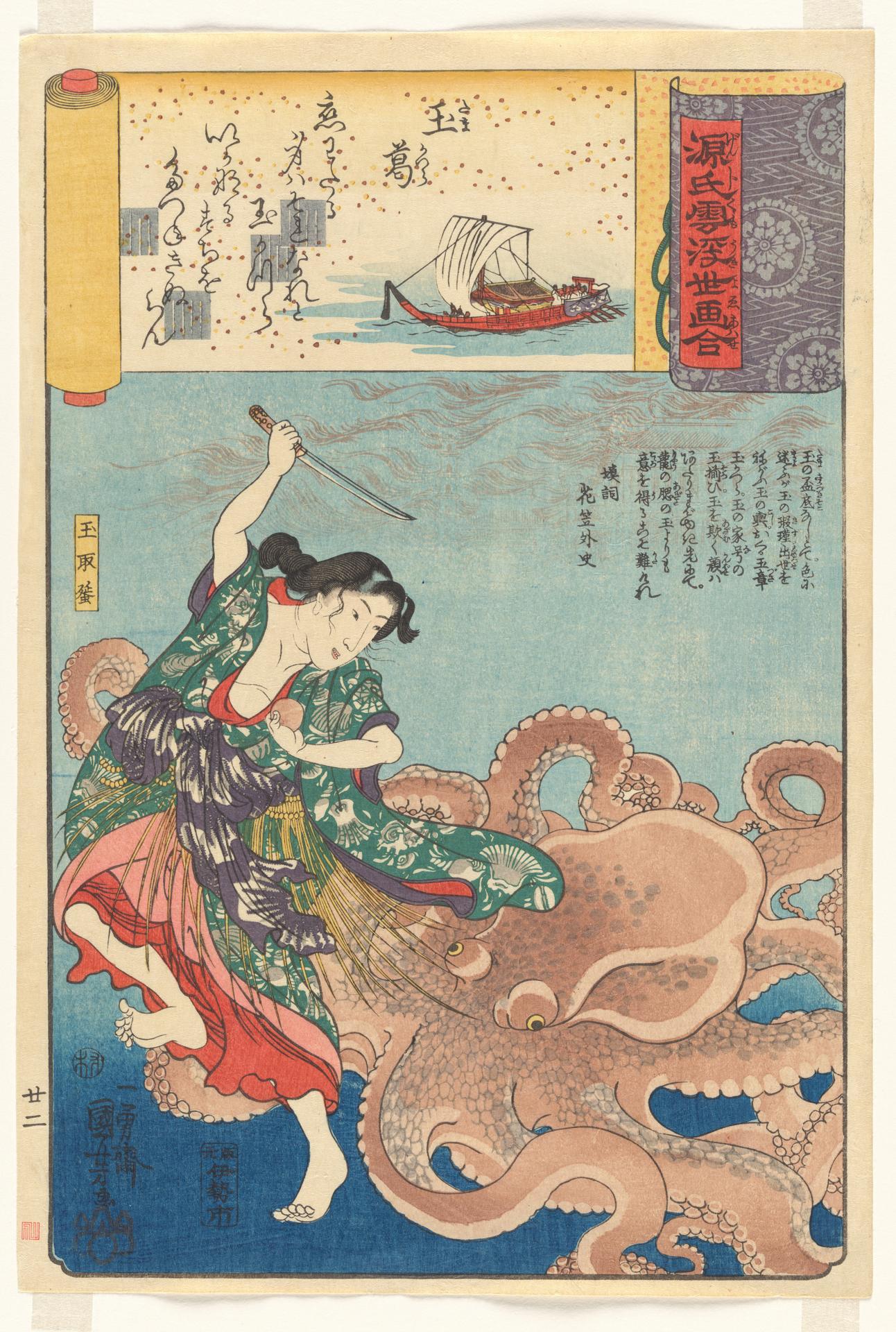
“A Lovely Garland” (Tamakazura): Tamatori-ama, from the series Scenes amid Genji Clouds Matched with Ukiyo-e Pictures (Genji-gumo ukiyo e-awase)
Original title: “‘A Lovely Garland’ (Tamakazura): Tamatori-ama,” from the series Scenes amid Genji Clouds Matched with Ukiyo-e Pictures (Genji-gumo ukiyo e-awase)
kurzbeschreibung
The pearl diver Tamakazura, known here as Tamatori-ama, wrestles with an octopus—a motif from the legend of the stolen pearl. Utagawa Kuniyoshi made this print in 1845–46 for the series Genji-gumo ukiyo-e-awase (Genji Clouds, Paired with Ukiyo-e Pictures). It is a vertical ōban color woodblock print (nishiki-e), printed with ink and color on paper.
Description
A woman in traditional Japanese dress fends off a large pink octopus with a sword in her right hand. Her upright stance and outstretched arms and legs convey fighting energy. Behind her opens a sea scene with a boat whose striking sail has the shape of a flower. Red, blue, and green dominate the lively, high-contrast palette. The layout is clear: figure and octopus command the foreground.
Context
The series Genji-gumo ukiyo-e-awase links scenes from the classic novel Genji Monogatari with contemporary ukiyo-e motifs and was very popular in Edo in the 1840s. Tamatori-ama is a legendary pearl diver who in a well-known tale retrieves a pearl from the hall of the dragon palace and is pursued by a dragon; Kuniyoshi replaces the dragon with an octopus. The print was made in the late Edo period, a phase when ukiyo-e artists increasingly tried experimental subjects and figures. Kuniyoshi was famous for his depictions of heroes, legends, and supernatural beings. The work belongs to a series that combined classical literature with popular visual art.
Impact
Dramatic energy emanates from this scene, and the unusual opponent—the octopus—makes it seem both threatening and bizarre. Strong colors and clear lines give the print an immediate visual presence that draws the viewer into the action. Heroism and fantasy merge into a distinctive, memorable aesthetic.
Technique
For this woodblock print in the nishiki-e technique, several color blocks were used to achieve the varied tones. The contours were printed in black ink, the colors applied in clear areas. Finest details—for example in the figure's garment and in the octopus's tentacles—attest to the high precision of the printing.
AI-generated description text
Source: Metropolitan Museum of Art · Public Domain (CC0 1.0)