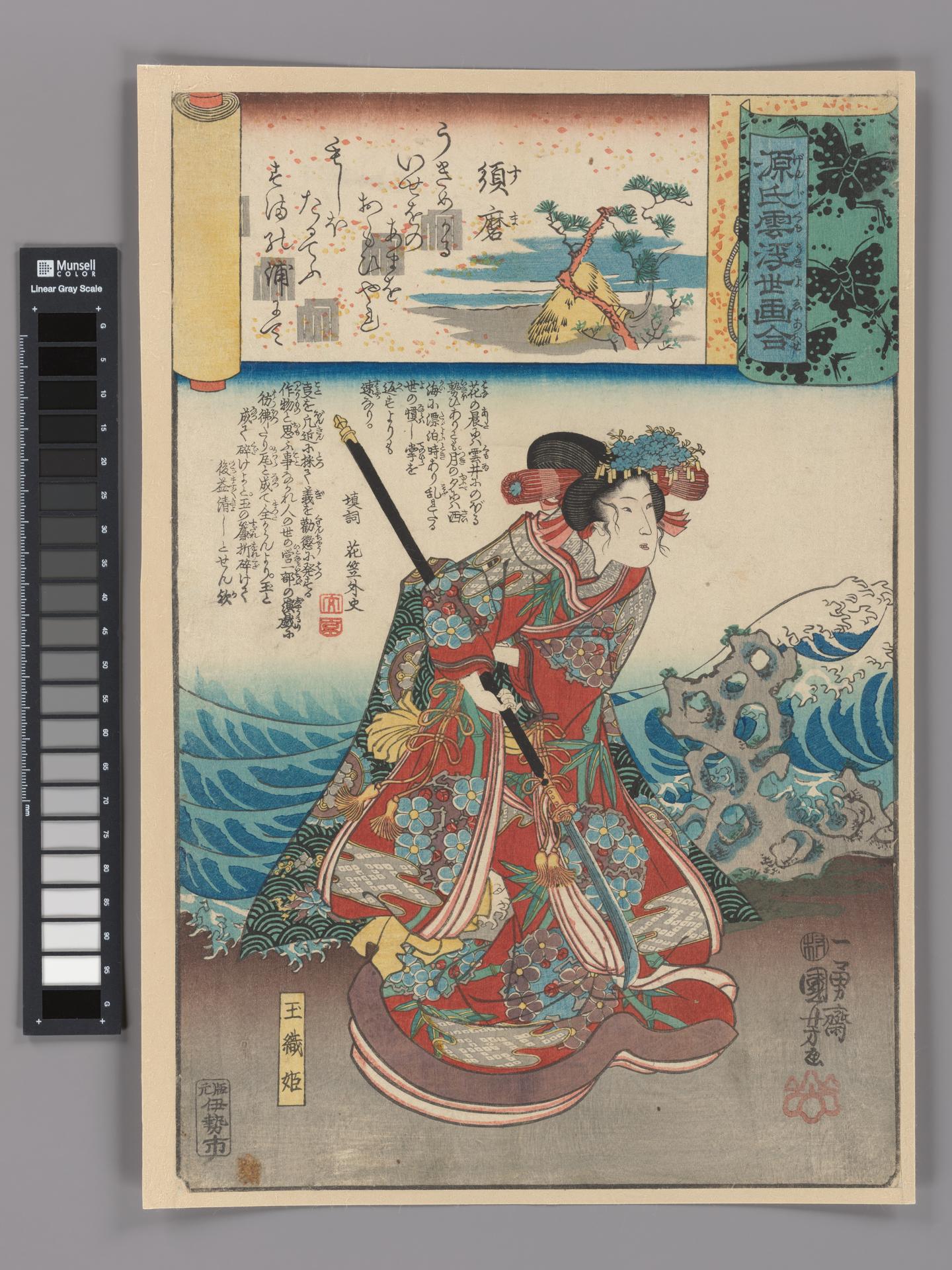
“Exile to Suma” (Suma): Tamaori-hime
Original title: “‘Exile to Suma’ (Suma): Tamaori-hime,” from the series Scenes amid Genji Clouds Matched with Ukiyo-e Pictures (Genji-gumo ukiyo e-awase)
kurzbeschreibung
Unlike the other sheets in its series, this colour woodblock by Utagawa Kuniyoshi, made between roughly 1845 and 1861, gives the spotlight to Tamaori-hime, a female figure connected with the world of the Genji story, dressed in an elaborately ornamented kimono. The print belongs to the sequence Genji-gumo ukiyo e-awase, which braids scenes from the classical Tale of Genji together with motifs from contemporary ukiyo-e. It was issued in ōban format as a nishiki-e, a woodblock printed in several colours.
Description
A woman in traditional Japanese dress steps forward, her costume built from red, blue and white and richly worked with ornament; a staff or weapon rests in her hand. Behind her open waves, a wooded landscape and a mountain. Tones are bright, as ukiyo-e prints tend to be, and figure and landscape are set against each other in calm balance. Japanese characters are scattered over several parts of the sheet, at the margin as well as in the rear, presumably as a title or explanatory inscriptions.
Context
Kuniyoshi ranks among the most distinctive ukiyo-e artists of the Edo period, known above all for history pictures and prints after literary material. The series Genji-gumo ukiyo e-awase appeared between the 1840s and 1860s, a time when engagement with the Tale of Genji was widespread in Japan. Pairing classical scenes with contemporary ukiyo-e motifs was a common device for bringing traditional material closer to a broad public.
Impact
What carries the print is its luminous colour and the exacting account of the kimono, which draws the eye to the figure. The quiet landscape behind is answered by the woman's commanding stance, and from that contrast comes atmospheric depth. Overall an elegant, narrative mood arises, characteristic of Kuniyoshi's handling of literary sources.
Technique
Several colour blocks were used for printing, as the nishiki-e technique in ōban format requires. Ink and colours were laid on paper, the colours applied in successive layers to achieve fine gradations. Precise contours and flat areas of colour accord with nineteenth-century Japanese woodblock practice.
AI-generated description text
Source: Metropolitan Museum of Art · Public Domain (CC0 1.0)