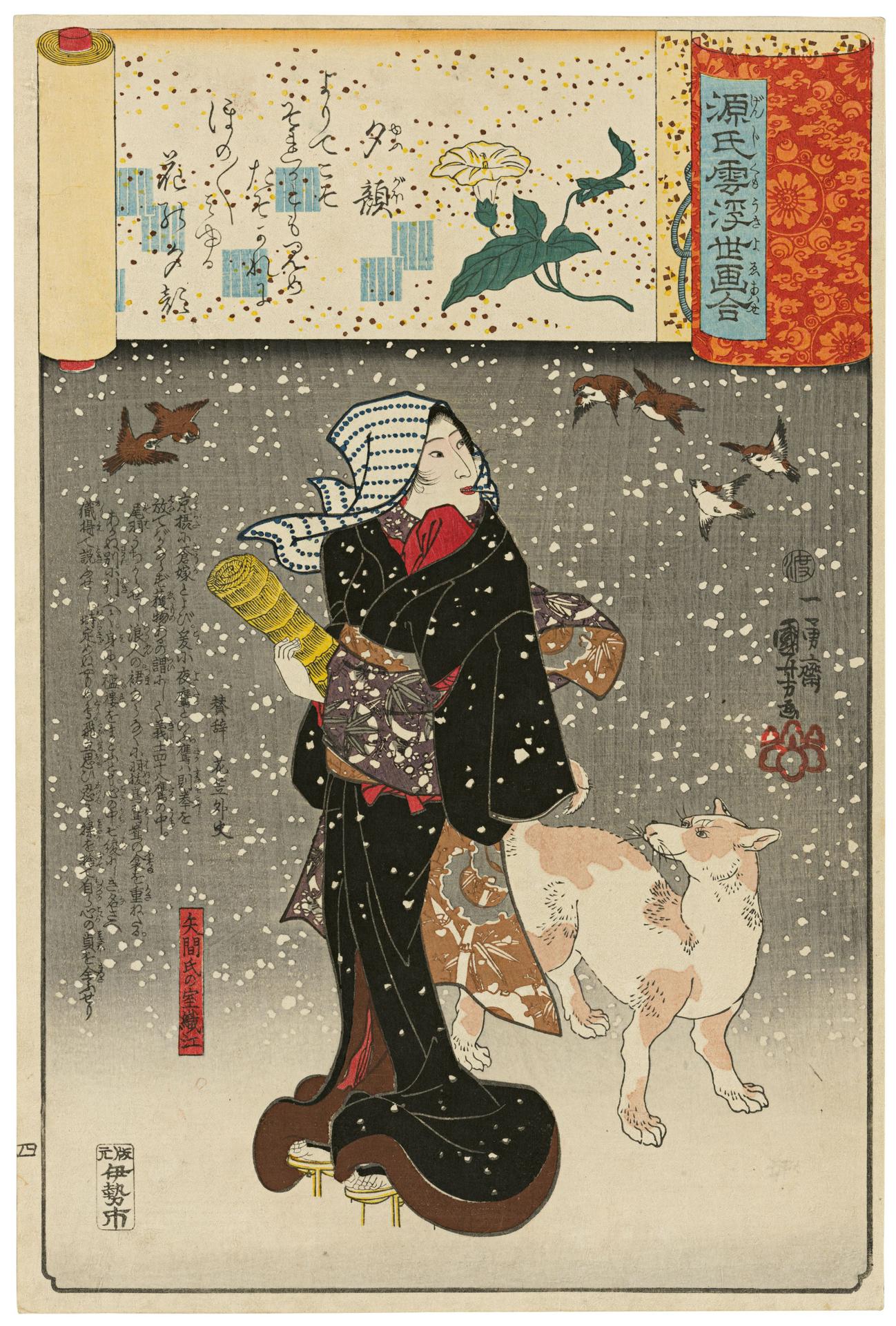
Lady of the Evening Faces (Yūgao): Yazama's Wife Orie (Yazama-shi no shitsu Orie), from the series Scenes amid Genji Clouds Matched with Ukiyo-e Pictures (Genji-gumo ukiyo e-awase)
Original title: ''‘Lady of the Evening Faces’ (Yūgao): Yazama’s Wife Orie (Yazama-shi no shitsu Orie),” from the series Scenes amid Genji Clouds Matched with Ukiyo-e Pictures (Genji-gumo ukiyo e-awase)
kurzbeschreibung
A colour woodblock print by Utagawa Kuniyoshi, made in 1845–46 as part of the series Genji-gumo ukiyo e-awase. On this ōban sheet (35.6 × 23.3 cm), a woman appears on a wooden bridge in a wintry setting, accompanied by a dog; snowflakes are falling.
Description
Above a headscarf sits the woman's gaze; she wears a red blouse and a black coat, and her right hand holds a yellow fan. She stands on the wooden bridge while a dog beside her turns to the left. Snowflakes are scattered across the ground, and from a window at upper left a bunch with a plant hangs down. A red frame with floral patterns surrounds the image, and at the top characters and a red banner complete the sheet.
Context
The series links scenes from the classic novel Genji Monogatari with contemporary ukiyo-e motifs. Kuniyoshi worked on this sheet in the late Edo period, when literary allusions and depictions of everyday life often came together. The reference to Yūgao (evening face) points to a chapter of the Genji novel, which is here associated with a woman named Orie.
Impact
Snowflakes and the restrained palette of black, red and yellow carry the wintry mood. The calm layout with bridge and dog conveys a contemplative atmosphere, which the ornamental frame further enhances.
Technique
Printed as a nishiki-e ōban sheet in ink and colour on paper, as ukiyo-e production prescribed. Several woodblocks brought the colours onto the sheet one after another; fine lines and area patterns lie precisely over one another. Hatching and tonal values reveal how contours and colour areas work together in the print.
AI-generated description text
Source: Metropolitan Museum of Art · Public Domain (CC0 1.0)