A Child’s Mirror of the Twenty-four Paragons of Filial Piety: Yang Xiang (Yō Kō)
Original title: Yang Xiang (Yō Kō), from the series A Child’s Mirror of the Twenty-four Paragons of Filial Piety (Nijūshi kō dōji kagami)
kurzbeschreibung
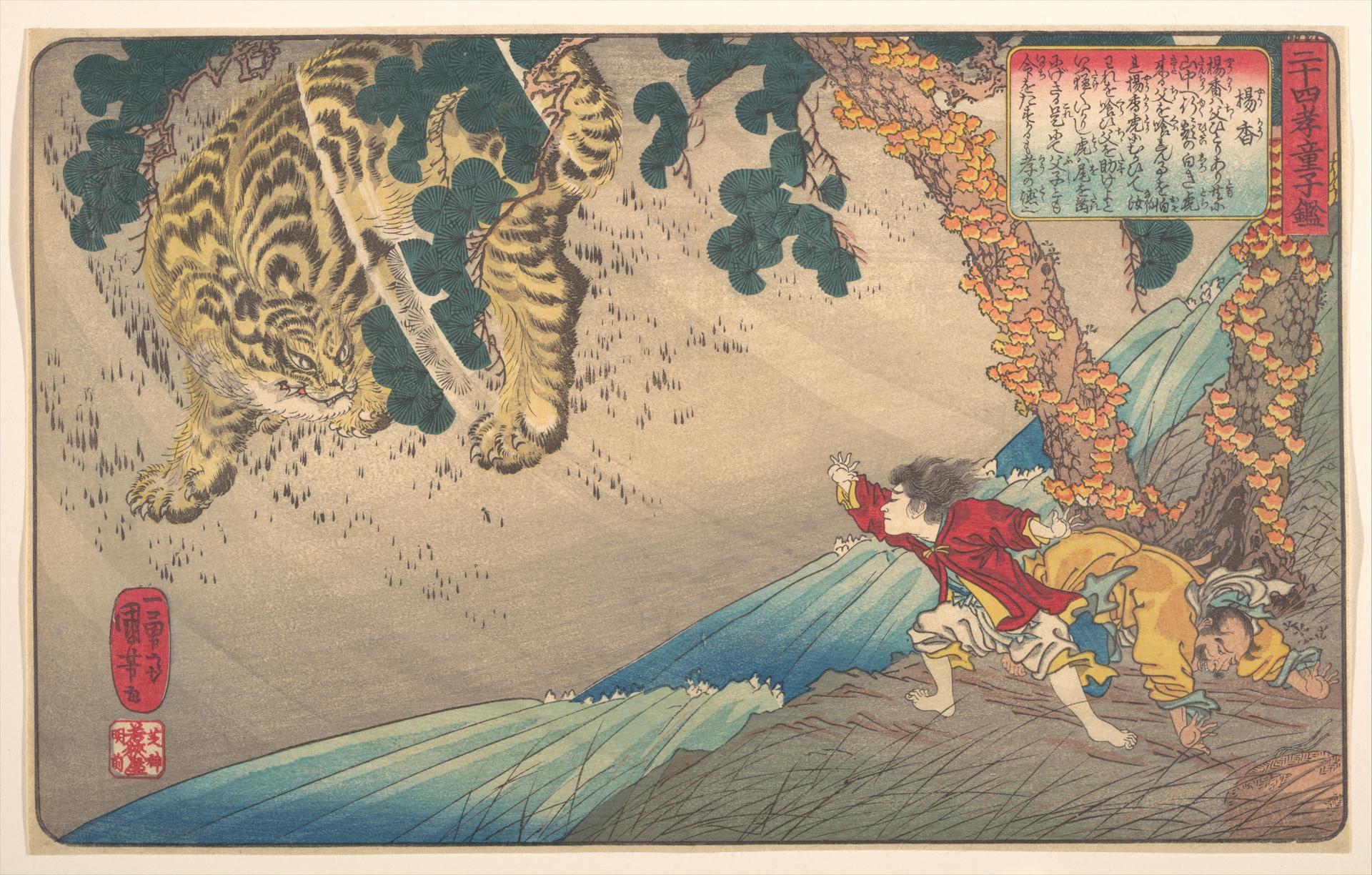
Unlike many sheets in the series, this colour woodblock print by Utagawa Kuniyoshi, made around 1843, foregrounds not an act of piety but a moment of danger: two figures flee through a forest from a tiger. Kuniyoshi thus tells the story of Yang Xiang, included in the set 'A Child's Mirror of the Twenty-four Paragons of Filial Piety'. The print is executed in ink and colour on paper.
Description
A large tiger, poised mid-leap, dominates the centre of the image, with two people in traditional Chinese dress close behind, their posture betraying shock and fear. Trees and dense undergrowth form the setting, placing the action outdoors. A text panel with Chinese characters on the right supplements the narrative. Blue, green and brown define the colour harmony, echoing the tones of the landscape; contours stand out clearly and the colour areas lie evenly, as is usual for ukiyo-e printing.
Context
The series 'A Child's Mirror of the Twenty-four Paragons of Filial Piety' (Nijūshi kō dōji kagami) examines the Confucian virtue of filial piety through 24 exemplary tales. Kuniyoshi worked on this sheet in the late Edo period, a phase in which woodblock prints circulated widely in Japan and moral and historical subjects found a receptive audience. The legend of Yang Xiang originates in China and was adopted in Japan. With the title 'Child's Mirror', the series clearly also addresses a younger public.
Impact
The tiger's leap and the frightened faces of the fugitives create an immediate tension. Set against this is the calm, even colouring, and the clear layout orders the dramatic action. From the contrast between violent movement and still surface, the print draws its appeal and pulls the viewer's gaze into the scene.
Technique
The sheet was produced by woodblock printing: the design is cut into wooden blocks, which are inked and pressed onto paper using ink and colour. To achieve such nuanced blues, greens and browns, several printing passes had to be precisely aligned; only thus did the fine details and gradations of shading emerge.
AI-generated description text
Source: Metropolitan Museum of Art · Public Domain (CC0 1.0)