Book of Humorous Poems (Kyōka shū)
Original title: Book of Humorous Poems (Kyōka shū) 狂歌集
kurzbeschreibung
Utagawa Kuniyoshi, one of the leading figures of the ukiyo-e tradition, produced the illustrated book Buch humorvoller Gedichte (Kyōka shū). It carries no date and is executed in ink on paper, measuring 8 5/8 × 6 × 3/4 inches (21.9 × 15.2 × 1.9 cm). In this volume, playful kyōka poems are paired with accompanying pictures that take up subjects typical of ukiyo-e art.
Description
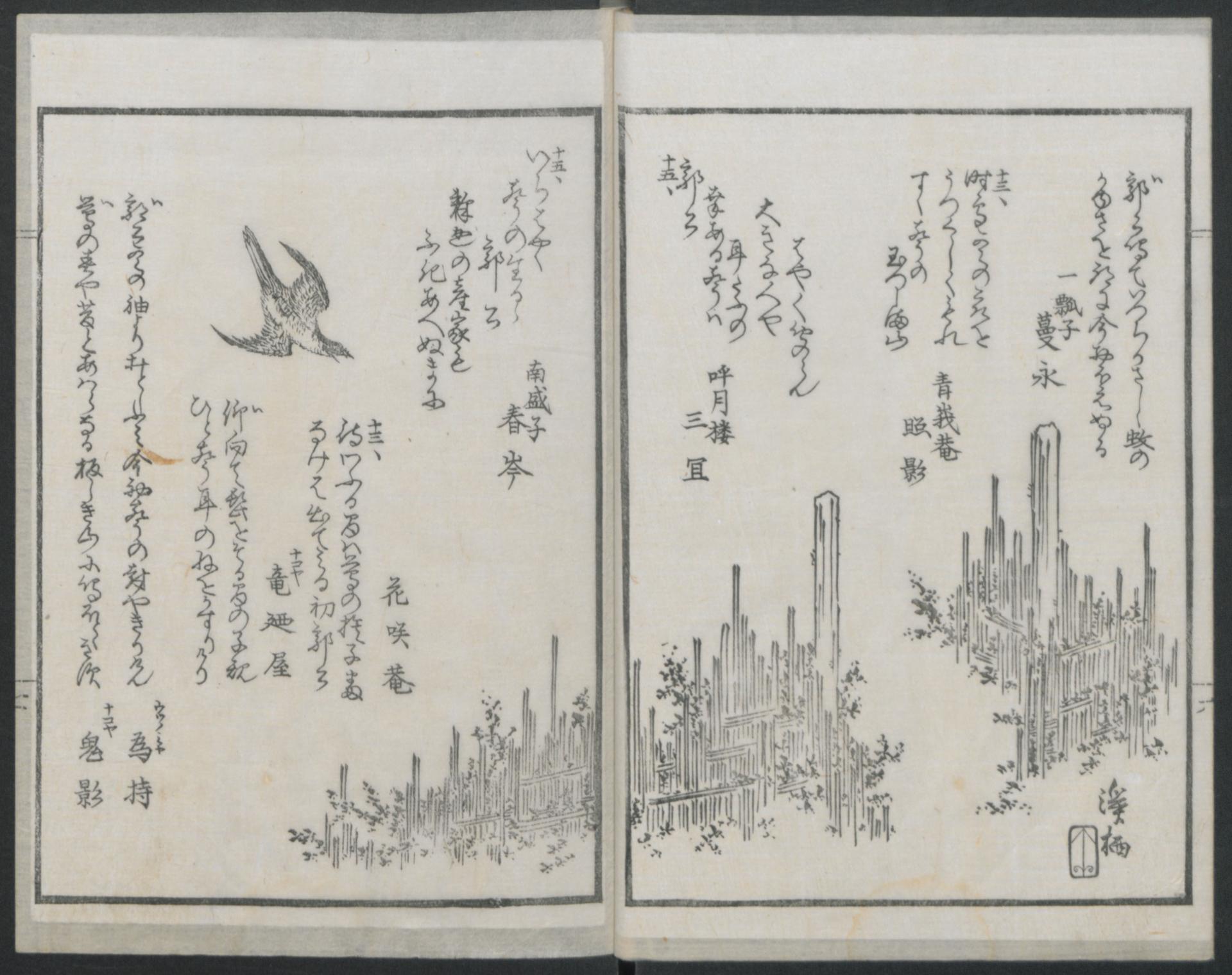
The open double-page spread holds two separate motifs arranged symmetrically. On the left, in the smaller field, a small bird flies against a ground of abstract strokes and plant forms. To the right, larger, stand thin vertical trunks recalling bamboo, with drooping leaves that suggest a wooded setting. In each case the poem texts sit at the middle of the image, framing the main motifs. The whole view remains in black and white, drawn with detailed strokes of varying strength.
Context
Kuniyoshi ranks among the important artists of the nineteenth-century ukiyo-e school, known for unconventional and often comic inventions. Kyōka, a genre of humorous poetry, was hugely popular with the urban public of the Edo period and frequently appeared in illustrated books. Such editions joined literary entertainment to the visual arts and addressed a broad, educated audience. No exact date of production is recorded for this work, yet it fits within Kuniyoshi's output, in which he repeatedly illustrated literary material.
Impact
The restrained black-and-white scheme directs attention to the precise lines and the balanced relation of the two picture fields. Setting the delicate bird drawing against the sturdy bamboo trunks creates a quiet, reflective mood. Because image and text work together, the viewer can connect the jesting poems with the visual scenes and savour the sheet's double meanings.
Technique
The work is executed as an ink drawing on paper, as is common in Japanese art. Line thickness varies, allowing precise rendering of both motifs and writing. It is a print that stays black and white, without further colour pigments.
AI-generated description text
Source: Metropolitan Museum of Art · Public Domain (CC0 1.0)