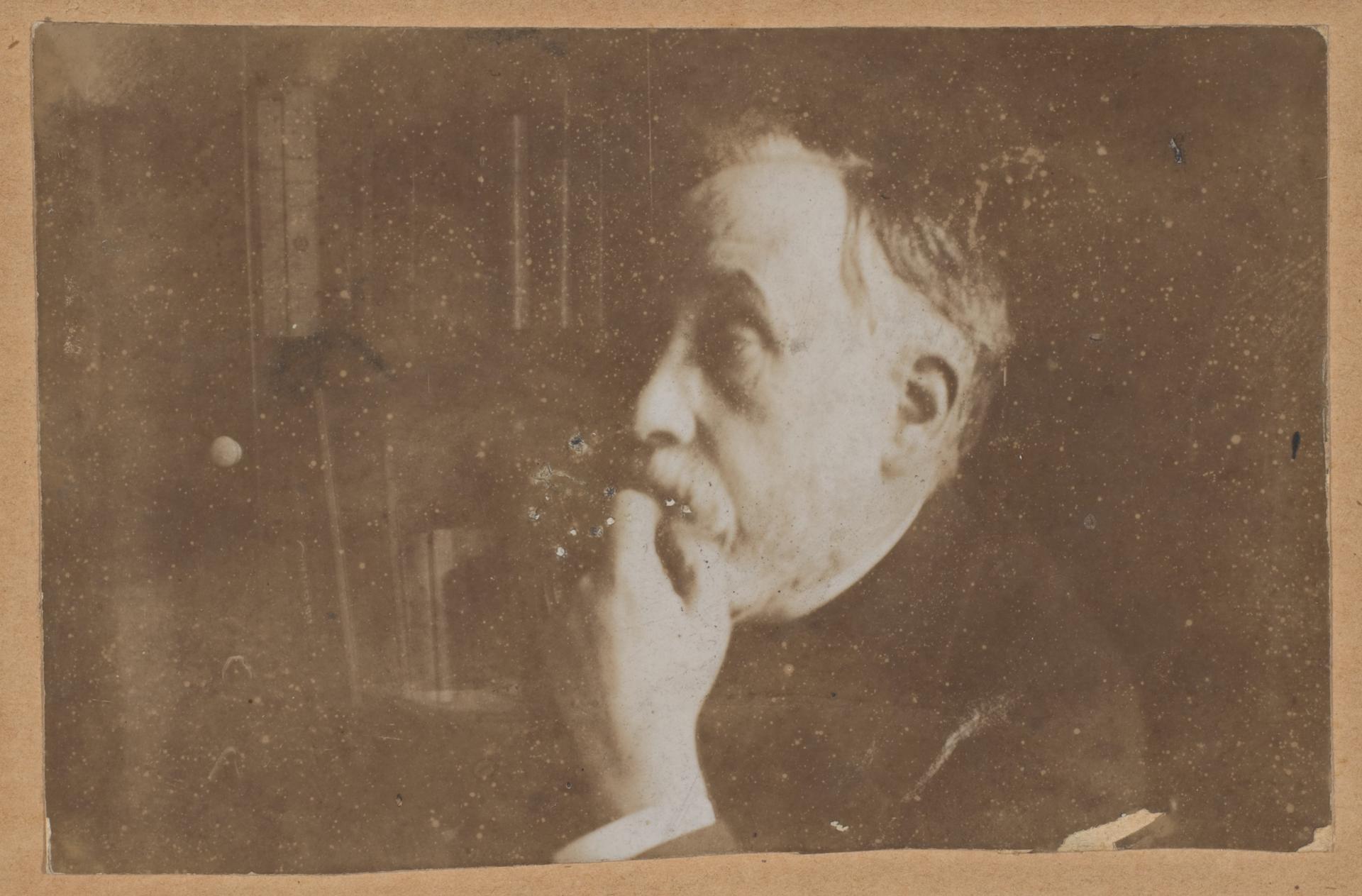
Self-Portrait in Library (Hand to Chin)
Original title: [Self-Portrait in Library (Hand to Chin)]
kurzbeschreibung
Unlike many 19th-century self-portraits that place the artist in the studio before an easel, Edgar Degas here situates himself in a library. The photograph was probably taken in 1895 and survives as a gelatin silver print, a process Degas used for photographic experiments in his later years. At only 5.8 by 8.7 cm, the sheet is very small, which reinforces the private, withdrawn character of the image.
Description
A man appears in half-profile, his head turned to the side so that only part of his face remains visible. His right hand supports his chin, his hair is combed tightly back, and a shirt is discernible on his upper body. Behind him, bookshelves blur, and a table may be suggested among them. The surface of the print looks slightly abraded, with small stains and wear along the edges.
Context
In the 1890s Degas began to engage with photography, experimenting with exposure and composition. This self-portrait was likely made in his studio, which also served as his library. The out-of-focus shelves point to this intellectual setting. The small format and casual pose suggest the print was not intended for an audience.
Impact
The turned head and hand at the chin give the image a pensive, almost detached expression. Because the background remains blurred, the artist's facial features stand out more strongly. The signs of wear on the paper lend the sheet a historical aura and emphasize that it is a personal document.
Technique
A gelatin silver print was used, in which silver halides are made light-sensitive in a gelatin layer — a modern process for the time. The small dimensions suggest a contact print from the negative. Stains and abrasions are among the typical signs of aging in such materials.
AI-generated description text
Source: Metropolitan Museum of Art · Public Domain (CC0 1.0)