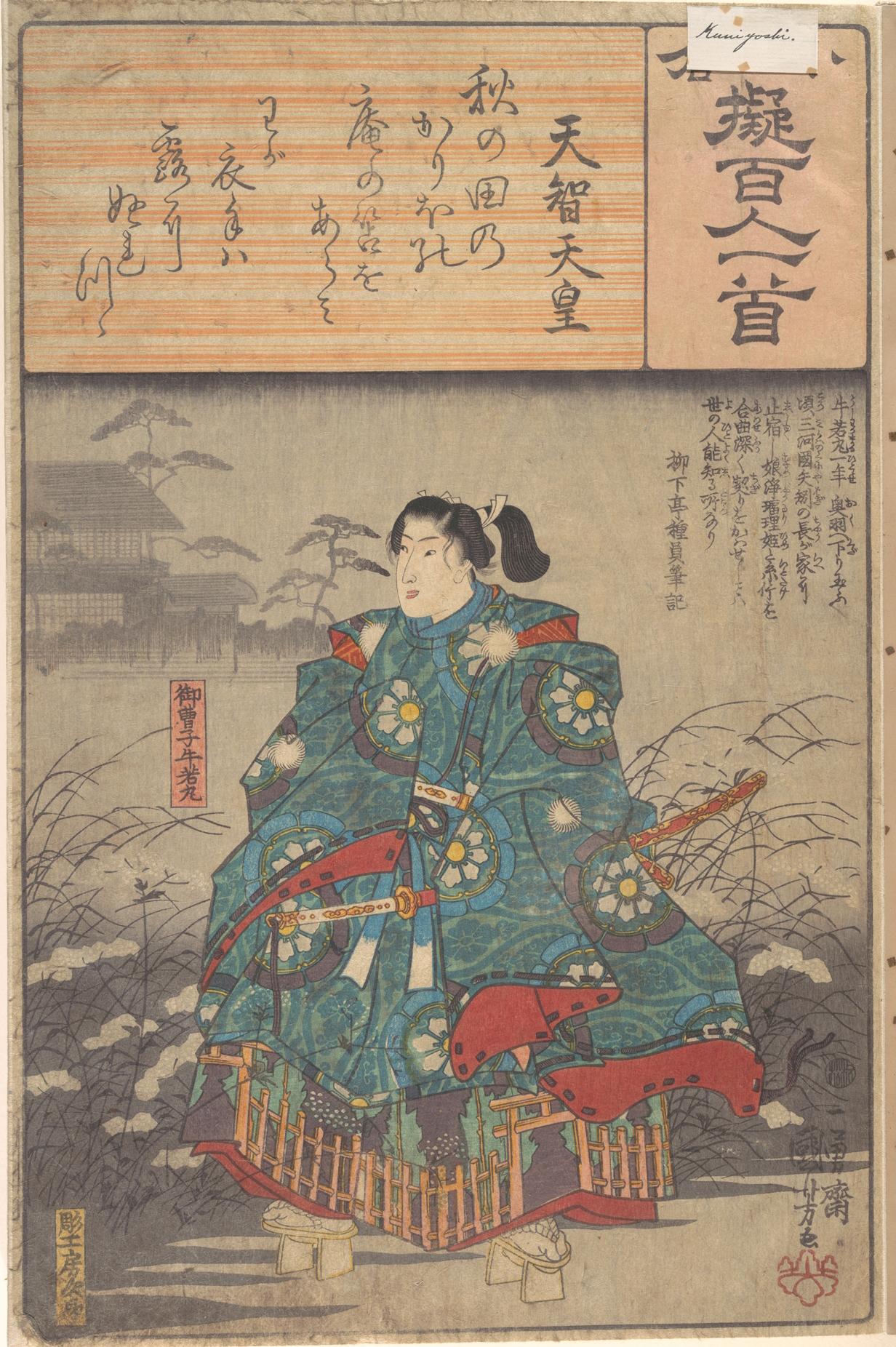
Album of Eighty-eight Prints from the series Ogura Imitations of One Hundred Poems by One Hundred Poets (Ogura nazorae hyakunin isshu)
Original title: Album of Eighty-eight Prints from the series Ogura Imitations of One Hundred Poems by One Hundred Poets (Ogura nazorae hyakunin isshu)
kurzbeschreibung
Utagawa Hiroshige assembled this album around 1845–48, bringing together 88 color woodblock prints in ink and color on paper. The starting point is the classical anthology One Hundred Poems by One Hundred Poets, and each sheet calls up a moment from one of the verses.
Description
A figure in bright traditional dress sits on a wooden platform, a floral pattern across the robe and a sword at the side. Japanese buildings and trees rise behind, and the layout holds a near-symmetrical balance, the seated person acting as the still point. Strong colors play against the quieter surroundings, while light falls evenly in the manner typical of the woodblock print. Calligraphy and blocks of text frame the page and carry the poem it belongs to.
Context
The series dates from the late Edo period, when ukiyo-e prints circulated widely. Hiroshige took up the Hyakunin Isshu, a favorite reference for artists, and recast its poems in fresh images. Gathering the sheets as an album of 88 prints suggests a selection or arrangement drawn from the original hundred. The publisher's mark points to the workshop of Uoya Eikichi.
Impact
Order and luminous color define these sheets and sit squarely within Hiroshige's manner. Word and image enter into a dialogue that leaves every page calm and poetic. Opening the album draws the reader into the world of classical Japanese verse.
Technique
The method is color woodblock printing, or nishiki-e, with several blocks used for the different colors. Ink and pigment were laid onto the paper in successive layers. Crisp lines and exact color registration testify to the high craft of Japanese printmaking.
AI-generated description text
Source: Metropolitan Museum of Art · Public Domain (CC0 1.0)