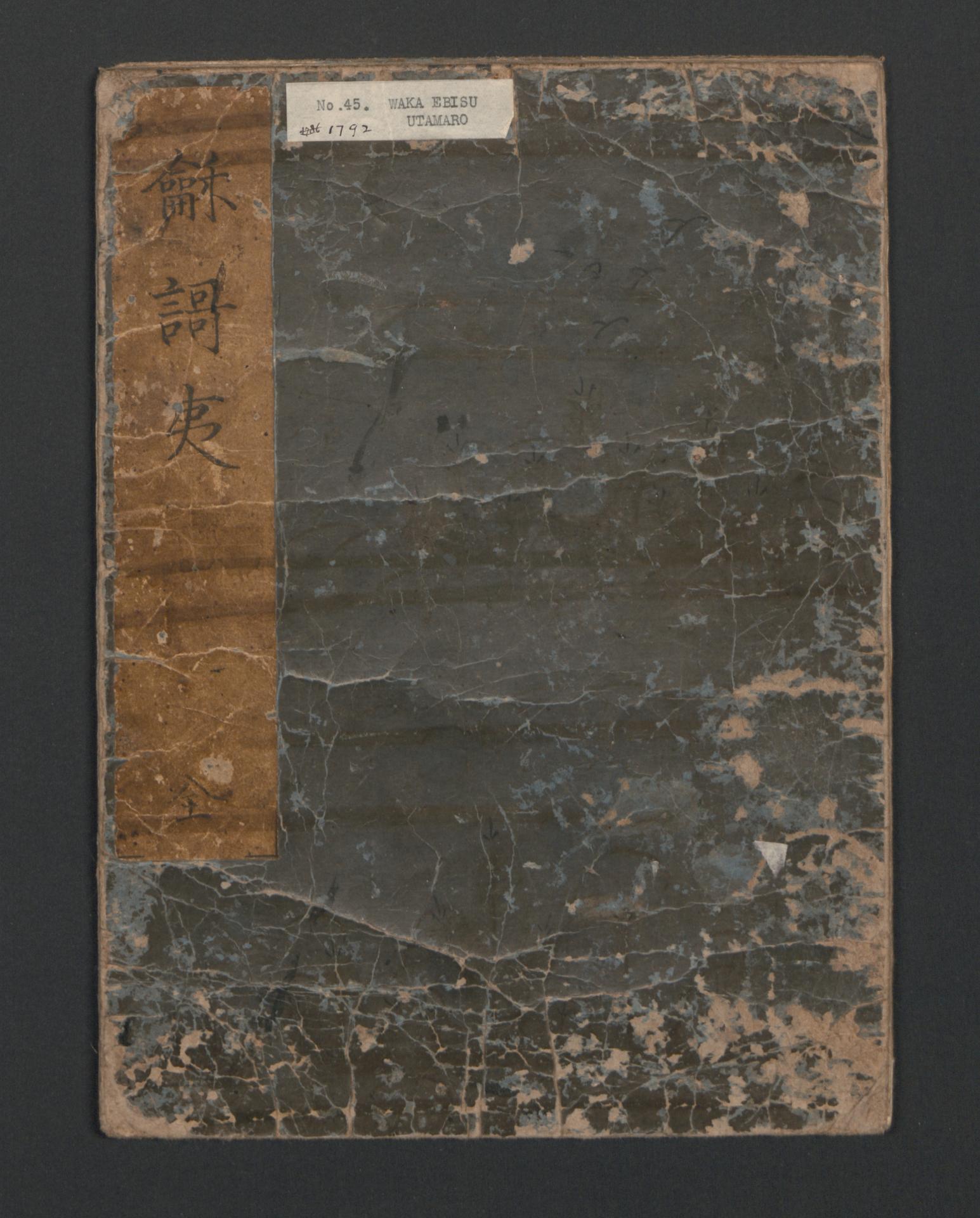
Picture Book with Playful Poems for the Young God Ebisu (Ehon waka Ebisu)
Original title: Picture Book with Playful Poems for the Young God Ebisu (Ehon waka Ebisu) 絵本龢謌夷
kurzbeschreibung
Where most images of Edo give us full-length figures, this title page turns to an illustrated woodblock-printed book by Kitagawa Utamaro from 1792. Ink and colour on paper, printed in polychrome, it sets out the work's title and the artist's name in traditional Japanese lettering.
Description
A dark, almost black ground takes up most of the sheet, which shows clear signs of wear. Down the left side runs a vertical golden strip bearing black characters that give the book's title. A small label at the top carries the number "No.45", the title "WAKA EBISU" and the name "UTAMARO". The arrangement stays spare; there are no figures and no action to be seen.
Context
The book appeared in 1792, in the late Edo period, when Japanese woodblock printing was flourishing. Utamaro made his name with pictures of women, but he also produced illustrated books (ehon). The young god Ebisu belongs to the circle of the Seven Lucky Gods of Japanese mythology. The work was aimed at a broad public and joined image with poetry.
Impact
The dark, golden title page gives off a refined and at the same time restrained note. Traces of wear lend the object a historical aura and underline its authenticity.
Technique
The book was made by woodblock printing with several layers of colour. What we have is a polychrome print in ink and colour on paper, of the kind characteristic of eighteenth-century ukiyo-e prints.
AI-generated description text
Source: Metropolitan Museum of Art · Public Domain (CC0 1.0)