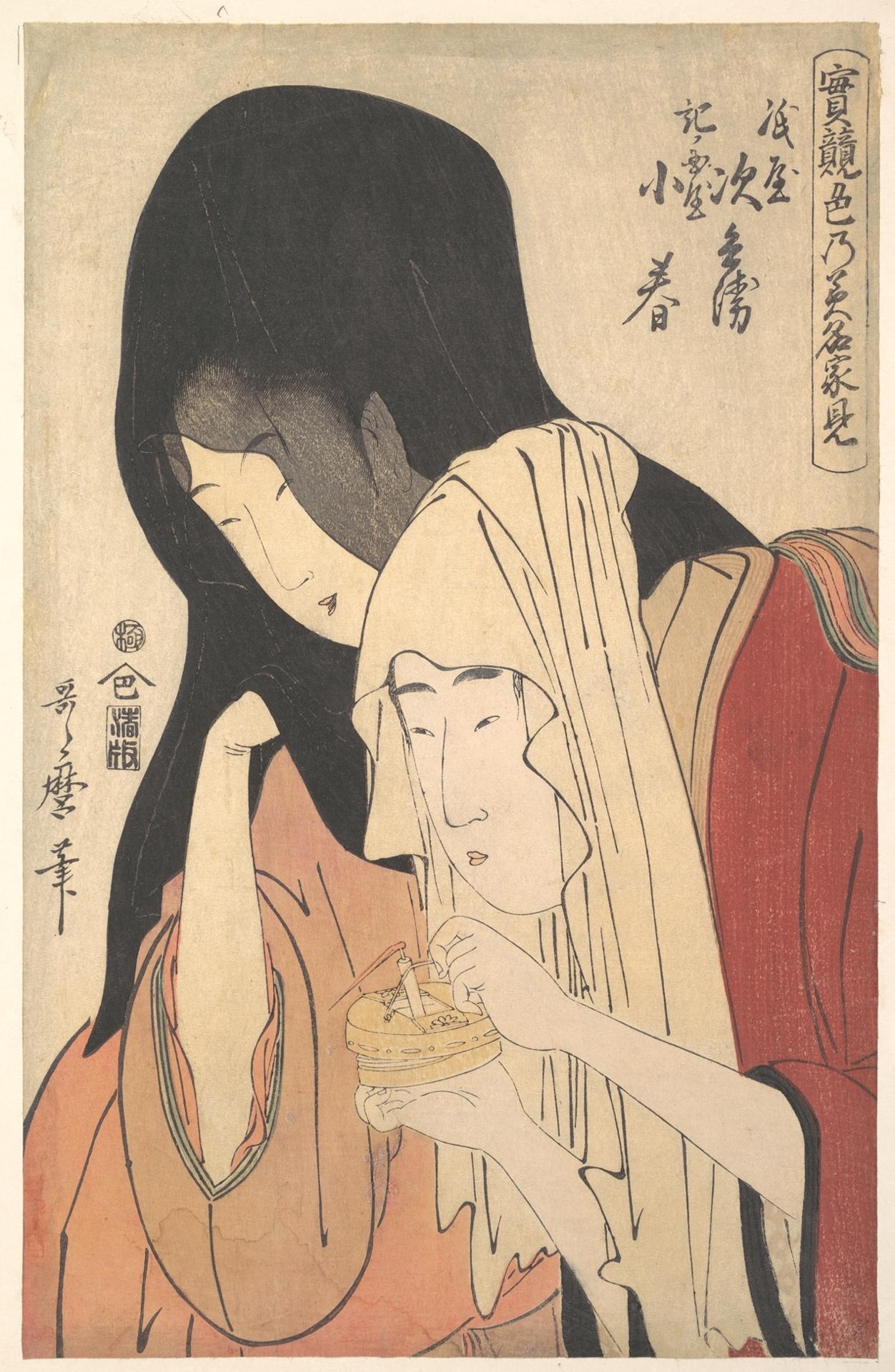
Jihei of Kamiya Eloping with the Geisha Koharu of Kinokuniya, from the series "True Feelings Compared: The Founts of Love"
Original title: Jihei of Kamiya Eloping with the Geisha Koharu of Kinokuniya, from the series “True Feelings Compared: The Founts of Love” (Jitsu kurabe iro no Minakami)
kurzbeschreibung
Kitagawa Utamaro's color woodblock print, from the series 'True Feelings Compared: The Sources of Love', dates to around 1798–99. It shows two figures in traditional Japanese dress: a woman with long dark hair and another who carries a bowl. The subject draws on a love story from the theater of the day.
Description
The layout is weighted unevenly: the left half is dominated by the dark hair of the figure on the left, while the second person stands in the middle holding a bowl. Reds, oranges, whites, and blacks set the palette. Both figures wear traditional Japanese garments, and the contours are drawn clearly and precisely. Even light without strong shadows fills the view, as is usual for woodblock prints of this era. Japanese characters on the sheet name the title and the artist.
Context
The series was made in the late 1790s, when ukiyo-e was flourishing. Famous lovers from literature and the stage are the theme of 'True Feelings Compared: The Sources of Love'. The pair shown, Jihei and Koharu, comes from the 1798 puppet play 'The Love Stories of Spring' (Koi no Tayori). As bijin-ga (pictures of beautiful women) and illustrations of popular tales, such prints were highly popular with the urban public.
Impact
The subdued coloring and elegant linework create a quiet, almost intimate mood. The uneven arrangement and the emphasized strand of hair direct the gaze to the emotional relationship between the two figures. The sheet combines decorative effect with narrative density.
Technique
As a nishiki-e, a color woodblock print with ink and color on paper, the sheet follows a process common in ukiyo-e. Each color required its own block, cut from cherry wood. The precise contours and graduated color transitions attest to the high craftsmanship of the printing workshops of the time.
AI-generated description text
Source: Metropolitan Museum of Art · Public Domain (CC0 1.0)